Snapbean Production in the Suwannee Valley
Snapbean is a key vegetable crop in the Suwannee Valley, with an estimated 3,000 acres grown in the spring season, and another 2,000 acres grown in the fall each year. This is a short-season legume and is one of many vegetable crops grown in the region and offer growers a reliable option for both production and market opportunity. While snapbean production is more widespread in South Florida where approximately 10,000 acres are planted annually, mostly under seepage irrigation, snapbean growers in North Florida manage fewer acres but have greater access to modern overhead irrigation and nutrient management technologies like center pivot systems. These technologies position the region well for the implementation of Best Management Practices (BMPs), especially those that improve nitrogen use efficiency and reduce nutrient losses to the environment through leaching.
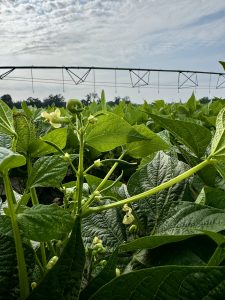
CRF Snapbean Research in the Suwannee Valley
Controlled-release fertilizer (CRF) is one such BMP that has gained traction in vegetable systems thanks to its ability to improve fertilizer efficiency, reduce the number of applications needed, and limit nitrogen leaching. At the UF/IFAS North Florida Research and Education Center – Suwannee Valley (NFREC-SV), several seasons of CRF research in snapbeans have demonstrated that growers can reduce nitrogen inputs while still maintaining competitive yields. Snapbeans are particularly compatible with CRF technology due to their consistent nutrient uptake throughout the short growing season.
Unlike crops such as corn, which have a high demand for nitrogen at specific stages, snapbeans require more of a steady supply over a relatively short time period, making them well-suited for a single, controlled-release fertilizer application. Local research has shown that CRF can help meet UF/IFAS nutrient recommendations without sacrificing crop productivity or profitability, which is critical in environmentally sensitive regions like the Suwannee Valley.
On-Farm Demonstration Success with CRF

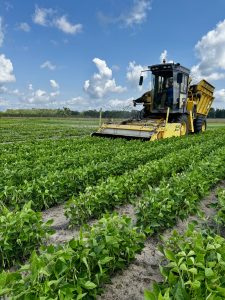
During the Spring 2025 season, BJ Wilkerson of Wilkerson Farms in Trenton, Florida participated in a 100 acre on-farm CRF demonstration as part of a pilot BMP incentive program that provided a small amount of monetary support for CRF implementation. While Wilkerson is already known for being a conservative and efficient fertilizer user, he was still able to reduce the N rate in the CRF field by 25 lbs in comparison to the conventional fertilizer program. The CRF program included 25 pounds of N/acre from a conventional starter fertilizer applied at planting, and the remaining 72 pounds of N/acre coming from a CRF broadcasted after planting. The total nitrogen rate used in the CRF field met the UF/IFAS recommended rate of 100 pounds of nitrogen per acre. Across the 100-acre demonstration, the nitrogen reduction equates to 2,500 pounds of nitrogen saved without any decreases in yield. Yield on the CRF field was equal to conventional fields during this same timeframe. Wilkerson indicated he was pleased with the comparable yields and ease of use for the CRF, requiring fewer fertilizer applications than the adjacent, conventionally fertilized fields.
In addition to CRF, Wilkerson incorporated several other BMPs at the demonstration site, including grid soil sampling, soil moisture sensors, pivot irrigation uniformity performance assessments, and remote pivot irrigation management. These practices worked together to optimize both water and nutrient efficiency, highlighting the potential for integrated BMP systems to reduce environmental risk while supporting efficient, yet productive farming.
This success story not only illustrates the effectiveness of CRF in snapbean production but also points to the broader potential for nitrogen reduction across the region. If similar reductions of nitrogen were achieved across the Suwannee Valley’s 5,000 acres of spring and fall snapbeans, that could represent approximately 125,000 pounds of nitrogen conserved! Widespread adoption of this practice in snapbean production would make a significant positive impact, helping to protect water quality and preserve the region’s natural resources for future generations.
Authors: Sydney Williams, Bob Hochmuth, and Taite Miller
University of Florida, Institute of Food and Agricultural Sciences; North Florida Research and Education Center – Suwannee Valley
 2
2