Winners of the 2025 STEP corn contest were announced at the October 30th awards banquet held at the North Florida Research and Education Center – Suwannee Valley. Taking the top spot this year was Team Quincey: Zane and Kelley Quincey of Quincey Farms II in Levy County. Longtime STEP participants, the Quinceys have used what they’ve learned through the program to fine-tune management on their diversified family farm. For their contest plots Team Quincey used Pioneer P1622VYHR corn hybrid, applied 195 lbs of N per acre and 8.75 inches of irrigation, and yielded 207 bushels per acre of grain corn. Second, third, fourth, and fifth place went to Riverbend Farms (Kyle Kelley, Tera Kelley, and Ed White), PS Farm (Philip Smith), Rootin Tutens (Travis Tuten and Titus Tuten), and Rocking D Squared (Kevin Dasher and Erin Dasher).

The Florida Stakeholder Engagement Program (STEP) began in 2022 with a simple but ambitious goal: to engage growers, agricultural industry partners, researchers, and Extension professionals in an interactive, real-world system that improves productivity, sustainability, and profitability.
Led by Dr. Vivek Sharma, Assistant Professor, Agricultural and Biological Engineering Department and Dr. Kevin Athearn, Regional Specialized Agent, NFREC-SV, the program is built on three pillars: (i) Competition – Teams manage corn farms by submitting management inputs virtually and compete for cash prizes and bragging rights, (ii) Peer-to-peer interaction – Growers, agents, and industry representatives share strategies, results, and lessons learned, and (iii) Action-oriented learning – Participants experiment with strategies using the latest agricultural technologies and datasets, without risking their own farm fields, and then use the results to refine future decisions. The program is supported with funding from the Florida Department of Agriculture and Consumer Services (FDACS), award sponsorship from Nutrien, and contributions from other industry partners.
A Real-World Learning Lab at NFREC-SV
The 2025 Florida STEP corn contest was conducted at UF/IFAS North Florida Research and Education Center – Suwannee Valley (NFREC-SV) under a variable-rate lateral irrigation system (Figure 2). Nineteen (19) teams entered the corn contest from eleven different counties. Each team was assigned four plots at NFREC-SV and made key agronomic and economic decisions on (i) Hybrid selection, (ii) Nitrogen management (rate, source, timing, and placement), (iii) Irrigation strategy (soil-moisture–based, ET/irrigation-app–based, or calendar-based), (iv) Crop insurance (Revenue Protection or Yield Protection), and (v) Grain marketing (flat-price or basis forward contracts). The teams had access to soil moisture data, weather information, drone imagery, and cost and marketing summaries through the STEP online platform. The NFREC-SV crew implemented each team’s decisions in the field.
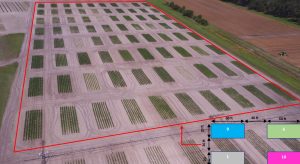
Teams competed in two categories (1) Input-use efficiency and (2) profitability – a true measure of both stewardship and success. The top five teams were awarded cash prizes ranging from $2000 to $750. Input-use efficiency was evaluated using the Water-Nitrogen Intensification Performance Index (WNIPI). This index helps determine efficiency in terms of yield relative to nitrogen and irrigation inputs. Gross profit for each team was calculated using the average price received on corn contracts, variable input costs, and fixed production cost.
2025 Results
Overall, the 2025 STEP corn contest demonstrated that implementing Best Management Practices (BMPs)—including soil moisture sensors, drone imagery, and controlled-release fertilizers (CRFs)—can significantly enhance both nitrogen- and irrigation-use efficiency. These innovations not only improve crop yields but also reduce environmental impacts by minimizing nutrient losses. A clear relationship between input-use efficiency and cost of production emerged in the competition. Teams that performed well in the efficiency category also tended to have lower production costs. Input-use efficiency and profitability did not always align, but the top teams scored high for both efficiency and profitability.
However, even the teams that scored best for profitability did not make a profit this year. Reflecting the current financial situation for corn growers, a combination of low corn prices and high production costs resulted in negative profit calculations for all teams. Teams that locked in flat-price forward contracts early in the spring received the highest average prices for their corn. One team selected Revenue Protection crop insurance at the highest (85%) level and received insurance proceeds (on paper) because of the decline in corn price during the year. The proceeds raised their profit score to above average relative to the other teams this year. The 2025 results demonstrated the challenges of growing a profitable corn crop. Teams who were efficient with their input applications and managed risks with forward contracting or crop insurance fared the best in the contest.
Blog authors: Shiva Bhambota1, Vivek Sharma1, Mark Warren2, and Kevin Athearn3
Acknowledgements: Carson Jones3 and Amanda Phillips3 supported contest management and contributed analysis referenced in this article.
1UF/IFAS Agricultural and Biological Engineering Department
2UF/IFAS Extension Levy County
3UF/IFAS North Florida Research and Extension Center – Suwannee Valley
 0
0