Whitehurst Cattle Company is a legacy in Florida agriculture. Established in the 1920s, this fourth-generation family farm stretches across more than 16,000 acres in Levy, Alachua, and Marion counties. With Adam Whitehurst actively involved in the operation, the farm includes 8,000 acres of timber, 8,000 acres of pasture for cattle, and 200 acres dedicated to watermelons. Adam has become a regional leader in adopting Best Management Practices (BMPs), using technology and innovation to improve sustainability, efficiency, and profitability, without compromising yield or quality. His proactive approach and willingness to test and adopt new BMP technology have earned him a reputation as a grower who’s not just keeping up with the times, but staying ahead of them.
Irrigation Automation
According to Adam, of all the BMPs implemented on the farm, irrigation automation has been the most impactful to the operation. Over the last four years, Adam has utilized TORO Ag automation systems on 120 acres of watermelons in Alachua County. Cost share support from the Florida Department of Agriculture and Consumer Services (FDACS) and the local water management district helped offset startup costs. Since implementing automation, the farm has seen an estimated 75% reduction in the labor and time required to manage irrigation. While employees are still involved, checking fields for issues and keeping an eye on system performance, fewer hours are needed, and the job is far less time-consuming. Adam no longer needs crews driving around to manually operate pumps; instead, he has the ability to manage them from his smartphone. This has translated into fuel savings, reduced risk of overwatering, and decreased the risk of mistakes. Precise irrigation management through automation has allowed Adam for higher efficiency in fertilizer use by keeping soil moisture right where it needs to be, in the root zone. Most importantly, automation has allowed Adam to reclaim valuable time, whether that’s a weekend at the beach, an afternoon at the ballpark, or dinner with the family. Through the past couple of years working with Adam, Tatiana Sanchez-Jones, Alachua County Extension Agent says she has heard him advocate for irrigation automation, often saying something along the lines of, “I can be sitting in my beach chair and turn a system on or off thanks to the use of automation.”
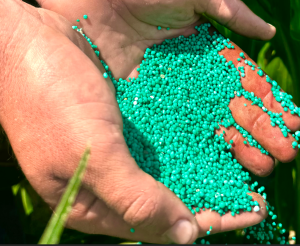
Controlled-release Fertilizer (CRF), Flow Meters & Soil Testing
Another cornerstone of the farm’s BMP strategy is Controlled-Release Fertilizer (CRF), which Adam first began using in 2023 as part of an on-farm CRF pilot program demonstration through UF/IFAS Extension, FDACS Office of Ag Water Policy and Suwannee River Water Management District (SRWMD) and has continued incorporating into the operation ever since. Adam applies CRF in the beds at planting and follows up with drip fertigation later in the season as needed. He sees CRF as a kind of insurance policy, protecting against nutrient loss during leaching rain events. It is also a way to ensure the plants always have access to the necessary nutrients in the instance that an injection event is missed. Although more costly upfront, CRF enhances nitrogen use efficiency and can contribute to reductions in overall nitrogen application for the season, all while maintaining or potentially improving crop yields, especially when paired with irrigation automation to maximize input use efficiency.
In 2024, Adam took his nutrient management a step further by installing flow meters on his fertigation tanks. These allow him to track liquid fertilizer applications daily, weekly, monthly and seasonally through a smartphone app, making it easier to calculate total nitrogen use per acre with confidence. Additionally, soil testing is performed every season to guide fertilizer decisions and CRF blend formulations. Together, these tools give Adam a strong grip on nutrient efficiency, helping him stay well aligned with the UF/IFAS recommended nitrogen rates.
Soil Moisture Sensors and Petiole Sap Testing
To ensure optimal irrigation and nutrient availability throughout the season, Adam has used BMP Logic’s soil moisture sensors for the past 10 years. With one installed in every field, these sensors help track moisture and nutrient movement at multiple depths in the soil, allowing the grower to keep the water and fertilizer in the root zone where it’s needed. The sensors also qualify for 75–90% cost share (from FDACS and SRWMD) upon initial purchase, and between 50-75% cost share reimbursement for yearly service agreements, making them a smart long-term investment.
Alongside sensor data, Adam relies on petiole sap testing, a practice he’s used for over 15 years on all 200 acres of watermelons grown. This free UF/IFAS Extension service provides real-time readings of nitrogen and potassium levels in the plants petiole and allows growers, like Adam, to fine-tune their fertigation schedules to meet the crop’s nutrient requirements. Beyond just data, sap testing also brings Extension agents out into the fields regularly, offering a second set of eyes to monitor plant health, insect pressure, and potential disease assessments.

Grafted Watermelons
In the 2025 watermelon season, Adam trialed grafted watermelon plants on approximately 30 acres, particularly in areas with higher soil-borne disease pressure like Fusarium wilt or tighter rotations. While grafted plants are more expensive and not yet practical for all acres, he sees them as a valuable tool in specific scenarios and would use them again in the future where necessary.
Community Involvement and Leadership
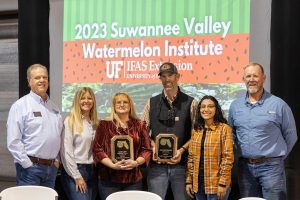
Adam’s commitment to BMP adoption extends well beyond his own fields. He is a regular attendee of Suwannee Valley Watermelon meetings and field days, and Whitehurst Cattle Company has hosted multiple UF/IFAS Spring Twilight On-Farm Watermelon Field Days, in April 2023 and again in April 2024. These events showcased on-farm demonstrations including CRF, irrigation automation, grafted watermelons, and innovative projects like WestRock paper mulch, and more. Adam also actively participates in grower and industry panel discussions, serves on the watermelon grafting advisory committee, and represents Whitehurst Cattle Company as a member of the Florida Watermelon Association. Adam has been a long-time follower of the “Weekly Suwannee Valley Watermelon Updates” and maintains regular communication with county Extension agents and the broader agricultural community, actively engaging to stay informed and contribute knowledge.
Results that Speak for Themselves
The combination of the implementation of these BMPs has produced tangible results. Over the past four years, Adam has averaged 150 lbs. of nitrogen per acre for watermelon, aligned with the UF/IFAS nitrogen recommendations. In 2025, he reduced that number to just 140 lbs./acre, applying 60 lbs. of nitrogen with CRF in the bed and injecting the remaining 80 lbs. through drip fertigation. Across 200 acres, that 10 lb. nitrogen reduction equates to 2,000 lbs. less nitrogen applied this year alone. These reductions don’t come from cutting corners; they’re the result of excellent crop management and smart, efficient BMP adoption.
Whitehurst Cattle Company is proof that BMPs don’t just protect our natural resources, they also help Florida growers save time, reduce inputs, and maintain high-quality yields. Adam’s success offers a powerful model for what sustainable, efficient farming can look like in today’s world.
Authors: Sydney Williams, Tatiana Sanchez-Jones, Adam Whitehurst, and Bob Hochmuth
 2
2