In recent years, carrots have taken root in the Suwannee Valley as a promising winter crop, with acreage steadily rising as the nation’s growers look for alternatives to traditional production regions, like California. With roughly 5,500 acres now grown annually in North Florida, the region’s deep sandy soils and mild winters have attracted large-scale farming operations, many with ties in California. This shift has positioned the Suwannee Valley as a key player in the expanding Southeastern US carrot industry.
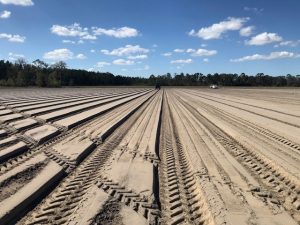
As production has increased, so has the need for region-specific research, particularly focusing on nutrient management on sandy soils, where nitrogen losses through leaching can be significant. While UF/IFAS recommendations have recently been updated to reflect higher nitrogen needs for current production systems and cultivars of carrots grown on sandy soil, there’s growing interest in how controlled-release fertilizers (CRFs) might improve nitrogen use efficiency, reduce environmental risk, and simplify fertility programs.
This trial, conducted during the 2024–2025 growing season at the UF/IFAS North Florida Research and Education Center – Suwannee Valley, focused on evaluating CRF in a commercial-scale carrot cropping system, with the objective to explore how split CRF applications and different CRF placement can support strong yields while aligning with Florida’s Best Management Practices (BMPs) for sustainable nutrient use.
Trial Overview and Treatments
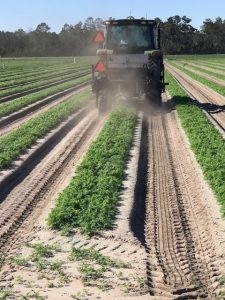
Field activities took place between October 2024 and March 2025 at the UF/IFAS North Florida Research and Education Center – Suwannee Valley. On October 23, 2024, a Harrell’s controlled-release fertilizer (CRF) blend of 16-8-16 with micronutrients was applied at 625 lbs/acre, supplying the first 100 lbs/acre of nitrogen. The following day, coated carrot seeds of the cultivar, ‘Maverick’, were planted at a target population of 450,000–500,000 plants per acre in eight rows per bed (40-inch bed tops). The trial was irrigated 0.15 inches daily until germination and then adjusted following soil moisture sensor readings throughout the season. In late December, a second Harrell’s CRF application (24-0-24 at 417 lbs/acre) delivered another 100 lbs/acre of nitrogen, bringing the total to 200 lbs/acre in alignment with UF/IFAS carrot nutrient recommendations. A significant leaching rain event (4.12 inches) occurred at this field on March 9 and 10, 2025. As a result of this leaching rain event and supporting data documenting subsequent lowering of N levels in leaf tissue samples in this field, it was decided to make one liquid nitrogen application through the pivot irrigation system. This application was made on March 25,2025 and resulted in an additional 20 lbs of N per acre using 28% UAN solution. This application made the seasonal total N rate 220 lbs per acre which would be in compliance with BMP requirements, given the leaching rain event and supporting leaf tissue data.
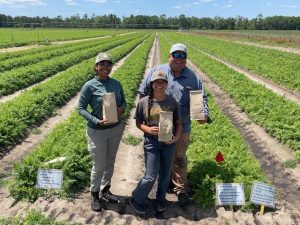
Throughout the growing season soil samples were taken biweekly and sent to the UF/IFAS Analytical Research Laboratory for nutrient analysis. Also, plant tissue samples from the trial were submitted to Waters Agricultural Laboratories for nutrient uptake monitoring.
To improve irrigation efficiency, the center pivot system used for this trial was retrofitted during this period based on recommendations from the annual Mobile Irrigation Lab evaluation. Mobile Irrigation Labs (MILs) offer free, site-specific evaluations to help agricultural producers improve irrigation efficiency. In addition to assessing system performance and water use, MILs provide guidance on water quality improvements and support the adoption of Best Management Practices. (Mobile Irrigation Labs / Water / Agriculture Industry / Home – Florida Department of Agriculture & Consumer Services)
To evaluate both the effectiveness of CRF and the impact of fertilizer placement, a separate half-acre field plot trial was also conducted within the larger 10-acre field study. This comparison focused on two methods of CRF placement at planting time: one where the fertilizer was incorporated directly into the entire bed prior to planting, and another where the CRF was applied on top of the bed surface after the beds were formed, then incorporated into only the top 2-inches of the bed. This was done with the anticipation that surface-applied CRF might offer more nutrient availability by being closer to the shallow root zone during early crop development. The goal of this comparison was to assess whether placement influenced carrot yield or nutrient efficiency.
Results and Conclusions
Prior carrot research has shown that a single CRF application often struggles to provide consistent nitrogen availability throughout the season due to the region’s highly variable winter temperatures. In this trial, the strategy of splitting the CRF into two separate applications appeared to effectively address these challenges, providing more reliable nutrient release over the duration of the crop cycle.
The large-scale trial yielded strong results, with an average harvest of approximately 40.6 tons per acre across the field. Within the small plot trial, fertilizer placement had a significant impact. Plots where CRF was incorporated into the bed produced an average yield of 41.85 tons per acre, significantly outperforming the 39.4 tons per acre average from plots where CRF was applied to the bed tops only. The highest-yielding individual plot came from the bed incorporated treatment producing an impressive 44.4 tons per acre. These results suggest that not only is a split CRF application effective for managing nutrient availability throughout the season, but that incorporating CRF into the bed may further optimize yields by improving nutrient efficiency and reducing losses due to leaching.

Authors: Sydney Williams, Bob Hochmuth, Jay Capasso, Taite Miller, and Alia Ortiz Bayron
University of Florida, Institute of Food and Agricultural Sciences; North Florida Research and Education Center – Suwannee Valley
 0
0