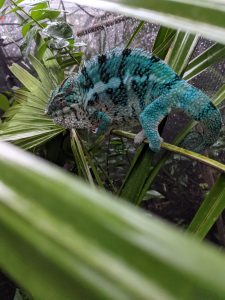
When exotic chameleons creep into a suburban Florida neighborhood, they bring more than their color-changing charm. They can also spark confusion, curiosity and social chaos.
A new study by scientists at the University of Florida Institute of Food and Agricultural Sciences (UF/IFAS) is among the first to explore the hidden human toll of invasive reptiles. The research focuses not on their impact on native ecosystems, but on the people living alongside them.
The species spotlight of this study is on panther chameleons, a highly valued pet species native to Madagascar that quietly moved into a Central Florida suburb.
Although many residents in the study area knew about the chameleons, few were worried about the reptiles themselves. Instead, it was the collectors wandering through yards at night with flashlights that sparked the most concern.
“Mismatches between the goals of stakeholder groups can result in challenges implementing invasive species management, which is often a direct consequence of societal effects of species introductions,” said Diane Sturgeon, post-doctoral researcher at the UF/IFAS Invasion Science Institute and co-author of the study.
Chameleons are increasingly appearing in Florida’s escaped pet scene, thanks to the state’s warm climate and booming wildlife trade. With some of them fetching up to $2,000 on the exotic pet market, panther chameleons are a prime target for “ranching” — the seeding of populations in the wild for collection later.
The UF/IFAS team discovered a localized, possibly decade-old population in a residential neighborhood in Orange County through online posts by collectors. To understand how this was affecting the community, researchers conducted anonymous surveys with residents.
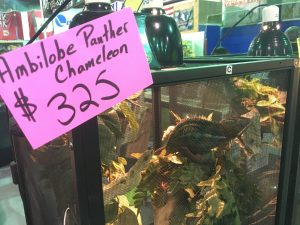
While many respondents said they liked the chameleons or didn’t mind them, those who had seen people with flashlights — particularly when combined with seeing chameleons — expressed greater concern for personal safety, frustration with nighttime activity and uncertainty about what was really going on.
“This demonstrates that invasive species can generate social conflict not through their own ecological impacts, but through the conspicuous and unfamiliar human behaviors they attract,” said Sturgeon. “When communities develop distrust toward the activities surrounding a species rather than the species itself, this can result in pushback against management efforts and even protective attitudes toward the invasive species.”
The authors note that public attitudes, trust and cooperation are critical, especially in urban and suburban areas where access to private land is necessary for research or removal efforts.
“A cognizant and willing public is a vital component to managing nonnative species, particularly in urban settings,” she said. “Chameleons in this area appear to occupy both public and private property, and this may present a problem to managers. Private lands can serve as refuge for the target species, and failure to gain access to private lands can act as a hurdle to eradication efforts.”
Some residents expressed a desire to protect the chameleons, seeing them as harmless and even beautiful additions to the neighborhood.
The researchers emphasize the need for more than just boots on the ground. To manage non-native species in residential areas, they say agencies must build trust, educate the public and consider the social side of science.
“It is imperative that researchers actively engage with the stakeholders who live near research sites. When stakeholders are not included in planning for an invasive species management action or feel strongly opposed to the decision to manage a species, there is the chance for serious conflict,” said Sturgeon. “Many of these residents we spoke with during chameleon-detection surveys expressed an interest in the research and a willingness to help.”
###
ABOUT UF/IFAS
The mission of the University of Florida Institute of Food and Agricultural Sciences (UF/IFAS) is to develop knowledge relevant to agricultural, human and natural resources and to make that knowledge available to sustain and enhance the quality of human life. With more than a dozen research facilities, 67 county Extension offices, and award-winning students and faculty in the UF College of Agricultural and Life Sciences, UF/IFAS brings science-based solutions to the state’s agricultural and natural resources industries, and all Florida residents.
ABOUT ISI
The mission of the University of Florida Invasion Science Institute (UF/ISI) is to facilitate interdisciplinary research that advances our understanding of the causes and consequences of invasive species; generates innovative approaches to reduce invasions and their impacts on natural, agricultural, and urban systems; and train the next generation of invasion scientists. UF/ISRI has over 190 affiliates and collaborators with a variety of backgrounds and expertise.
invasionscience.ufl.edu | @invasionscienceuf
 0
0

