Thoughts from Operation TRAP’s UF Fall 2025 Undergraduate Gulf Scholar: Cameron Sargent
When I joined Operation TRAP (Trash Reduction for Aquatic Preserves) this fall, I expected to learn about environmental conservation. What I didn’t expect was how deeply this internship would change the way I see my community and its relationship with the environment.
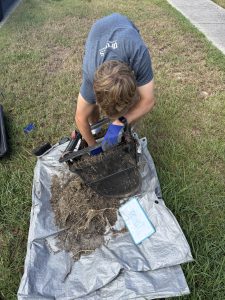
Under the guidance of Dr. Monica Wilson, Coastal Debris Project Coordinator for Operation TRAP, my responsibilities took me across Florida’s Gulf Coast three Fridays each month. The first trip of each cycle brought me to Pasco County, where our team cleaned out several Watergoat litter interception devices. These are essentially buoys installed in creeks and stormwater channels that trap debris before it reaches local waterways. We also emptied monofilament tubes, designed for safely disposing of used fishing lines and gear.

The following Friday, we head to Cedar Key, where we open and clean storm drain traps packed with leaves, sediment, plastic, cigarette butts, and so much more. Recently, we added the cleanup of monofilament tubes there as well. Our third trip of the month brings us back to Pasco for another round of storm drain cleanouts. After that, we take a week off — and then start again.
At first glance, our work might look like simple litter cleanup. But in reality, Operation TRAP is about data and impact. Every piece of trash we collect is recorded: the type, the material, even the brand when possible. These records provide powerful evidence of how consumer habits and corporate products affect our waterways. For example, after a year in Cedar Key, Operation TRAP collected over 1,800 cigarette butts, a staggering statistic that forces residents, companies, and policymakers to confront a pressing environmental truth.
Different Perspective
Unlike some of my fellow Gulf Scholars who approach this work from a conservation or scientific perspective, I see it through a political lens. My studies in Political Science, International Studies, and Russian at the University of Florida have taught me to look for the systems, not just the symptoms, behind societal issues. In this internship, I saw how pollution isn’t merely the result of careless individuals, but of weak community engagement and a lack of political prioritization.


Every bottle cap, straw, and fragment of plastic tells a story — one of neglect, but also of opportunity. This experience has left me not just more aware, but more motivated. I’ve learned that meaningful change often starts small: a conversation with a passerby, a tabling event at a seafood festival, or a single volunteer showing up to help. But I’ve also seen how systemic inaction can allow the same problems to persist.
I truly valued my time with the Operation TRAP team, but it also opened my eyes to a critical truth. Each cleanup reminded me that we still have a long way to go, not just as individuals, but as communities. In Hillsborough County, where I’m from, litter is usually an afterthought. There is so much commerce and so many residents that the most prevalent issues revolve around taxation, education, or crime. And although I was part of this mentality of civic service, I see environmental issues in a much bigger light. I see it as a mirror of our collective care and attention to the world around us.
Thoughts for the Future
In my future career, whether as a Foreign Service Officer or perhaps a public servant here at home, I’ll carry with me the lessons from this internship. The importance of accountability, of leadership that doesn’t just speak about responsibility but practices it. For now, I’ll continue doing what I can, even in small ways, to protect the spaces that protect us. Because if there’s one thing I’ve learned from Operation TRAP, it’s that change starts with me, and with you.
Operation TRAP is supported by NOAA’s Marine Debris Program and in partnership with FDEP’s Aquatic Preserves, Florida Sea Grant, Pasco County, Keep Pasco Beautiful, and the City of Cedar Key.
 5
5