I feel like it’s time to clear up a few common misconceptions.
I recently acquired a pet daddy long legs because I have free will, and I use it to the fullest. If you’re in the entomology or arthropod world like me, you probably already know this, but the name “daddy long legs” is one of those classic common names that causes way more confusion than it needs to.
The problem is that “daddy long legs” doesn’t actually refer to just one organism. Depending on who you ask (and where they’re from), that name can mean very different things.
So… what is a daddy long legs?
There are three main arthropods that commonly get lumped under the name “daddy long legs”:
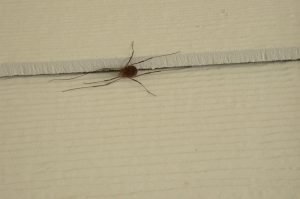
Harvestmen (Order Opiliones)
These are spider-like arachnids, but they are not true spiders. Harvestmen have a single, rounded body that looks like one segment because their cephalothorax and abdomen are fused. They only have two eyes, don’t produce silk, and don’t have venom. Many are omnivores and will happily eat small invertebrates, decaying organic matter, fungi, or plant material.
This is the group many people in entomology are referring to when they say “daddy long legs.”

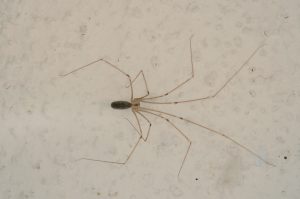
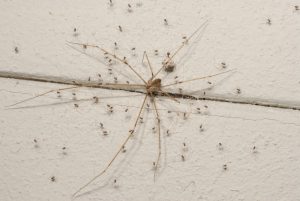
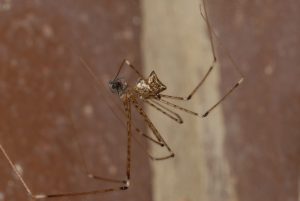
Cellar spiders (Family Pholcidae)
This is where my new pet comes in. These are true spiders, despite often being mistaken for harvestmen. You can tell because they have two distinct body segments, eight eyes, and—importantly—spinnerets, meaning they can produce silk and build webs. These are the leggy spiders you find hanging out in corners of houses, garages, and basements. They’re harmless to people and excellent at eating other insects (and sometimes other spiders).
This is the organism I (and many others) call a daddy long legs.

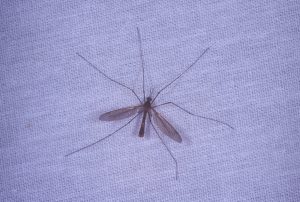
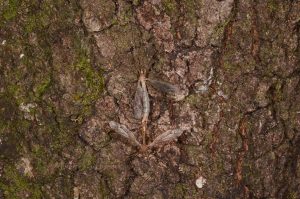
Crane flies (Family Tipulidae)
Surprise—some people also call these daddy long legs. This was news to me because I had never heard of this before, but many sources confirmed it. Crane flies are insects, not arachnids. They have six legs, wings, and often look like oversized mosquitoes (even though they don’t bite or sting). They’re seasonal, short-lived as adults, and mostly just exist to reproduce.
If you’ve ever panicked because a “giant mosquito” flew into your house, it was probably a crane fly.

The problem with common names
This whole situation is a great example of why common names can be… messy.
They’re useful in casual conversation, but they fall apart the second you want clarity. Common names aren’t standardized, and one name can be used for completely different organisms depending on region, culture, or personal experience. That’s fine for casual conversation, but it becomes a problem when we’re trying to actually talk about biology. When someone says “daddy long legs,” they might be talking about a harvestman, a true spider, or even an insect.
Scientific names exist for a reason. They give us precision and clarity, especially when organisms look similar at a glance but are not closely related at all. In this case, lumping harvestmen (Opiliones), cellar spiders (Pholcidae), and crane flies (Tipulidae) under one name hides some really interesting differences and fuels a lot of persistent myths.
That said, common names aren’t going anywhere—and honestly, I don’t think they need to. I just think it helps to know what we’re actually talking about when we use them.
Also, while going down this rabbit hole, I had an absolute blast reading through Wikipedia pages, and I feel obligated to share one of my favorite disclaimers of all time from the Pholcidae page:
“ ‘Daddy longlegs spider’ redirects here; not to be confused with Opiliones or Crane fly.
Not to be confused with Phocides, a genus of butterflies, or Phocidae, a family of seals.”
In a way, this disclaimer highlights that both common and scientific names can be confusing. Biology is complicated, but that complexity is what makes it interesting. I couldn’t help but appreciate how perfectly this disclaimer captures that fact.
Let’s talk about that venom myth
One of the most common things I hear is that daddy long legs are “the most venomous spiders in the world, but their fangs are too small to bite humans.”
This is not true.
This myth almost always refers to cellar spiders (family Pholcidae), since harvestmen don’t have venom at all. While cellar spiders do have venom—like most spiders—there is no evidence that their venom is unusually potent or dangerous to humans. In fact, it’s considered medically insignificant.
In short, daddy long legs spiders are not secretly deadly. They’re just misunderstood.
If you want a deeper dive into how this myth started and why it persists, this article from Dr. Rick Vetter, arachnologist at the University of California, Riverside, does a much better job than I ever could at breaking it down:
https://spiders.ucr.edu/daddy-long-legs
Video
In this video, I show my new eight-legged roommate wrapping up some insect prey I lovingly caught for him.
References
University of California, Riverside. (n.d.). Daddy long legs. Spider Research. https://spiders.ucr.edu/daddy-long-legs Spider Research
University of California, Riverside, Department of Entomology. (2022, January 14). Are daddy longlegs really the most venomous spiders in the world? https://entomology.ucr.edu/news/2022/01/14/are-daddy-longlegs-really-most-venomous-spiders-world Department of Entomology
Wikipedia Contributors. (n.d.). Pholcidae. In Wikipedia, The Free Encyclopedia. https://en.wikipedia.org/wiki/Pholcidae en.wikipedia.org
 5
5