Good soil management is critical for retaining organic matter especially with Florida’s sandy soils. Soil organic matter stores water, nutrients, and microbes–all necessary things for a healthy crop. Leaving soil bare exposes it to the baking sun and beating rains causing runoff, denitrification, and beneficial microbe die-off. So how do you preserve your soil? Mulch! Mulch comes in many forms: wood chips, hay, straw, plastic, even living! How can your cropping system include living mulch?
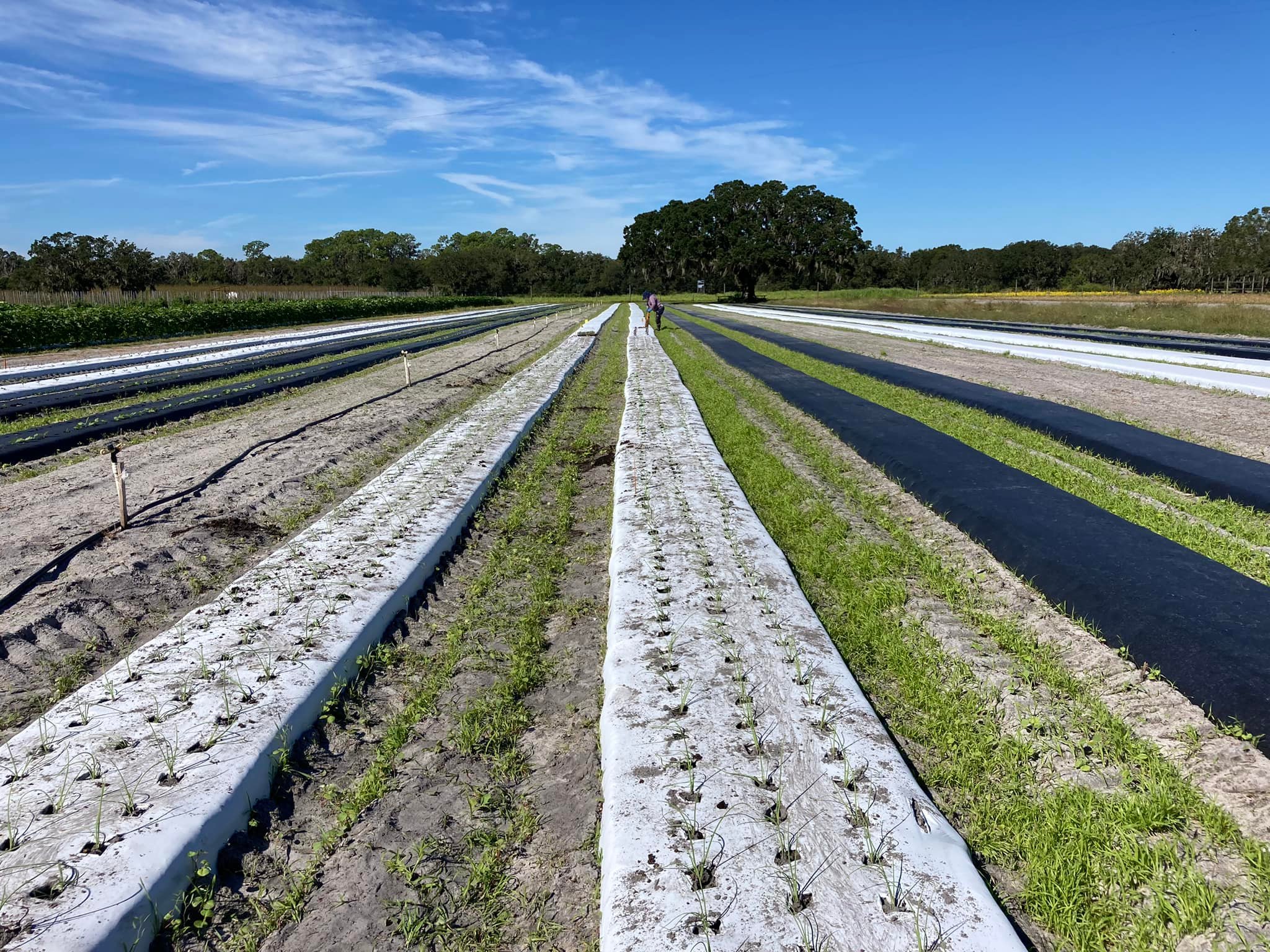
First, the benefits of living mulches:
- Adds organic matter: living mulch grows biomass in place.
- Living roots exude compounds into the soil to attract soil microbes that help them uptake nutrients
- They are active carbon sinks
- Attract beneficial insects: flowering species will attract not only pollinators, but natural enemies of your pests such as hoverflies, soldier beetles, lacewings, lady bugs, big eyed bugs, and parasitic wasps. The closer these beneficial insect habitats are to your crops, the easier access they have and the more effective your biological pest control will be.
- Weed suppression
- Versatility: there are many different species with different characteristics to achieve your goals and suit your site conditions
Considerations
Living mulch also comes with its challenges. Can this living mulch become a nuisance? Will you have the time and proper equipment to mow it if i
t gets out of hand? Also consider planting time, seeding rate, cost, and species.
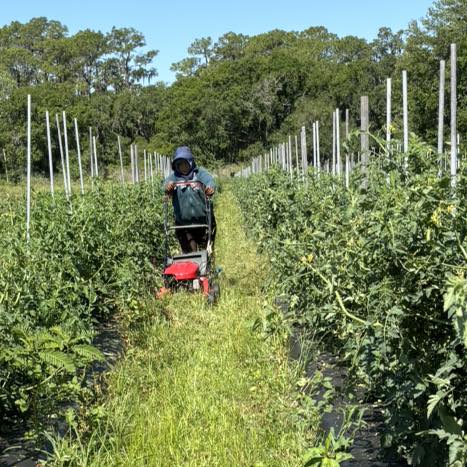
Timing Living Mulch Plantings
The timing of your plantings will determine success or failure. Will the living mulch outcompete and shade out your main crop if they are planted at the same time? Usually, a living mulch can be planted under or adjacent to a main crop 2 weeks after the main crop has been planted. This gives your main crop time to establish itself before the living mulch. This might need adjusting depending on the growth rates of both the main and cover crop. With plastic mulch beds, we planted the living mulch in the walkways before the main crop was planted. Freshly disturbed soil from making beds offers a great opportunity for the desired living mulch to take hold before weeds take over.
Labor & Equipment
Establishing a living mulch is much less labor intensive than, say, laying down hay mulch by hand. However, it may need to be mowed once or twice if it obstructs harvesting operations. For a 10 acre operation where we planted 1/4 acre (or 2,000 bed feet every week), we used a hand push Scotts drop seeder available at Home Depot or Lowes. Planting is easy this way and we would run over the walkways with a tractor while punching holes in plastic to get seed to soil contact. When the walkways needed maintenance, we used a weed whacker, push mower, or brush cutter to knock it down.
Species
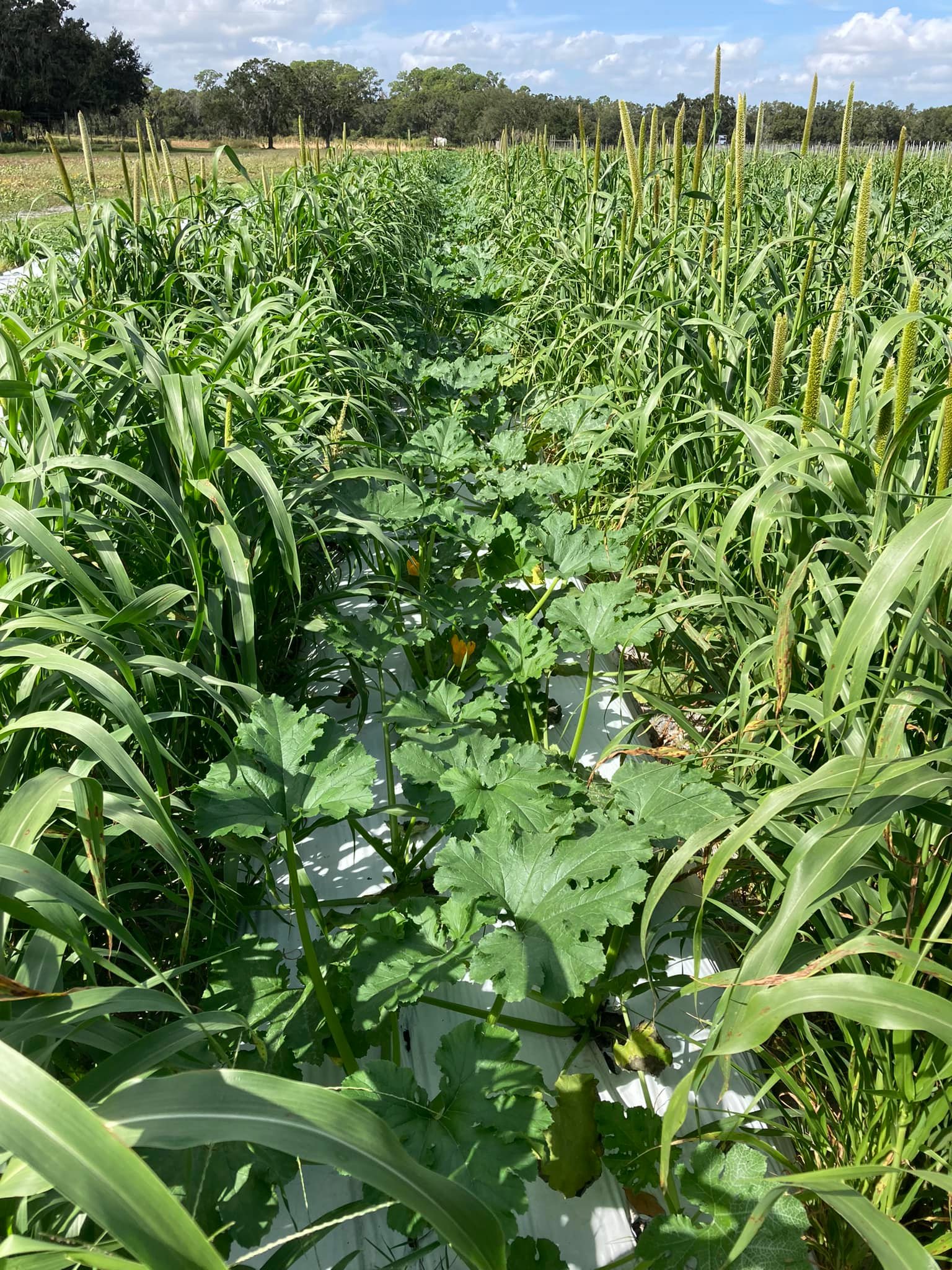
Some species are just better suited to interplanting. I quickly found that out when I once mistakenly tried pearl millet and had to deal with 5 ft high thick stems at harvest time for zucchini.
- Buckwheat– a great option for attracting beneficial insects. Quick growing, around 30-40 days. Known for mining phosphorous.

Buckwheat and Teff growing between young tomatoes grown on plastic mulch - Teff – a warm season C4 grass = great for Florida, that doesn’t grow over 18” tall, unlike pearl millet and sorghum which gets to 6ft. So, if you don’t have time to mow it, this is a great option.
- Brown top millet – a good cost-effective option. It is taller than teff but not as tall as pearl millet and sorghum sudan grass. Quick cover.
- Ryegrass works great with your cool season crops like kale (feature photo) and never needed mowing in our experience.
- Hairy Vetch – Planted during cool season with ryegrass. Produces a good amount of biomass, stayed under 18″, and fixes nitrogen into the soil.
- Clovers – a nitrogen fixer, but they can take a couple months to be well established. Plant them with an annual grass and once the grass starts to decline, the clover takes over. Plant with long season crops.
- Mustard – flowers are attractive to beneficial insects and it may provide some biofumigant properties(1).
- Subterranean clover – a very low growing cool season legume that tolerates wet soils and attracts big eyed bugs(2).
- Sunn hemp, pearl millet, oats, sunflowers, sorghum Sudan grass, and cow peas are great cover crops but not living mulch due to their growth habits.
What could go wrong? Squash plants growing between tall stands of pearl millet that need harvesting every other day

Mix it up!
Plant mixes of 2-5 species whenever possible. If germination is poor for one species, another will fill in. The more diverse your cover crops, the more diverse your soil microbiology, with each one providing a different service or benefit to your soil or crop.
Generally, the smaller the seed, the lower the seeding rate and higher the cost per pound. When creating a mix, start with your largest seeds, filling the hopper 1/2 or 2/3 full filling the rest with the next largest seeds, and finishing off with a pound to a handful each of the smallest seeds. Set your seeder opening based on how thick you want your stand to be.
Typically, grasses are tougher to break down, adding to long term soil organic matter. Residue management may be a concern. Legumes and broadleaves like buckwheat break down quicker releasing nutrients for immediate crops.
The Takeaway:
Living mulches improve soil health, contribute and attract biodiversity, and provide many benefits to your crops. However, be prepared to manage any overgrowth and residue, timing your plantings correctly, and factor in the cost of seed.
Resources:
(1) Qui Y, Dixon M, Lui G. 2021. Chinese Mustard Cultivation Guide for Florida. UF/IFAS. https://edis.ifas.ufl.edu/publication/hs1402
(2)Sustainable Agriculture Research & Education. 2012. Managing Cover Crops Profitably. www.sare.org.
 4
4