In today’s rapidly evolving agricultural landscape, staying ahead of grove health issues is more important than ever. Traditional methods of scouting for pests, diseases, and irrigation problems are effective but labor-intensive, especially on large acreage. Enter artificial intelligence (AI) citrus grove scouting—a game-changing approach that leverages drones, machine learning, and mobile apps to monitor grove health with unprecedented speed and precision. In this post, we will explore how combining boots-on-the-ground expertise with innovative technology can help citrus growers make smarter, faster decisions.
Manual Scouting: The Traditional Approach
Manual scouting remains a cornerstone of grove management. It involves training personnel to walk the grove, and inspect trees, traps, and irrigation systems. The training would start with a healthy grove looks like. Inexperienced staff need to know this to determine when the grove has an issue. The training includes insect and disease identification (at each life cycle level). As an identification example, incorporate biological identification so workers do not misidentify “good, beneficial insects” for harmful insects or abiotic issues versus diseases. Manual scouting is feasible on small acreage. However, it is labor-intensive as the acreage increases. Manual scouting provides direct insight into grove conditions.
Key Manual Scouting Efforts
– Insects & Pests: Monitor traps (e.g., pheromone traps) for Asian citrus psyllid, citrus leafminer, Diaprepes root weevil, blackfly, nematodes, and Lebbeck mealybug to name five important pests. Also, workers should be able to identify if biological control is establishing itself?
– Diseases: Look for symptoms of citrus greening, citrus black spot, tristeza, and phytophthora-related diseases to name a few. Training is important on these diseases to spot them early and respond appropriately. Additionally, what drives these diseases, water, wind, people, equipment, or animals?
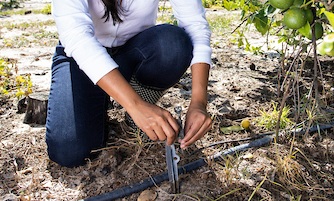
– Irrigation: Check emitters and distribution tubing during operation for clogs, leaks, or damage from animals like feral pigs, squirrels, rats, or snails.
– Weeds: Inspect under-canopy zones for invasive species and ensure a weed-free buffer around trees. Weeds compete for the same resources provided to your citrus trees. They suck up water and nutrients that the citrus trees need. Weeds devour sun and cast shade on the canopy of a thriving young tree. I have seen Palmer pigweed and Guinea grass at six- and seven-foot-tall breaching the canopy of young trees and blocking the required sun for the young tree’s growth.
– Canopy Health: Identify thinning, discoloration, or dieback that may indicate abiotic issues (water uptake), nutrient deficiencies or disease.
Scouting Tips
– Scout during various times of day, week, and seasons. A key pest in the spring may be a secondary or non-pest in the fall.
– Use a consistent sampling method (e.g., quadrant or transect).
– Record findings with GPS-tagged photos or notes. Journaling is important when scouting. Our memory is not as dependable as thorough record keeping.
– Train workers in pest ID, life cycles, symptom recognition, and solution to a pest outbreak.
AI-Powered Scouting: The Future is Quickly Approaching
AI and sensor technologies are revolutionizing grove scouting by increasing efficiency, accuracy, and data accessibility. AI will not completely replace our visual inspection of the grove (yet); AI improves our time efficiency in the grove allowing us to focus our precious time elsewhere on the grove.

Unmanned Aerial Vehicles, UAVs or drones equipped with RGB (red, green, blue additive color models), multispectral or hyperspectral sensors will detect early signs of stress, disease, or pest infestation across large areas. According to UF/IFAS researchers, Ampatzidis and Wade, these tools with RGB have become cost-effective solutions for grove owners.
– AI Smartphone Apps: Analyze leaf images to diagnose pests and diseases instantly.
– Automated Tap Sampling: Uses machine vision to detect and count pests like Asian citrus psyllid.
– Cloud Platforms (e.g., Agroview): Integrate aerial and ground data to visualize tree health, nutrient levels, and inventory.
– Robotic Scouting Platforms: Especially useful in CUPS (Citrus Under Protective Screen) systems for daily monitoring.
– Hyperspectral Imaging: Assesses nutrient levels and stress indicators non-destructively.
Benefits of AI Scouting
It is ideal to detect issues in the citrus grove as early as possible. AI offers early detection; the tools can spot issues before they escalate. AI offers precision management to apply treatments only where required. You will have the ability to increase labor efficiency by reducing reliance on manual labor and having extra aerial “eyes” on the grove. Lastly, data-driven AI offers decision-making to improve irrigation, fertilization, pesticide necessity, and harvest planning.

Integrating Manual and AI Scouting
The most effective approach often combines both methods:
– Use manual scouting for ground-truthing and detailed inspections.
– Deploy AI tools for large-scale monitoring and trend analysis. Several AI technologies are now are our fingertips.
Summary
This blog explores how citrus grove management is evolving by integrating traditional manual scouting with advanced AI and drone technologies. A hybridized approach, combining human expertise with technology for optimal grove health, monitoring and management. If you want details on some of the newer AI technologies, please review this article. https://journals.flvc.org/edis/article/view/125666. Keep an eye on Citrus Research and Education Center’s webpage for updates. https://crec.ifas.ufl.edu
- Manual scouting involves trained personnel inspecting groves for pests, diseases, irrigation issues, and canopy health. It’s effective but labor-intensive, especially on large farms.
- AI-powered scouting uses drones, smartphone apps, and cloud platforms to detect early signs of stress, disease, or pest infestations. These tools enhance efficiency, accuracy, and decision-making. However, some may be cost-prohibited now.
Keep your eyes open for new innovative technologies as UF/IFAS continues its research.
Resources
Agroview AI Platform: https://crec.ifas.ufl.edu/media/crecifasufledu/extension/extension-publications/2021/2021_may_artificial.pdf
High-Tech Scouting in Citrus Production (EDIS): https://journals.flvc.org/edis/article/view/125666
Investing in Artificial Intelligence. Angle, J. Scott. 2023. https://citrusindustry.net/2023/01/23/investing-in-artificial-intelligence/
UF/IFAS Citrus Research and Education Center: https://crec.ifas.ufl.edu/
 0
0