Rules of Thumb
Science-based urban tree care requires knowledge in tree biology and anatomy, soil and water relations, pest management and plant health care, and a wide range of other subject domains. When faced with this sort of complexity, humans often employ heuristics, or simplified decision criteria that help reduce information overload and analysis paralysis. In arboriculture and urban forestry, we often use these “rules of thumb” to aid in teaching best practices and create standardized care expectations. An example of this would be Santamour’s 10-20-30 Rule, which is intended to offer guidance for communities looking to make their urban forests more resilient to pathogens and pests by intentionally diversifying the species palette so that a single species makes up no more than 10 percent, a single genus makes up no more than 20 percent, and a single family makes up no more than 30 percent of the entire population.
As an applied researcher who is always looking for ways to make my work more transferable to the tree care industry, I have no problem glossing over some nuance in order to create useful guidelines that, when followed, will lead folks to the right decision most of the time. That said, one of the things that does bother me somewhat is when heuristics take on a life of their own and become dogmatically embraced as universal truths. Those who have been around long enough may have seen this transformation as over the course of a few years our industry has collectively moved from “given the limited research we have, it is complicated, but XXX generally appears to be the best approach” to “do this or the tree will die”. Then new research comes out which shows, once again, that there is no clear pattern and is either met with indifference or even resistance.
Research on Deep Tree Planting
An example of this progression from a more nuanced to an absolute understanding within arboriculture is the oft-repeated view that deep planting is bad for trees. While I completely agree that trees should never be intentionally (or even unintentionally) planted deeply, the idea that deep planting is destined to negatively impact tree health is not supported by research or the evolutionary history of many of the species we select for urban plantings. This is best captured by a 2009 literature review on deep planting by Susan Day, Gary Watson, Eric Wiseman, and Roger Harris, which concludes that “Deep structural roots sometimes hinder successful establishment of trees, occasionally enhance establishment, and often have little or no effect on growth or survival.”
Ecological Adaptations to Deep Planting
These findings may come as a shock to some, but they may be less surprising when you think of some of the challenges trees face in nature. Many species used in urban plantings come from riparian areas, especially those capable of surviving in challenging low-oxygen soil conditions (e.g., saturated or compacted soils). Riparian systems flood regularly with spring snowmelt and extreme precipitation events. When this occurs, swift-moving floodwaters scour out riverbanks and bottoms, depositing silt, sediment, and organic material over the roots of these trees as they recede. As such, many species have developed strategies for coping with deep planting and grade increases.
An extreme example of this is willow (Salix spp.). When I was a young in-house arborist at the ISA headquarters in Champaign, I used to bounce technical questions off others in similar roles. One day Tchukki Andersen (the then-staff arborist at TCIA) sent a picture of a willow trunk with red growths on it. We puzzled over it, wondering if it was some sort of fungal or rust disease. The homeowner had disclosed that the trunk was regularly hit by spray from the lawn irrigation system. Tchukki eventually found someone who cleared up the mystery – the increase in moisture along the trunk was triggering new root formation just as it would if muck from a receding flood had been piled up against the trunk.
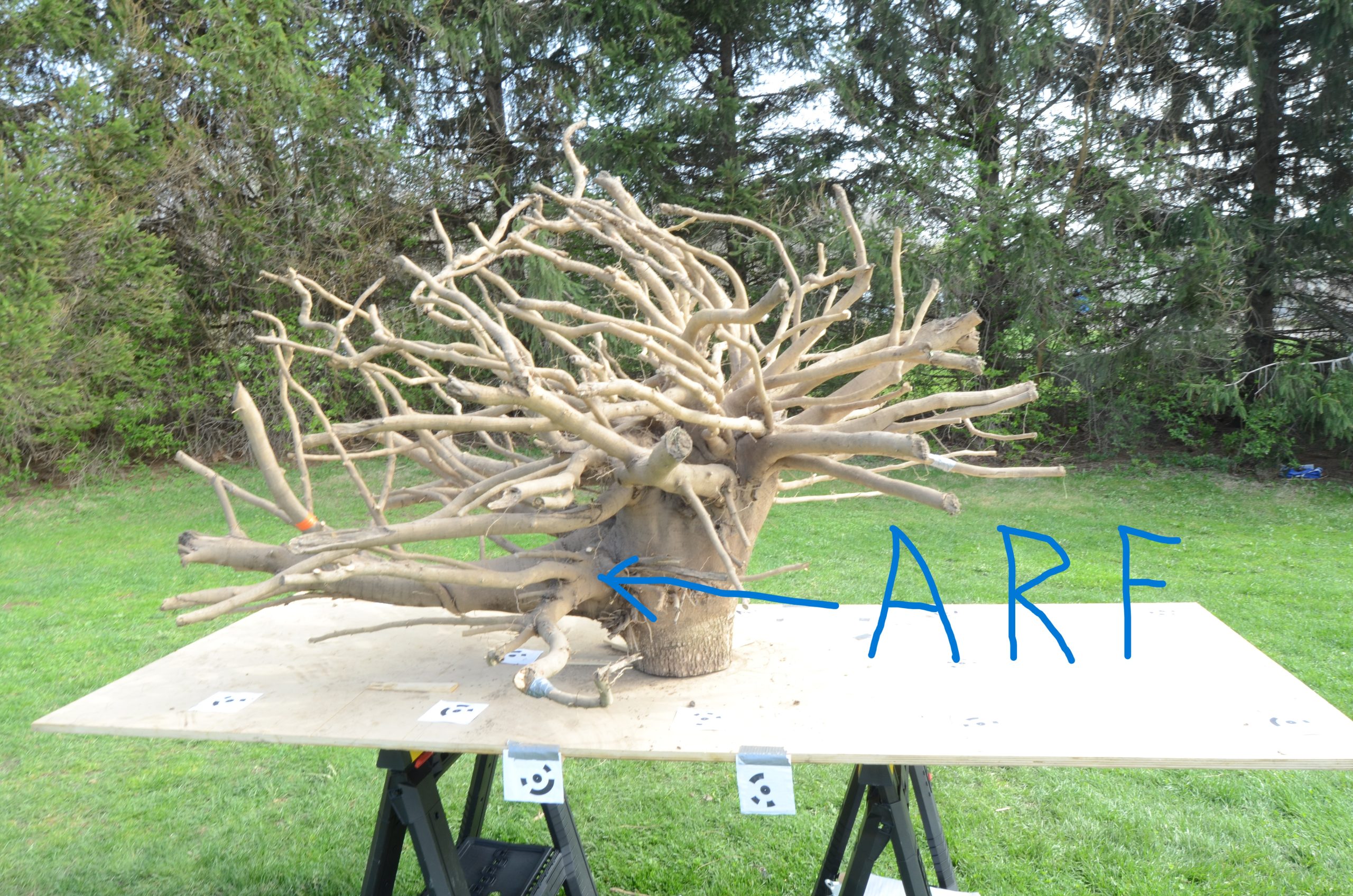
Another (once-common) North American urban tree that is naturally found along river and stream banks is green ash (Fraxinus pennsylvanica). One of my first studies as a newly minted PhD was wrapping up a long-term deep tree planting project that was started by one of my former committee members, Gary Kling. Gary and his collaborators had planted green ash liners at grade and at two different levels below grade (graft union at grade and graft union 6 inches below grade). Nearly ten years later, there was no difference in stem diameter and height among the treatments. We dug up the trees to look at the root systems and found that many of the deeply planted treatment trees had both their original root flare from the nursery and a second, higher adventitious root flare that developed once planted (Fig. 1). As a side note, “adventitious root flare” is a term that I believe Gary Watson coined. I enjoy a funny acronym (ARF), and it is a real shame that it has not gained more ground in our industry.
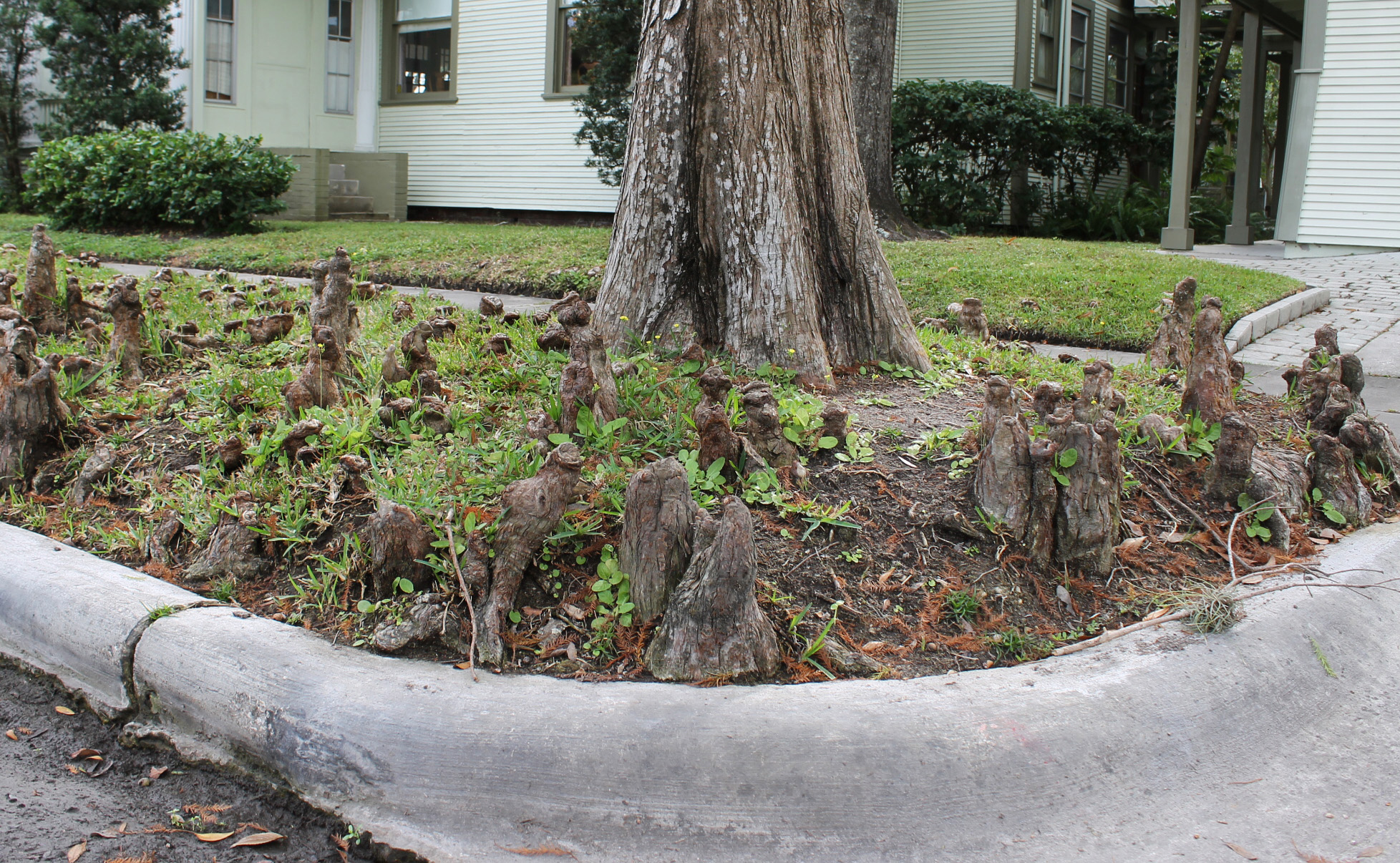
Finally, there are some species that *may* actually benefit from root adaptations that facilitate a buildup of soil and organic matter at their base. Baldcypress is a riparian species which creates enlarged, vertical root structures commonly described as “knees” (Fig. 2). We still aren’t completely sure what these structures do. Some people have hypothesized they help with oxygen transfer, but they lack the hollowed-out channels seen in species with actual pneumatophores, and they are often absent in cypress that are in standing water (and would presumably be in the greatest need of a way to get oxygen to their roots). Others theorize that they offer greater anchorage in saturated soils or that they may have even served as some sort of caltrop for prehistoric mega-herbivores. The theory that is relevant to this particular discussion is that knees are used in nutrient acquisition—slowing or trapping sediment and organic material from floodwaters in order to gain greater access to essential elements. I am not sure if I subscribe to this one myself, but have been on enough litter pickups in mangroves to be convinced that a prominent patch of knees would make a good trap for whatever washes their way. Supporting this theory is the observation that knees are most pronounced on trees located along riverbanks where the water routinely fluctuates in depth.
Conclusion
The takeaway here is not that we should abandon proper planting depth as a best practice, but rather that many of the truths we hold dear in our industry are coarse guidelines that could never capture all the variety that is seen in the world’s trees. As with many aspects of tree care, the answer to “is deep planting bad?” is often “it depends.”
About this blog
Rooted in Tree Research is a joint effort by Andrew Koeser and Alyssa Vinson. Andrew is a Research and Extension Professor at the University of Florida Gulf Coast Research and Education Center near Tampa, Florida. Alyssa Vinson is the Urban Forestry Extension Specialist for Hillsborough County, Florida.
The mission of this blog is to highlight new, exciting, and overlooked research findings (tagged Tree Research Journal Club) while also examining many arboricultural and horticultural “truths” that have never been empirically studied—until now (tagged Show Us the Data!).
Subscribe!
Want to be notified whenever we add a new post (about once every 1–2 weeks)? Subscribe here.
Want to see more? Visit our archive.
 5
5