Since 1986 the University of Florida IFAS LAKEWATCH program has used citizen scientists to monitor nutrients in Florida’s lakes and estuaries. Monitoring has been going on in the Pensacola Bay area since 2002. Water samples are collected by volunteers in six bodies of water and at 3 different stations in those bodies of water. The samples are analyzed for both total phosphorus and total nitrogen. These nutrients can trigger algal blooms, which can reduce dissolved oxygen and cause fish kills. The concentration of algae is monitored by analyzing the samples for total chlorophyll a. Volunteers also use a Secchi disk to measure water clarity.
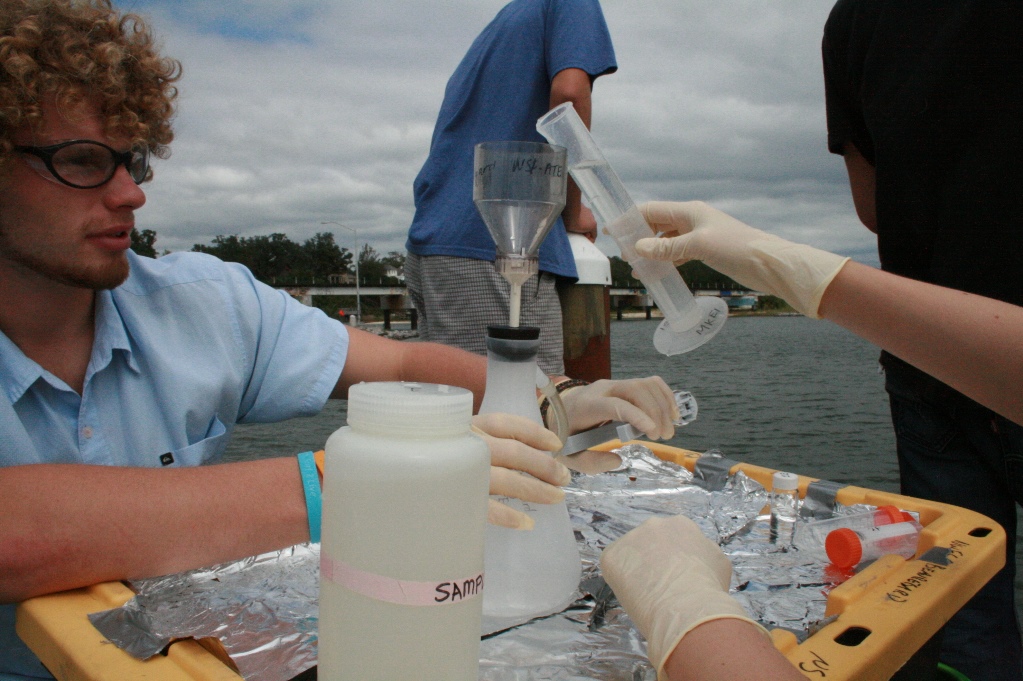
Photo: Marine Science Academy Washington High School
Below are the averages of all samples collected from each body of water. Not enough samples have been collected from Big Lagoon to determine long-term trends.
Total Phosphorus (µg/l)
| Body of Water | Station 1 | Station 2 | Station 3 |
| Bayou Chico | 27 | 26 | 21 |
| Bayou Grande | 15 | 15 | 16 |
| Bayou Texar | 17 | 17 | 17 |
| Big Lagoon | 13 | 12 | 11 |
| Pensacola Bay | 11 | 13 | 11 |
| Perdido Bay | 15 | 15 | 15 |
Most of the stations had values between 11-17 µg/L – Bayou Chico was higher with values between 21-27 µg/L. 12 of the 15 stations with long term data (Big Lagoon does not) have seen a decrease in phosphorus over time, with station 3 in Pensacola Bay seeing a significant decrease. Three stations have seen little change over time, those being station 1 Bayou Texar, station 1 Pensacola Bay, and station 1 in Perdido Bay.
Total Nitrogen (µg/l)
| Body of Water | Station 1 | Station 2 | Station 3 |
| Bayou Chico | 506 | 533 | 362 |
| Bayou Grande | 310 | 285 | 303 |
| Bayou Texar | 758 | 647 | 573 |
| Big Lagoon | 218 | 184 | 185 |
| Pensacola Bay | 220 | 231 | 181 |
| Perdido Bay | 321 | 312 | 310 |
Overall total nitrogen has been decreasing over time. Most of the stations had values between 100-400 µg/L. The lowest values are found in Big Lagoon. There are two bodies of water with values > than 500 µg/L. Those being Bayou Chico and Bayou Texar. Two of the stations in Bayou Chico are between 500-800 µg/L and all three stations in Bayou Texar are within this range. Though the values in Bayou Texar are much higher than the rest of the bay area, they have been on the decline over time. The highest values are in the upper part of the bayou near 12th Avenue – near Carpenter’s Creek. Interestingly there is one station that has had a slight increase over time, station 3 in Bayou Chico – this is near the mouth of the bayou where it meets Pensacola Bay.
Total Chlorophyll a (µg/l)
| Body of Water | Station 1 | Station 2 | Station 3 |
| Bayou Chico | 13 | 12 | 8 |
| Bayou Grande | 4 | 4 | 4 |
| Bayou Texar | 6 | 8 | 7 |
| Big Lagoon | 3 | 2 | 2 |
| Pensacola Bay | 4 | 4 | 4 |
| Perdido Bay | 5 | 5 | 5 |
Nine of the 15 stations (60%) had values between 0-5 µg/L. Four had values between 6-10 µg/L, these included 1 station in Bayou Chico and all three in Bayou Texar. Two stations (both in Bayou Chico) had values between 11-15 µg/L. Overall, the chlorophyll a values have been decreasing over time.
Water Clarity (feet)
| Body of Water | Station 1 | Station 2 | Station 3 |
| Bayou Chico | 1 | 4 | 4 |
| Bayou Grande | 5 | 6 | 6 |
| Bayou Texar | 4 | 4 | 4 |
| Big Lagoon | 10 | 10 | 12 |
| Pensacola Bay | 9 | 8 | 9 |
| Perdido Bay | 6 | 6 | 6 |
Visibility is less than 10 feet in all but one body of water, that being Big Lagoon. All three stations in both Bayou Chico and Bayou Texar had less than 5 feet of visibility. All but one station showed an increase in water clarity over time. The only one that does not is station 3 in Perdido Bay, which has shown a slight decrease. The bays are overall much clearer than the bayous, which is to be expected.
Summary
Overall, the nutrients and chlorophyll a are higher in the bayous than in the bays and the water visibility there is lower. Nutrients have been decreasing over the last decade at most stations and water clarity has been improving. However, nutrients are much higher in Bayou Chico and Bayou Texar, particularly the total nitrogen in Texar. There is work to be done here.
We would like to thank our LAKEWATCH volunteers who have given many hours, over several years, to obtain this data.
Bob Jackson – Perdido Bay
John Williams – Big Lagoon
John Blackwell – Bayou Grande
Guy Fisher – Bayou Chico
Steve Nicosia – Bayou Texar
Julie Parsons – Pensacola Bay
 1
1