 My daughter worked all summer as a camp counselor in south Alabama. It’s an old school outdoorsy camp, with plenty of time swimming and sailing in the bay, climbing a ropes course in the woods, and singing goofy songs in the dining hall. Mosquitoes and yellow flies are a given, but I was pretty concerned when she sent me a photo of a nasty bite on her knee, which was swelling and starting to feel warm, numb, and rigid.
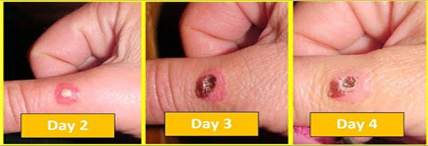
We eventually got her a to a doctor, where a spider bite was confirmed and antibiotics were prescribed. She’d seen all manner of spiders this summer, but based on photos and the way her injury responded, we are 90% certain it was a brown recluse (Loxosceles reclusa). Their bites usually don’t cause an immediate reaction or pain. The cytotoxic venom, however, is necrotizing, meaning it breaks down—and essentially liquefies—skin tissue. According to a UF publication on the typical symptoms, they “start two to six hours after the bite. Blisters frequently appear at the bite site, accompanied by severe pain and pronounced swelling…By 12 to 24 hours, it is usually apparent if a Loxosceles wound is going to become necrotic because it turns purple in color…If the skin turns purple, it will then turn black as cells die. Eventually the necrotic core falls away, leaving a deep pit that gradually fills with scar tissue.”

The blister and purple coloration followed by those weird hollow pits on her knee were the dead giveaway. While her bites were localized, in about 10% of situations the sores can widen out and become quite dangerous. Thankfully, the antibiotics worked like a charm, and only a handful of brown recluses have been positively identified in Florida. However, the entirety of Alabama is in the spider’s range, and of course that’s where she picked up her bite.
True to their name, the spiders are reclusive. People rarely see them, with the spiders active at night and preferring to run away when threatened. They are not regular biters—I’ve heard firsthand accounts and read of houses infested with brown recluses yet no one was bitten the entire time they lived there. When they do bite, it’s often because they were hiding somewhere and were inadvertently trapped by a human. They live in dark, dry areas, under woodpiles or debris if outdoors. My daughter thinks her culprit may have been underneath a picnic table. If a brown recluse goes inside, it will often hide out in undisturbed areas like boxes, dark corners, wall spaces, and attics.
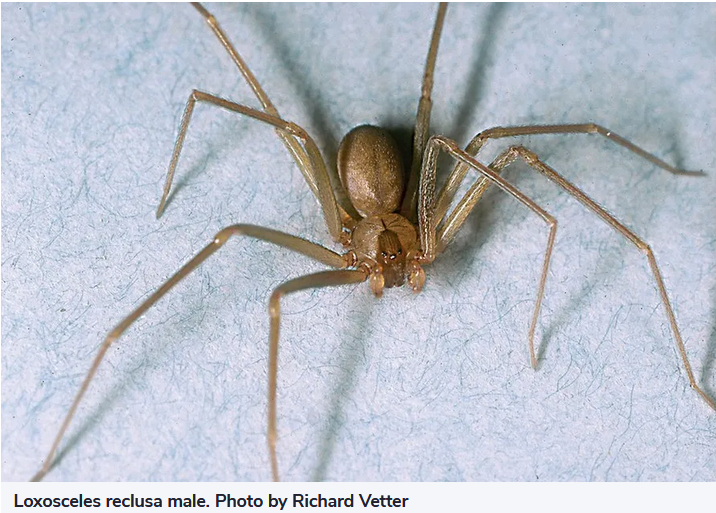
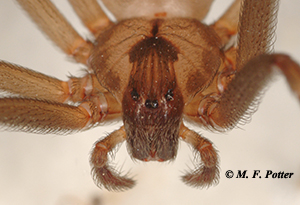
Brown recluse spiders are identifiable by the “violin” pattern on their cephalothorax. Their bodies are less than 10 mm long, but their legs are lean and spindly. All told, they’re usually no bigger around than a quarter. Face to face, they would be quite intimidating, with 3 pairs of eyes in a row and a gnarly pair of mandibles. For spiders, brown recluses are quite long-lived, up to 2 years. They are tough, too—they can go a year without food or water! Their webs are atypical. Called “retreats,” they are just flat wads of silk built up in a corner or tight space. Unless living within one of those large home infestations, they are typically solitary.
Despite their infamous reputation, it turns out brown recluses rarely bother people and mostly want to be left alone. After my family’s run-in with one, we have found them more fascinating than scary.
 8
8