Rattlesnakes are only found in the new world. Species exist in North, South, and Central America. In the U.S. and Canada there are 30 known species. Most prefer high dry habitats, but many can be found on high ridges near, or within wetlands, and we know some will live on our barrier islands. In such habitats, if their prey is available (usually rodents), rattlesnakes can be found.
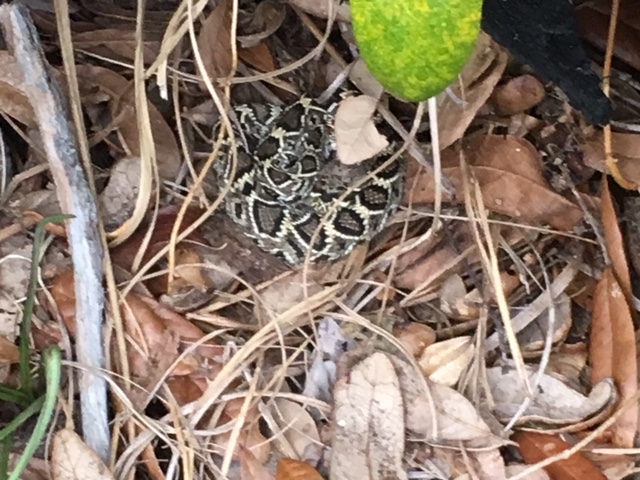
Photo: Rick O’Connor
Species richness across North America includes 18 species and additional 20 subspecies.
The highest richness is found in the American southwest. The state of Arizona leads the way with 14 species and subspecies. There are five that are only found in this state, and it is the mascot of their major league baseball team. California and Texas follow with 9 species and subspecies. New Mexico is a close third with 8 species and subspecies. California and New Mexico both have one rattlesnake unique to their states.
From the southwest, rattlesnakes’ richness spread to the southeast and Midwest. Another group moved up the Rockies and the Pacific northwest. Species richness begins to decline in these areas, and even more so in New England and the Mississippi Valley. The timber rattlesnake has the largest range being found in 28 states across the country. Below are the number of species and subspecies by states.
| Number of Species and Subspecies | States |
| 14 | Arizona |
| 9 | California, Texas |
| 8 | New Mexico |
| 4 | Georgia, Alabama, Kansas, Nevada, Utah |
| 3 | North Carolina, South Carolina, Florida, Mississippi, Louisiana, Arkansas, Missouri, Idaho |
| 2 | New York, Pennsylvania, Tennessee, Ohio, Indiana, Illinois, Nebraska, Oregon, Colorado |
| 1 | Vermont, Massachusetts, Connecticut, New Jersey, Maryland, Virginia, West Virginia, Kentucky, Montana, Washington, Minnesota, North Dakota, South Dakota, Wyoming, Wisconsin, Michigan |
Depending on the state, the number found in the southeast is 3-4 species and subspecies. The coastal states have barrier islands and there is at least one species found there – the Eastern Diamondback Rattlesnake.
In the classic text published by Ray and Patricia Ashton in 1981, eight species of Florida snakes have been reported from coastal dune habitats. Another six species from salt marshes – which are found on many of these barrier islands. Based on the Ashton’s publication below is a breakdown of the species and where they can be found in the state.
| Species | Habitat | Status in those habitats (1981) | Location | Notes |
| Everglades Rat Snake | Coastal dunes | Uncommon | SW – SE FL but not the Keys | This subspecies categorization was questionable |
| Eastern Coachwhip | Coastal dunes | Uncommon | Statewide | I have seen plenty of these on our local islands |
| Crowned Snake | Coastal dunes | Uncommon | North and central Florida | The coastal subspecies is found in the Indian River area |
| Southern Hognose | Coastal dunes | Rare | North and Central Florida | At this point this snake is rare everywhere |
| Florida Pine Snake | Coastal dunes | Rare | Statewide except the Everglades and Keys | This snake is also now rare across the state |
| Brown chin racer | Coastal dunes | Uncommon | Apalachicola Bay – St. Joe Bay area | |
| Everglades racer | Coastal dunes | Rare | SW-SE FL | |
| Eastern Diamondback Rattlesnake | Coastal dunes and Salt marsh | Rare in dunes
Uncommon in marsh |
Statewide | I have not encountered this snake in salt marshes but have in coastal dunes |
| Cottonmouth | Salt marsh | Rare | Statewide | This snake is becoming more common on barrier islands. I would consider it common |
| Florida Kingsnake | Salt marsh | Uncommon | Peninsula Florida | |
| Blue Striped Ribbon Snake | Salt marsh | Uncommon | Big Bend | |
| Atlantic Salt Marsh Snake | Salt marsh | Rare | Indian River region | This snake is now listed |
| Gulf Salt Marsh Snake | Salt marsh | Uncommon | Panhandle and Big Bend | I have found these in the bay area, not on the island. But would expect them there |
| Mangrove Salt Marsh Snake | Salt Marsh | Uncommon | Hernando County south – the Keys – north to Palm Beach |
Based on the Ashton’s publication – the only rattlesnake found in either habitat would be the Eastern Diamondback Rattlesnake. The Dusky Pygmy Rattlesnake has been found statewide but no records on barrier islands – though it has been reported just across the Intracoastal Waterway from our islands and could very well be there. The Timber rattlesnake has only been reported from upland habitats in north Florida.
So, based on this, our next article will focus on the one rattlesnake known to be on our islands – the Eastern Diamondback.
References
Rubio, M. 2010. Rattlesnakes of the United States and Canada. ECO Herpetological Publishing & Distribution. Rodeo, New Mexico. pp. 307.
Gibbons, W., Dorcas, M. 2005. Snakes of the Southeast. The University of Georgia Press. Athens, Georgia. pp. 253.
Graham, S.P. 2018. American Snakes. John’s Hopkins University Press. Baltimore, Maryland. pp. 293.
Ashton, R.E., Ashton, P.S. 1981. Handbook of Reptiles and Amphibians of Florida; Part 1 – The Snakes. Windward Publishing. Miami, Florida. pp. 176.
 0
0