The purpose of consuming food is to acquire energy. It does not make sense to expend more energy to kill your prey than you will receive from consuming it; there would be a net loss. Therefore, as we mentioned in Part 2, predators select prey that are easy to kill and require little energy.
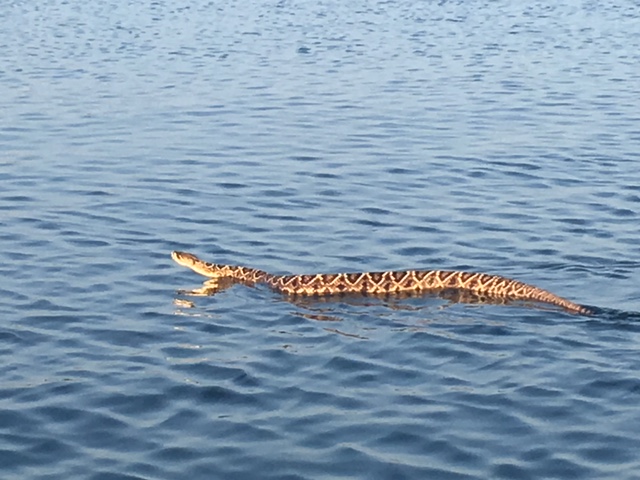
Photo: Sue Saffron
The problem for snakes is that they lack forearms and claws for doing this; they have only their teeth – and then to hold on with dear life so as not to lose it. A second problem for the rattlesnakes is that their feeding seasons are short due to hibernation, aestivation, and for some females – gestation. With a shorter feeding season, they need to feed on something with a lot of energy to hold them during non-feeding periods. This means feeding on endotherms – and the larger the better. This of course means going after prey that might be difficult to subdue, thus breaking the general rule. Answer to this problem… venom.
With venom rattlesnakes do not have to expend a lot of energy. The energy costs are within the lightning quick strike and in the production of the venom itself. As my professor said when I was in school – “venom is expensive for snakes”. This is why many venomous snakes will give a dry or bluff bite when dealing with potential predators. It is best to save the venom for what it was intended for. So, with venom, they can quickly strike a larger, energy rich, rabbit for a meal. And they do like rabbits.
Young rattlesnakes will consume what they can, adults prefer mammals. Rattlesnakes are good swimmers and are known to take both frogs and salamanders while swimming, but they do not prey on fish. Their menu also includes a variety of rodents, rabbits, shrews, moles, bats, lizards, toads, birds, bird eggs, centipedes, scorpions, crickets, and other insects.
Though many consider rattlesnakes apex predators, they are not. There are many species that feed on them, albeit mostly the smaller rattlesnakes within the population. By far their number one problem is humans. Based on the natural history of these snakes we have discussed in previous articles; you can understand their problem with us. They settle down in a selected hibernaculum for hibernation, aestivation, or gestation, only to have the habitat disturbed or destroyed by heavy equipment clearing land for new homes, roads, or shopping centers. These disturbed snakes now must move, which places them within view of humans, and we know what happens then. There is also the habitat fragmentation problem. Where roads, and other developments, cut through their range forcing them to again to move through our neighborhoods while trying to find prey, hibernacula, or females if breeding season. You can understand they really do not want to be around us but often have no choice.
With more natural predators, no species targets rattlesnakes but rather takes them when the opportunity presents itself. Their predators include opossums, armadillos, badgers, skunks, ring-tails, fox, coyotes, feral hogs, feral dogs, feral cats, bobcats, panthers, javelinas, hawks, eagles, owls, osprey, kites, falcons, shrikes, ravens, crows, road runners, turkeys, king snakes, racers, whip snakes, indigo snakes, cottonmouths, alligators, snapping turtles, and – at times – other rattlesnakes. Keep in mind, these will take on smaller rattlesnakes, larger adults have few predators.
As we mentioned in Part 3, typically only one out of 12 newborn rattlesnakes will reach the age of three. Those who reach full growth (up to eight feet with it the eastern diamondback) may live to be 25 years old. But we have also mentioned that very few rattlesnakes reach full growth these days. This and their habit of not breeding every year has placed many populations in peril.
In Part 7 we will look at the habitat and range of rattlesnakes across our country.
References
Rubio, M. 2010. Rattlesnakes of the United States and Canada. ECO Herpetological Publishing & Distribution. Rodeo, New Mexico. pp. 307.
Gibbons, W., Dorcas, M. 2005. Snakes of the Southeast. The University of Georgia Press. Athens, Georgia. pp. 253.
Graham, S.P. 2018. American Snakes. John’s Hopkins University Press. Baltimore, Maryland. pp. 293.
 0
0