It is understood that rattlesnakes are carnivores and will select some form of meat for their food. The general principle is to select something that is easy to kill and requires less energy to do so. Most rattlesnakes will select rodents but depending on the species and the part of the world they are in, some will select lizards or other prey.
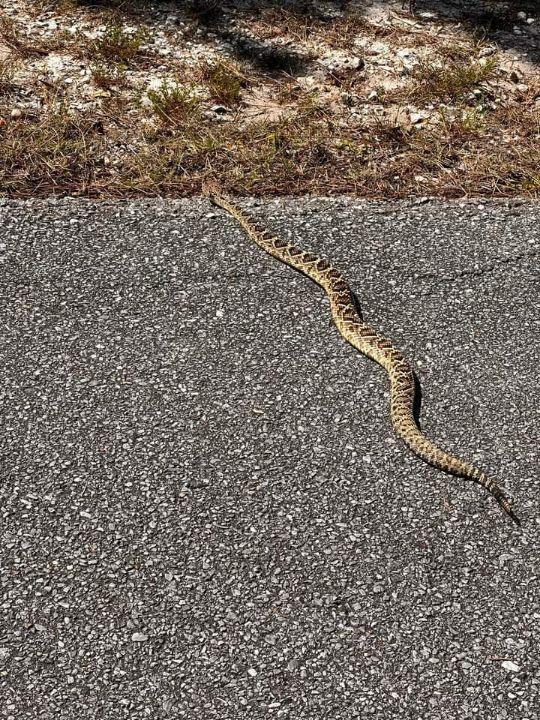
Photo: Bob Pitts.
Due to their long periods of hibernation and/or aestivation, their feeding seasons are shortened. If you add low prey availability when they emerge from hiding, the feeding season is shorter still. They respond by binge eating – basically gorging on prey as often as they can. They may consume massive meals that will take over a week to digest.
Rattlesnakes who feed on rodents over lizards will grow larger. Many species have young with bright pink or yellow tips on their tails, much like cottonmouths and copperheads. These are used to lure small prey such as lizards and toads. They are predominantly ambush hunters, lying in wait for selected prey to wander into striking range. They like spots where they are half in the shade, half in the sun to do this.
Here is a scenario…
In the spring, when the temperature reaches 70°F, rattlesnakes will leave the hibernacula they used for hibernation. Having not eaten in a while, food is on their mind. They will use their sense of smell to find the trails of their potential prey, find a good ambush spot, and wait. Some studies suggest they sleep while waiting. They may first detect their prey by seeing it. It could be by hearing or smelling. Or by a combination of these. They will begin to flick their tongues – using the Jacobsen’s organ – to further identify the target. When within range, the facial pits can help “see” the target and assist in accuracy of their strike.
The strike is extremely fast. The snake injects their venom, releases, re-coils, and folds their fangs back into their sheath. The target often will run but is usually dead within a minute and not far away. The rattlesnake will now find the scent trail with their tongue and follow its meal. It can take several minutes to an hour to find it. Once found the prey is dead and already in the process of digestion due to some of the enzymes within their venom. In some prey the rattlesnake may not release and rather hold on to the prey after the bite. This often happens when they select birds, possibly due to the difficulty of finding them because they may fly before they die. Another interesting twist to this scenario holds for the timber rattlesnakes, who sometimes lie at the base of a tree with their heads facing up the trunk waiting on an unaware squirrel coming down.
Swallowing the prey involves “unhinging” their lower jaw making the diameter of their mouths larger. This way rattlesnakes can swallow large prey such as squirrels and rabbits. They have six rows of smaller pointed teeth in their mouths. There are two rows on the lower jaw, two on the upper, and two on the roof of their mouths. With the fangs folded back in their sheath, they begin to grab the prey with one set of jaws (the right or left) pull in, then alternate with the other jaw. It appears they are “walking the prey down” their throat. There is a tube called the glottis on the forward portion of the lower mouth that is used for breathing while their mouth is full. They have been seen taking breaks and resting while this process is ongoing. After swallowing, they re-align their lower jaw and find a place to rest and digest the meal.
Being ectothermic they will need to find warmth to digest their meal. They require internal temperatures between 80-85°F for proper digestion, so, they will need to find a location where there is good sunlight but enough cover to hide them. Depending on the size of the meal, digestion can last up to a week.
This scenario can be altered if prey density is low. If it is, rattlesnakes may move, and forage more than they typically do. As you can see, an approaching human during any part of this scenario would be unwanted by the snake.
In the next article we will take a closer look at the venom of these snakes.
References
Rubio, M. 2010. Rattlesnakes of the United States and Canada. ECO Herpetological Publishing & Distribution. Rodeo, New Mexico. pp. 307.
Gibbons, W., Dorcas, M. 2005. Snakes of the Southeast. The University of Georgia Press. Athens, Georgia. pp. 253.
Graham, S.P. 2018. American Snakes. John’s Hopkins University Press. Baltimore, Maryland. pp. 293.
 1
1