Members of Fort Valley State University collaborated with researchers at the UF/IFAS Honey Bee Research and Extension Laboratory, Texas A&M University and the USDA to assist with a research project investigating the efficacy and persistence of different entomopathogenic nematode (EPN) species in managing small hive beetle (SHB) larvae. Below is a summary of the research as well as a link to the full publication.
Background
SHBs are honey bee pests that damage hives by eating pollen, honey, and bee brood. The chemical treatments labeled for use against SHBs have low efficacy. As a result, researchers are investigating biological control options to manage SHB populations.
In the larval stage, SHBs pupate in the soil outside of the hive, where they are most vulnerable to control strategies. EPNs have shown to be potential biological control agents against soil-dwelling pests in agricultural settings. However, studies are needed to determine the most appropriate EPN species needed to control SHBs.
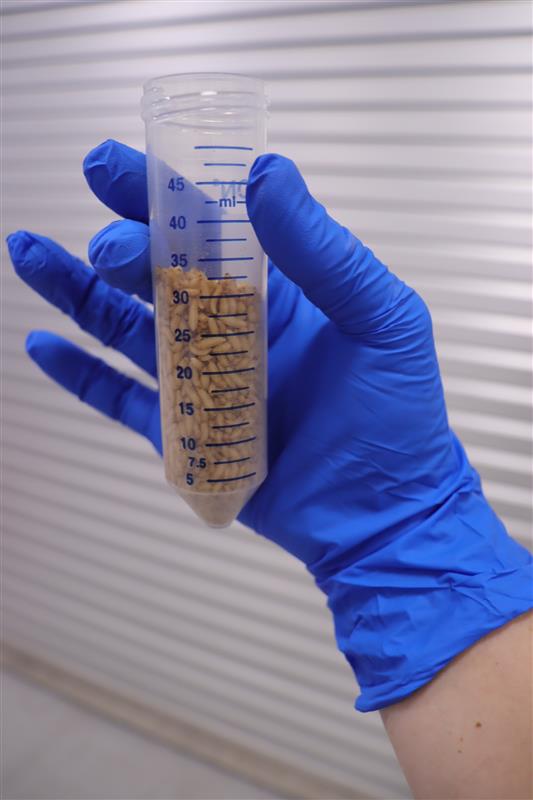
Figure 1: SHB larvae being measured for research. Photo by Hannah Gurland.
Purpose
The purpose of this experiment was to investigate the efficacy and persistence of different EPN species in managing SHB larvae, focusing on beetle mortality rates across different EPN doses, time points, and environmental conditions. Researchers compared the ability of the following seven species of EPNs to kill developing SHB larvae: H. bacteriophora (VS), H. floridensis (K22), H. georgiana (Kesha), H. indica (HOM1), S. carpocapsae (All), S. rarum (17C+E), and S. riobrave (355).
Key findings
- All tested EPN strains parasitized SHB larvae.
- S. carpocapsae (All) and H. floridensis (K22) exhibited the greatest impact on SHBs, causing 100% mortality in developing SHBs 14 days post-inoculation.
- S. carpocapsae (All) was the only species to cause 100% mortality in SHB larvae 7 days post inoculation, making this EPN a possible candidate for application to soil surfaces in apiaries.
- H. bacteriophora (VS), H. georgiana (Kesha), and H. indica (HOM1) had the lowest impact on SHB mortality.
- Further research is necessary to determine the frequency of application of EPNs and understand how environmental factors impact their effectiveness in field settings.
Significance
This research provides valuable insight into the long-term effectiveness of S. carpocapsae (All) and H. floridensis (K22) against SHB larvae. These EPN strains demonstrate high efficacy and persistence, showing their potential as a sustainable pest control strategy for managing SHBs.
To read this publication, visit: https://pmc.ncbi.nlm.nih.gov/articles/PMC11954647/
This blog was written by UF/IFAS Honey Bee Research and Extension Laboratory employee, Katie Shealy and revised by Amy Vu and Dr. Jamie Ellis.
Mbata GN, Browning K, Warsi S, Li Y, Ellis JD, Kanga LH, Shapiro-Ilan DI. Comparative Virulence of Entomopathogenic Nematodes to the Small Hive Beetle (Aethina tumida Murray, Coleoptera: Nitidulidae). J Nematol. 2025 Mar 29;57(1):20250011. doi: 10.2478/jofnem-2025-0011. PMID: 40161028; PMCID: PMC11954647.
 2
2