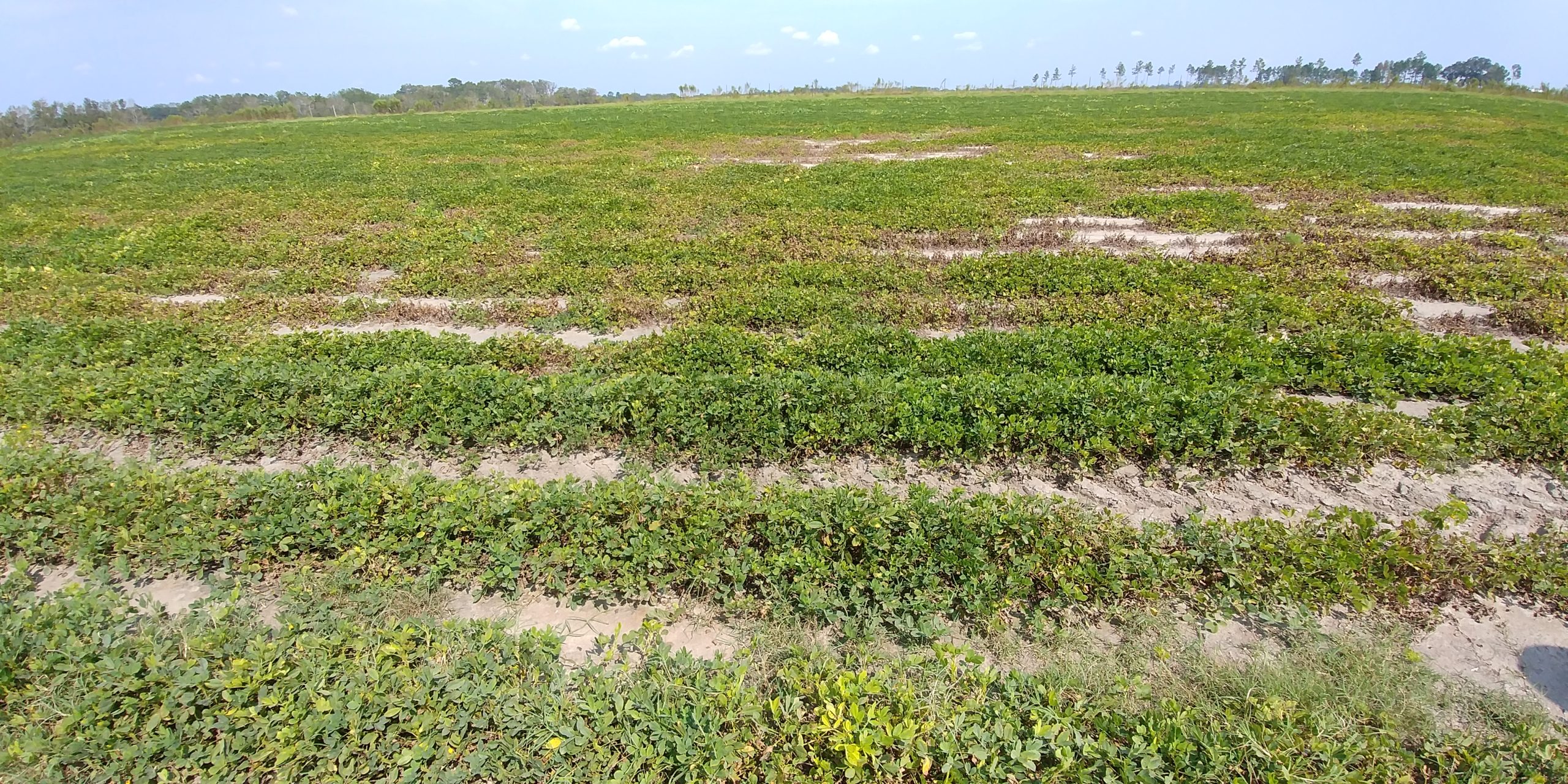
Plant-parasitic nematodes are a major yield-limiting factor in peanut production, with peanut root-knot nematode the major nematode of concern (Figure 1). Now is the time to plan a nematode management approach for 2026 peanuts. So, what options are available? Crop rotation and other cultural practices are an important part of a long-term nematode management plan. Choosing to divert 2026 acres to cotton, corn, certain cover crops, pasture, or clean fallow would help with peanut root-knot nematode management down the road, but there are many economic and agronomic considerations as well. For the 2026 peanut crop, use of resistant cultivars and nematicide application are the main nematode management tools.
Peanut cultivars resistant to peanut root-knot nematode
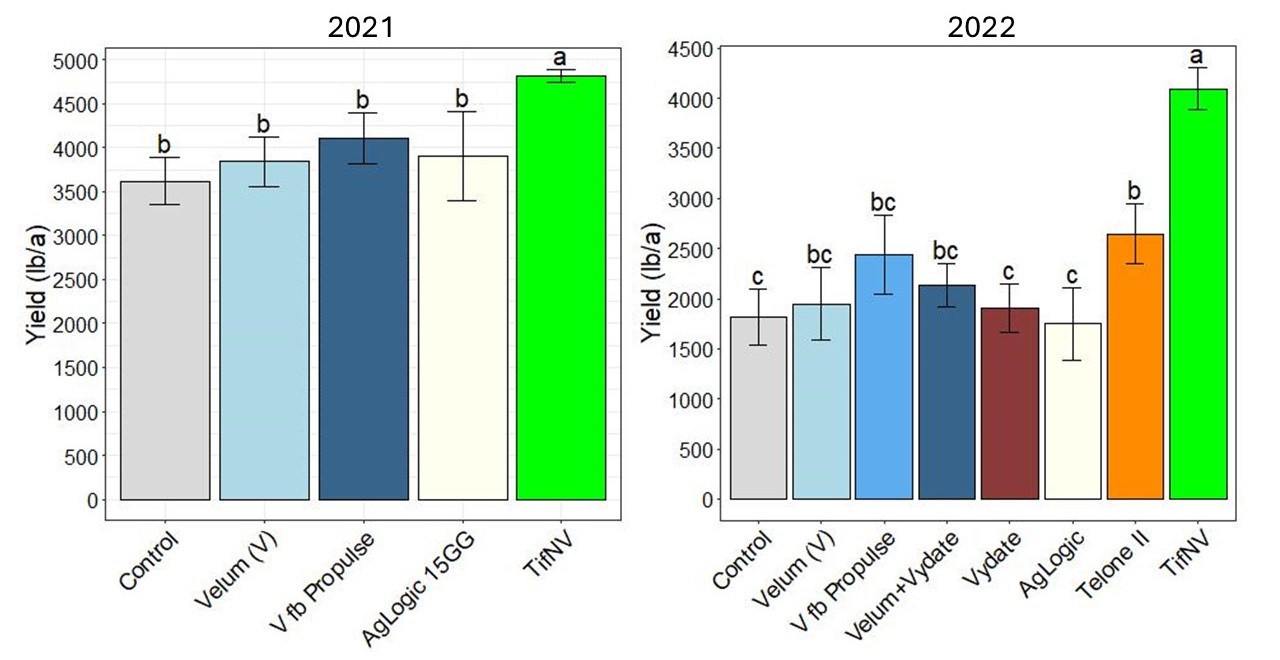
Peanut cultivars highly resistant to peanut root-knot nematode are available. So far, all resistant cultivars derive from the same background and generally have a similar high level of resistance. (One exception is ACI-N104, which has shown a more moderate level of resistance in our testing.) Under pressure from peanut root-knot nematode, resistant cultivars typically greatly improve yield relative to a susceptible cultivar, regardless of whether nematicide has been applied. For examples, see Figure 1 as well as previous articles Panhandle Ag articles on performance of recent resistant cultivars and a resistant cultivar relative to nematicides.
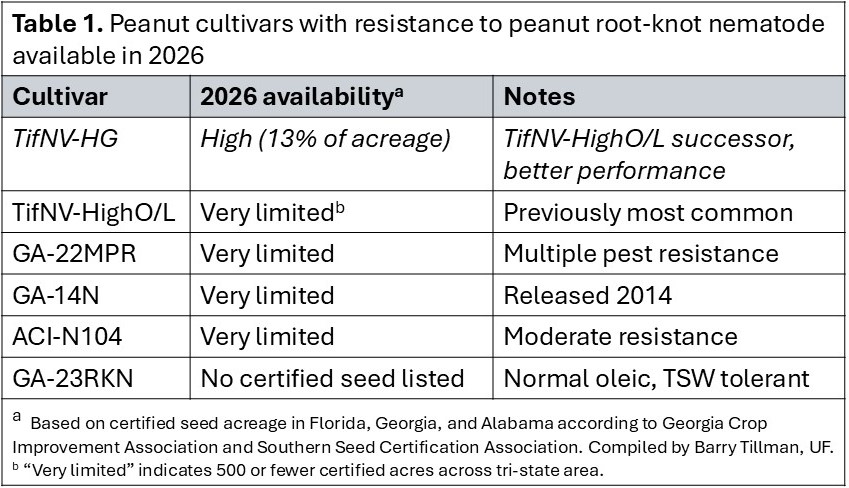
In 2026, TifNV-HG is your main choice if you plan to grow a cultivar resistant to peanut root-knot nematode. Availability of TifNV-HG is high and other resistant cultivars have very limited availability (Table 1). This is a new development as TifNV-HighO/L had been the mostly readily available resistant cultivar in recent years. The good news is that TifNV-HG is highly resistant to root-knot and yields well relative to susceptible cultivars, even in situations with minimal nematode pressure. This likely why it has garnered a relatively high market share as it is the first cultivar other than GA-06G grown on more than 10% of the certified acreage in the last few years. Except for GA-23RKN, all current resistant cultivars are high oleic. Remember that resistant cultivars do not affect sting or lesion nematodes, so other tactics will be needed if those pests are present.
Nematicides available in peanut production
Regarding chemical nematicides, options are the same as in recent years with liquid products such as Velum (fluopyram active) and Vydate C-LV (oxamyl), granular AgLogic 15GG (aldicarb), or the fumigant Telone II (1,3-dichloropropene) available. In-furrow application of liquid or granular products are the most common treatment and can be supplemented with liquid products as a broadcast spray at pegging. Liquid or granular nematicides can help with management, but are less effective than a resistant cultivar (e.g. Figure 1).
The release of new biological nematode control products is the most recent development in peanut nematode control. Products with Bacillus bacteria (e.g. Outreach SC) or Trichoderma fungi (e.g. Atroforce and Triario WG) as the active ingredient are available in peanut production. A few other products are available in row crops, but seem to be less targeted at the peanut market based on label restrictions or other factors. Bacillus and Trichoderma biologicals have been tested by UF/IFAS to a limited extent and more research is needed to evaluate their efficacy. From the data collected thus far, resistant cultivars are a more effective option than biologicals.
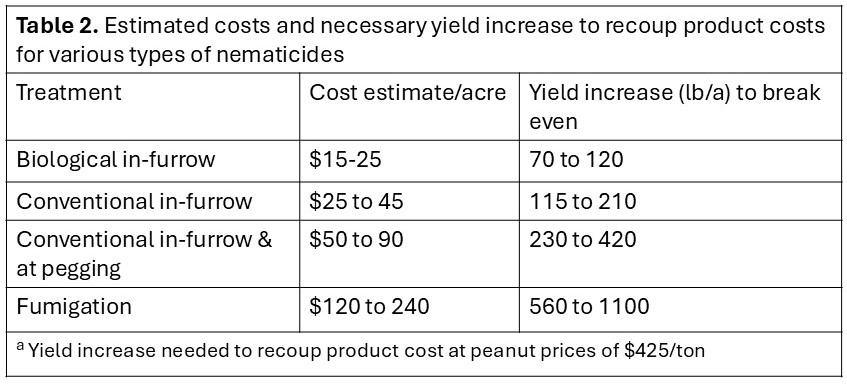
For both chemical nematicides and biologicals, growers should consider whether the yield increase from applying a product will be enough to cover the product costs. If not, skipping application would be a prudent financial choice. Chemical or biological nematicides typically help with nematode management for a maximum of a single season, so there are no carryover financial or production benefits. Table 2 provides estimates of product costs and the necessary yield increase to cover product costs.
Summary
In summary, TifNV-HG is the only widely-available cultivar resistant to peanut root-knot nematode in 2026. More biological nematode control products are available in 2026, but the efficacy of these products needs further evaluation. No new chemical nematicides are available in peanut for the 2026 season.
 0
0