New Rooftops Aren’t the Only Things Choking out Native Flora and Fauna.
Invasive plants are a huge problem in Florida’s natural areas, yet many people are unaware that the plants in their yard are a part of the problem. How many times have I heard folks say, “It doesn’t spread in my yard.” This may be true. But many invasive plants are spread by birds eating the seed or have seed capsules that shoot the next generation several meters away from their parent plant. Over 1.5 million acres of conservation land in Florida have been invaded by introduced plant species. Many of these plants are still sold by nurseries and the average consumer has no idea that they may be planting a Category I invasive in their flowerbed. However, plant breeders have developed sterile varieties to combat this problem.
One of the most sold invasive plants is the lantana.
It’s a beautiful perennial, blooms nearly year-round, and a nectar source for butterflies. Lantana is not a problem just a few hours north of Florida, where freezes are common in winter. Here it is a Category I invasive that alters native plant communities and can cause liver damage or even death to cattle when they eat it as a weed growing in pastures. Researchers at the University of Florida began breeding lantana in 2004 with the goal of producing plants that retained all the characteristics people love but are infertile. The program was a success and in 2016, the UF/IFAS Cultivar Release Committee approved the introduction of two new sterile varieties, ‘Bloomify Red’ and ‘Bloomify Rose.’ Ball Horticultural Company was awarded an exclusive license to propagate these newly patented varieties. They can now be purchased online or at some nurseries.

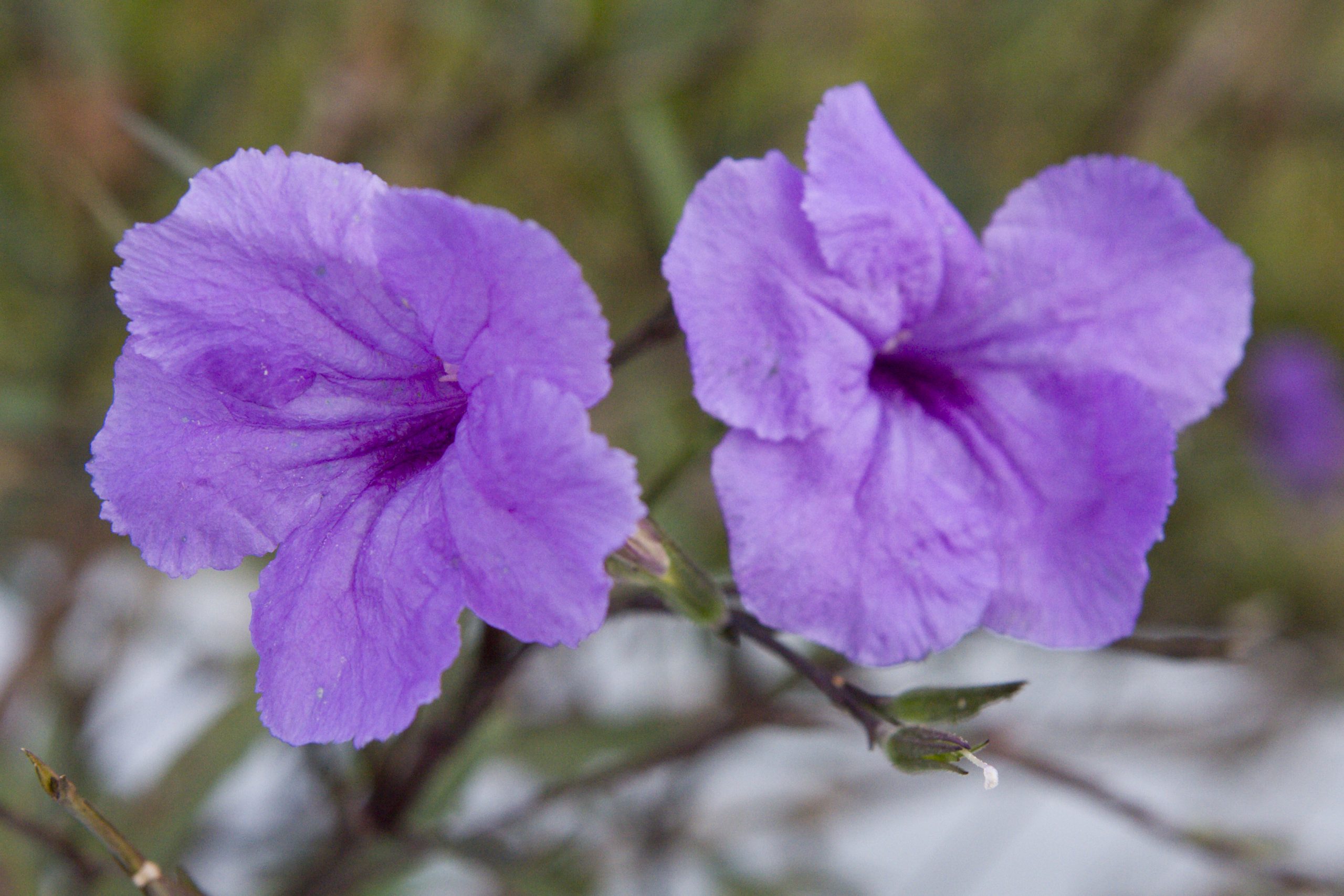
Perhaps the second most sold of the flowerbed offenders is the easy to grow Mexican petunia.
Their seed capsules make around 20 seed each, which are flung up to 3 meters away when they dry out and burst open. After they escape the backyard, they can germinate and grow in almost any environmental condition. In Florida, Mexican petunia has been found growing in pine flatwoods, prairies, hardwoods, freshwater marshes, rivers, springs, and salt marshes. In places where it has taken hold, it makes up 50% of the plant layer, dramatically changing the plant community. Breeding for sterile varieties of Mexican petunia began at the University of Florida in 2007. By 2014, three new varieties were commercialized, ‘Mayan Purple’, ‘Mayan White’, and ‘Mayan Pink.’ ‘Mayan Compact Purple’ was released sometime later.
Maybe you are wondering why University of Florida Extension, plant societies, and conservation groups are still so vocal about encouraging people not to grow these two plants in their yards. The point of the breeding program was to offer consumers a better choice at the nursery. Surely the nurseries are only selling sterile plants, right? Unfortunately, this is not the case. Growers are still allowed to propagate, and nurseries are allowed to sell the invasive varieties. In fact, it can be difficult to find the sterile varieties for sale.
What can you do as a gardener?
If you have the standard, garden variety lantana or Mexican petunia, remove them from your landscape. Plant only the sterile ‘Bloomify’ or ‘Mayan’ series varieties. When you go to your local nursey, ask for them specifically. If they don’t carry them, take a moment to explain that you only want to plant the sterile varieties and ask if they will order them. If they are unwilling to do that, the plants can be purchased online. The solution for these two invasive plants is available, if we as consumers will demand it.
 2
2