Research-backed tools to help crops defend, adapt, and thrive are often overlooked. Understanding plant defense and adaptation enhances crop performance. Here, we aim to highlight several natural tools for combating pests and diseases while improving plant efficiency.
This is why it’s so important for growers to fully understand the water, light, and environment in the groves.
Authors: Gutierrez-Rodriguez Edwin, Jonael Bosques-Mendez
What happens below the ground influences what we see above.
Do Roots Search for Water?
When the soil surface starts to dry out, but moisture remains deep down, roots receive a hormonal signal to grow deeper, chasing those water reserves.
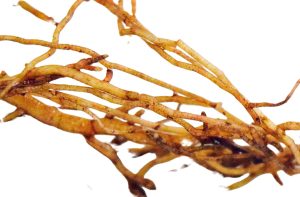
Conversely, roots are also smart about growing sideways. They will actively form more branch roots in moist soil pockets while avoiding growth in dry patches. This architecture is orchestrated by several plant hormones, such as auxins and abscisic acid (ABA). Plant hormones may act as messengers, traveling from the leaves and shoot tips down to the roots, telling them where to grow. Here is why one of the priorities in HLB management at earlier stages should be to maintain this hormonal balance.
Roots continually interact with their environment, actively functioning in the underground ecosystem. (Book recommended), interacting with microorganisms, soil types, and weather conditions. This complex interplay sustains the Soil-plant-atmosphere complex: flow of water and nutrients from the soil through the plant and into the atmosphere.
Water is not just a nutrient carrier. A strong root system is essential, and growers should focus on horticultural strategies that enhance quality and growth.
Remember, water is a universal transporter, HOWEVER too much or too little can create serious issues.
While roots respond to many signals, in this post, I will focus on one aspect: the relationship between roots and water and light. Plants’ roots don’t just passively absorb water; they actively respond to where and how it is provided, especially through our irrigation practices. Light goes beyond photosynthesis.
Don’t guess the amount, measure it!
Water in the soil, availability, frequency, wet bulb temperature, time, and other factors provide different information to plants. UF/IFAS and other institutions have been working on strategies involving both low-cost and more expensive instruments, apps, and sensors. We can’t truly know what’s happening in the root zone without measuring.
While many tools exist, the key is to move from guessing to data-based decision-making. For crops like citrus, science has shown that sensors using TDR (Time Domain Reflectometry) or TDT (Time Domain Transmissometry) technology can be more effective at providing an accurate soil moisture information.
For example, a healthy, mature citrus tree on deep, sandy soil can have roots extending five feet deep, far beyond what we can see on the surface
The Hidden Helpers in the Soil
Roots don’t live in isolation. They are surrounded by a community of microscopic organisms that impact plant health and modify its ability to overcome stressful conditions.
Some of these microbes, called endophytes, live inside the plant and can help it defend against diseases like Huanglongbing (HLB) or citrus greening. Studies have found, for example, that citrus trees showing no symptoms of HLB often host a greater number and variety of these helpful microbes. Specifically, a bacillus called Bacillus subtilis appears to boost a citrus tree’s natural defenses, with its presence linked to milder disease symptoms.
Learning how roots work is not about stressing trees with drought. It’s about using water more efficiently and wisely
The sunlight is your ally. Collaborate with it.
What sunlight does for plants is far beyond photosynthesis. Although it is poorly discussed in the context of disease management, it has long been explored for its role in plant defense. So far, scientists have identified more than 100 different natural plant compounds that can

become toxic or irritating when exposed to light, and new ones are still being found.
Specific data on plant pathogens are limited; chlorophyllin derivatives are the most effective in agriculture, with others showing potential but no direct evidence for plant pathogenic bacteria.
The inactivation of microorganisms by sunlight is also being explored. This is a natural process in which sunlight helps kill or weaken the pathogen (fungi, bacteria, some spores) by activating light‑sensitive compounds.
In plain language:
Sunlight + oxygen + certain natural compounds = damage to pathogens

On the insect management side, some plant compounds have been proven to be sunlight‑activated pest killers with high potential. α‑terthienyl, thiophenes, and furanocoumarins may help plants defend themselves. The last group may be less consistent for pest control.
Take-Home Messages
- Soil moisture sensors help to decide when to irrigate, how long to run the system, and where it is needed.
- Proper irrigation keeps oxygen in the root zone and prevents trees from reaching the permanent wilting point, which causes lasting damage.
- Place irrigation emitters to wet the active root zone, not the trunk. This prevents stunting, encourages strong root growth, and improves water-use efficiency.
- Prune when necessary by removing twisted, overcrossed, sick, or dead branches.
- Optimize light penetration into the canopy based on your crop, tree age, and other factors.
- Consult with your local extension Agent
- A well‑managed irrigation program:
-
- Reduces air bubbles(cavitation) in the tree’s sap flow
- Minimizes nutrient loss from leaching
- Supports steady photosynthesis for healthy growth and yields
Additional references and resources
- 2018_july_using_soil.pdf
- ATTRA_SoilMoistureMonitoringTools&Methods_2006.pdf
- Effect of Various Irrigation Rates on Growth and Root Development of Young Citrus Trees in High-Density Planting – PMC+
- Root Plasticity in the Pursuit of Water
- Abscisic acid dynamics, signaling, and functions in plants – Chen – 2020 – Journal of Integrative Plant Biology – Wiley Online Library
- Recent progress in the understanding of Citrus Huanglongbing: from the perspective of pathogen and citrus host | Molecular Breeding | Springer Nature Link
- Cas le, Wil iam. (1978). Citrus Root Systems: eir Structure, Function, Growth, and Relationship to Tree Performance. 1978 Proceedings of the International Society of Irrigation and Drainage. 1. 62
An Equal Opportunity Institution. UF/IF S Extension, University of Florida, Institute of Food and Agricultural Sciences
 0
0