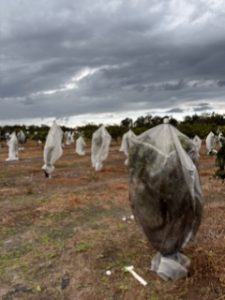
In the ongoing battle against Huanglongbing (HLB), also known as citrus greening, Individual Protective Covers (IPCs) may be a powerful tool for Florida citrus growers. These mesh covers, designed to exclude (keep outside) the Asian citrus psyllid (ACP), vector of HLB, offer a non-chemical and cost-effective strategy to protect citrus trees at early stages, from planting during their most vulnerable years. According to UF/IFAS research, as outlined in EDIS publication HS1425, IPCs work highly efficiently, excluding psyllids and preventing HLB infection. While the plants covered may remain HLB-free for up to three years, once uncovered, symptoms and positive results for the disease can take as little as six months.
Material and Installation
Commercially, currently, IPCs are made either from high-density polyethylene (HDPE) or polyvinyl, with a mesh size of 50 (0.297 mm holes), which is small enough to block psyllids. So, a proper installation and maintenance area is fundamental: first, covers may be (or not?) secured right after planting, below the graft union, to PVC poles to prevent their collapse.
When IPCs Become a Risk?
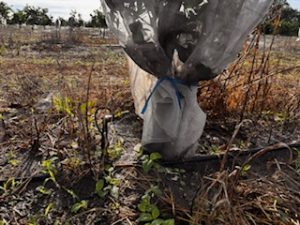
Along with the benefits, IPCs can also incur a liability if not properly maintained. Most common issues are:
-

Organic residues accumulated inside the citrus Individual Protective Cover (IPC) system, along with water, create a perfect combination for stem diseases. Credit Edwin Gutierrez-Rodriguez, UF/IFAS Weeds and grass growing inside the cover compete for water and nutrients, creating a humid microclimate that fosters pests and diseases.
- Overly tight fabric that constrains the stem can potentially cause it mechanical damage and diseases.
- Accumulation of dust, soil particles, and water can lead to the development of secondary pests and diseases.
- Branch deformation, due to limited space, is especially evident on vigorous growth cultivars.
- Light blockage caused by dust crusts or fungal growth, such as fumagine —a black, sooty mold that thrives on honeydew excreted by sap-sucking insects and reduces photosynthesis by blocking sunlight.
Light: A Double-Edged Sword
IPCs and Citrus Under Protective Screens (CUPS) may both modify the light and environment for the inside plants due to the cover material. While changes in light (wavelength and refraction) inside the covers can enhance photosynthesis and growth, excessive shading or deformation of branches can reduce light interception and hinder their development.
Some Recommendations
While the plants start growing, make sure:
1. Inspect IPCs inside—Especially least seasonally and after storms.
2. Replace IPCs when damaged or too small to allow trees to grow.
3. Scout for pests and diseases, even inside.
4. Make sure proper light and air circulation, and avoid moisture buildup.
5. Remove IPCs in a timely manner to prevent growth deformations.
Remember, before considering fancy strategies, technologies, or fertilizers, citrus trees require their basic nutritional pillars—water (H₂O), carbon dioxide (CO₂), and light. These are the true drivers of photosynthesis and growth. Without them, no nutrient program will succeed.
References and additional resources
- Individual Protective Covers (IPCs) for Young Tree Protection from the HLB Vector, the Asian Citrus Psyllid (HS1425/HS1425: Individual Protective Covers (IPCs) for Young Tree Protection from the HLB Vector, the Asian Citrus Psyllid)
- Citrus Greening (Huanglongbing, HLB) Ask IFAS: Topic – Citrus Greening (Huanglongbing, HLB)
- A Close-up Look at Screens for Excluding Asian Citrus Psyllids (SL489/SS702: A Close-up Look at Screens for Excluding Asian Citrus Psyllids)
- 2025–2026 Florida Citrus Production Guide (2025-2026 Florida Citrus Production Guide by UF/IFAS Statewide Citrus Research and Extension – Issuu)
 1
1