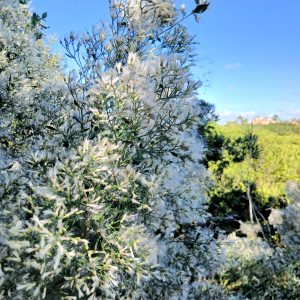
Well before the Category II invasive groundcover blooming right now in the area took the label of “Florida Snow”, I remember when a native plant held this title – often an uninvited guest – the saltbush. Saltbush is a native, large shrub growing up to eight-feet tall at maturity. The white autumnal flowers produce fluffy seeds that blow in the wind spreading randomly across the landscape – they may end up in your yard. I once even found one growing out of a rock! This very successful native plant may already be somewhere in your landscape.
Saltbush is seldom planted on its own accord but normally drops into your yard for an extended stay. This evergreen to semi-evergreen shrub develops into a vase-shaped to rounded large shrub or small tree with multiple branches that can be pruned to size as needed. The simple, toothed leaves are alternatively arranged on the branches, and each leaf is up to three-inches long, gray green on top and silvery-green underneath. There are separate male and female plants each with different flowers shapes and colors – yellow for male and white for female. Pollinators are attracted to these abundant nectar-filled saltbush flowers. The pollen is considered an allergen, so sensitive individuals should keep this mind. The resulting seeds from the female plant are fluffy with a great capacity to travel in the wind across the landscape – like gently falling snow. Another note to mention – the seeds are poisonous to humans.
Other than finding saltbush shrubs on your own property, this plant is often found naturally near retention ponds and drainage ditches, often in habitats favored by wax myrtles. A great choice for rain gardens, saltbush is tolerant of flooding, drought, brackish water, and of course salt spray. Being native, saltbush shrubs are likely available at native nurseries but are not commonly found on the market elsewhere. Saltbush shrubs are very abundant in nature – sometimes to the degree of almost being “weedy”. In addition to the attractive foliage, saltbush has an added ornamental feature – they flower in the fall at a time of year when most other woody plants have nothing to offer.
Go on a horticultural treasure hunt today to see if you have a saltbush already on your property – I have several tucked away in nooks and crannies, and I did not plant them. If not today, a saltbush might find your yard another day – depending on which way the wind blows this other “Florida Snow”! For more information on all types of plants for your garden, or to ask a question, you can also call the Master Gardener Volunteer Helpdesk on Mondays, Wednesdays, and Fridays from 1 to 4 pm at 764-4340 for gardening help and insight into their role as an Extension volunteer. Ralph E. Mitchell is the Director/Horticulture Agent for UF/IFAS Extension Charlotte County. He can be reached at 941-764-4344 or ralph.mitchell@charlottecountyfl.gov. Connect with us on social media. Like us on Facebook @CharlotteCountyExtension and follow us on Instagram @ifascharco.
Resources:
Brown, S. H. (2011) Baccharis halimifolia. The University of Florida Extension Service, IFAS – Lee County.
UF/IFAS Gardening Solutions – Saltbush (2025) The University of Florida Extension Service, IFAS.
Beckford, M. (2017) Florida snow – pretty or pesky? The University of Florida Extension Service, IFAS – Citrus County
 1
1