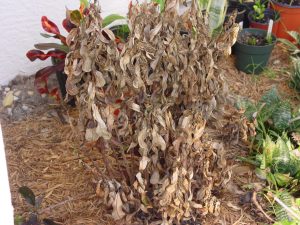
Freezes and frosts – just like death and taxes – can be expected even here in Southwest Florida. I remember twenty-six years ago when I first arrived in Charlotte County. I planted a couple of marginal plants that I thought would be fine. We soon had a freeze and to my disappointment, these plants were frozen toast! Since then, I have learned to choose wisely and expect occasional damage and even lose. I received my share of frost/freeze damage this year which always looks bad and is somewhat depressing. However, this is generally a temporary condition and most everything eventually grows back – sometimes more than expected! How do you deal with our yearly potential of cold weather in the landscape? I would like to offer some suggestions on how to beat, work around or avoid cold and freeze damage to your landscape plants.
My first point will be to “plan before you plant” or in Florida-Friendly Landscaping™ jargon “Right Plant, Right Place” – Principle #1. Keep in mind that we are in certain plant hardiness zones which gives a sense of what plants can survive in our area. For the most part we are in zone 10a with 9b as you move inland. Like Real Estate, it is often a matter of “Location, Location, Location”. The closer you are to the water, the more chances there are of finding a sliver of warmer temperatures. There may also be warmer spots known as “micro-climates” which are places that are often warmer or more protected than the surrounding landscape. The shade provided by a tree can offer a reduction in cold injury by reducing the heat loss from the ground. However, plants that need full sun will of course not do well under these circumstances in the long run. Fences and buildings can also protect plants from frigid winds and some associated freeze injury. Hardiness zones are not completely exact and can vary a bit, but at least they give you an idea what plant is ideal for a spot, what plant is not going to make it and what plant may be marginal. Colder temperatures can almost always be expected in interior portions of our county. Culturally, avoid fall pruning that may initiate a flush of new growth. This new growth will be tender and more susceptible to cold temperatures. Overall, healthy plants will better withstand cold temperatures. In a fertilizer mix, Potassium is the nutrient that helps plants deal better with stress – in this case, cold. Proper timing of a balanced fertilizer is always important. Don’t make any late fall fertilizer applications as this can stimulate untimely growth which is not cold hardy.
You have a better chance in providing protection from a frost, than you do from a hard freeze when using covers. These covers have to extend to the ground to hold radiant heat and should be firmly attached making sure that the material does not rest on the foliage. Good coverings include commercial “frost cloth,” as well as bedsheets and quilts.
After the freeze event, inspect the plants for damage, but don’t jump to remove any injured parts. Truly dead leaves can be removed when they turn brown. Don’t prune any woody parts out until you see new growth in the spring as you must allow time to be able to determine what is truly dead and what is still alive. Once damage has been delineated, prune just below the dead portion – preferably in March. So, don’t get disappointed or disheartened with our crispy brown and mushy, olive-drab landscapes! We have to face this weather from time to time and can deal with it with common sense and practical prevention. Otherwise, watch the local weather reports and always have your supplies on hand. By July – if your plants are still alive – they will likely have grown back to a point where you might find yourself forgetting that we ever had a freeze! It will get warm again! For more information on all types plant culture and care, or to ask a question, please visit https://www.facebook.com/CharlotteCountyExtension. You can also call the Master Gardener Volunteer Helpdesk on Mondays, Wednesdays, and Fridays from 1 to 4 pm at 764-4340 for gardening help and insight into their role as an Extension volunteer. Ralph E. Mitchell is the Director/Horticulture Agent for UF/IFAS Extension Charlotte County. He can be reached at 941-764-4344 or ralph.mitchell@charlottecountyfl.gov. Connect with us on social media. Like us on Facebook @CharlotteCountyExtension and follow us on Instagram @ifascharco.
Resource:
Brown, S., P. (2021) Cold Protection of Landscape Plants. Cold Protection of Ornamental Plants, The University of Florida Extension Service, IFAS.
 0
0