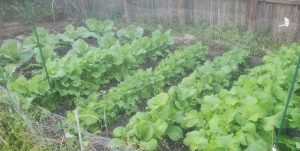
My vegetable garden is very “cool” because I have filled it with cool-season vegetables. To further confuse you, many of these vegetables are “Cole” crops. What types of cool Cole crops am I growing?
Right now is the perfect time to be planting and enjoying cool-season crops – many which are Cole crops or “cruciferous vegetables” or also known as “brassicas.” Getting more specific, a group under the scientific name, Brassica oleracea, would include kale (collards), cabbage, broccoli, and cauliflower, while Brassica rapa would include turnip, Pak choy, and rutabaga. In addition to all doing best in our relatively cooler weather, they are also ridiculously easy to grow.
Early fall through winter is a fine time for these crops as they thrive in the cooler temperatures. Essential to success is planning so that the soil is prepared, the seeds have been selected and time is carved out of your schedule to accomplish this task. In addition to working the ground, add as much compost as you can afford to enrich the soil for better water-holding capacity in our very sandy base soil – remember that our state sand is called “Myakka Fine Sand”. Once the garden is plotted out in rows for the various greens, incorporate a good vegetable granular fertilizer – as per label instructions – before planting. Form a shallow furrow with your hoe and sow your seed as per the label directions for depth and distance between seeds. I find that instead of pushing surrounding soil over the row to cover the seed, carefully covering the newly sown seeds with some sterile potting medium helps the seedlings more easily push through this material with less impediments. Also, don’t be skimpy on seed sowing as not every seed will sprout and emerge. Once the seedlings have made their appearance and are beginning to crowd each other, thin them to allow more growing room – this is essential for best results. Thinning will be an on-going effort as the various vegetables continue to grow. As the seedlings mature, you can also harvest these thinned extras as baby vegetables for the table.
Specifically, I have a number of winter vegetables that I direct seed right into the garden such as kale, collards, Pak choy, turnips, and rutabagas. With cabbage, broccoli, and cauliflower I start the seeds in a pot and when they have their first true leaves, transplant them into a bigger pot or cell and grow them on to a size that I can transplant into the garden. This takes four to six weeks of prior planning to get the seedling big enough to plant. While the mature cabbage and cauliflower are picked whole, broccoli can provide a main harvest with the initial head, and then numerous sideshoots that form for future picking. The leafy vegetables like kale and collards can be repeatedly picked over an extended period of time – leaf by leaf. Variety is the name of the game and there are, for instance, many types of kale to pick from including ‘Dwarf Blue Curled Vates’ and the very dark green, Tuscan. Root-forming vegetables such as turnips and rutabagas need room to grow their bulb-like roots, so allow for this expansion. Turnips are dual-purpose and provide a double-crop of leaves and roots – some turnips are even grown just for their leaves.
These common – and perhaps underappreciated – vegetables can be a mainstay in your garden at this time of year for greens, soups, etc. You still have some time to get them in, so check out the seed racks at your local garden center. You can also always plan for next year’s winter dream vegetable garden – you will not be disappointed! For more information on all types of vegetables you can grow in our area, or to ask a question, please visit https://www.facebook.com/CharlotteCountyExtension. You can also call the Master Gardener Volunteer Helpdesk on Mondays, Wednesdays, and Fridays from 1 to 4 pm at 764-4340 for gardening help and insight into their role as an Extension volunteer. Ralph E. Mitchell is the Director/Horticulture Agent for UF/IFAS Extension Charlotte County. He can be reached at 941-764-4344 or ralph.mitchell@charlottecountyfl.gov. Connect with us on social media. Like us on Facebook @CharlotteCountyExtension and follow us on Instagram @ifascharco.
Resources:
UF/IFAS Gardening Solutions (2025) Cole Crop Confusion. The University of Florida Extension Service, IFAS.
Park-Brown, S., Silvasy, T., Williams, L. & Treadwell, D. D. (2025) Florida Vegetable Gardening Guide. The University of Florida Extension Service, IFAS.
UF/IFAS Gardening Solutions (2025) Turnips. The University of Florida Extension Service, IFAS.
UF/IFAS Gardening Solutions (2025) Kale. The University of Florida Extension Service, IFAS.
 0
0