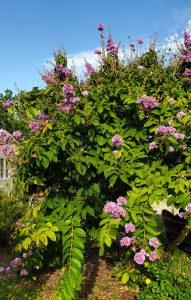
While many crape myrtles do best with cooler weather found north of us, there is one type of this beautiful flowering tree that actually benefits from warmer, subtropical temperatures. This crape myrtle reigns supreme in flower and leaf size in comparison to its classic cousins – the Queen’s Crape Myrtle truly rules the landscape!
The queen’s crape myrtle looks like a regular crape myrtle on steroids with huge three-inch wide pink/lavender ruffled flowers on one- to two-foot-long panicles (clusters) blooming mostly from June through July. The leaves are also large with lengths ranging from four to fourteen inches that turn red before they drop for the winter on this deciduous/semi-deciduous tree. The trees can reach thirty-feet tall with a similar width and are surprisingly storm tolerant with durable wind-resistant wood. Proper pruning during its formative years will help provide structurally sound branches better able to handle windstorms.
The queen’s crape myrtle is truly best adapted to subtropical to tropical climates that can be found in hardiness zone 10. I had one small specimen that grew for a couple of years in Port Charlotte – it even flowered – but was frozen back to the ground during one cold snap – dead as a doornail. I also observed others in Port Charlotte that were larger and froze back less severely for several years, but rarely if ever flowered. More recently, some winters were mild enough to allow this planting to produce a fairly good flower crop. So, extra cold test winters aside, the closer you grow this tree to the coast, bodies of water or recognized micro-climates, the better your success rate. I have seen several full-grown queen’s crape myrtles in Punta Gorda that are doing just fine. While coastal areas provide a better climate for these trees, they are only moderately salt-tolerant – so plan ahead. Provide enough space in a full-sun area to properly accommodate this magnificent tree, which – once established – is highly drought-tolerant.
The queen’s crape myrtle may be hard to find in box store garden centers but should be readily available in family-run nurseries. If a nice neighbor or a friend has an established tree, you can also propagate one yourself from that source. Start your own queen’s crape myrtle from cuttings or seeds. Cuttings can be rooted in as early as four weeks – seeds can germinate in as quick as fifteen days. The good news overall is that the crape myrtle will begin to flower in as early as the second year from seed – that is pretty quick!
For beautiful summer blooms of a different color, nothing outperforms the queen’s crape myrtle. While it may be a bit tender to our sometimes-frosty winters, in the right site – remembering “Right Plant, Right Place” – the queen’s crape myrtle will make your yard worthy of royalty! For more information on all types of flowering trees, or to ask a question, or to ask a question, please visit https://www.facebook.com/CharlotteCountyExtension. You can also call the Master Gardener Volunteer Helpdesk on Mondays, Wednesdays, and Fridays from 1 to 4 pm at 764-4340 for gardening help and insight into their role as an Extension volunteer Ralph E. Mitchell is the Director/Horticulture Agent for UF/IFAS Extension Charlotte County. He can be reached at 941-764-4344 or ralph.mitchell@charlottecountyfl.gov. Connect with us on social media. Like us on Facebook @CharlotteCountyExtension and follow us on Instagram @ifascharco.
Resources:
Gilman, E. F., Hilbert, D., Watson, D. G., Klein, R., Koeser , A. & McLean, D. C.(2018) Lagerstroemia speciosa: Queens Crape Myrtle. The University of Florida Extension Service, IFAS.
Bailey, C. C. (2022) How to propagate Queen’s Crape Myrtle. Treasure Coast Newspapers.
Landre, C. (2026) Queen Crape Myrtle Tree: Lagerstroemia speciosa. South-Florida-Plant-Guide.com.
The Florida-Friendly Landscaping™ Guide to Plant Selection & Landscape Design (2022) The University of Florida Extension Services, IFAS.
 0
0