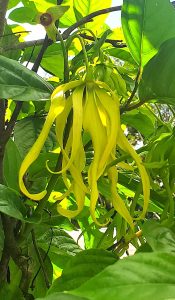
I wanted to write once more about the ylang-ylang tree as I saw some in the area during early fall that spurred my memory. Fragrance in the garden can be subtle or sometimes overwhelming, but always memorable. When I lived in the West Indies, my neighbor had a sizeable ylang-ylang tree that each evening released the famous heavenly fragrance that lilted through the air currents and eventually into my house. The scent of this ephemeral flower is neither subtle nor in-your-face, but rather addictively engages your nose to want more. Not commonly grown in Charlotte County, you may have seen one at a local botanical garden.
The ylang-ylang tree is originally from tropical Asia and is a member of our more well-known custard-apple family. While considered a large tree in ideal growing conditions, the ylang-ylang is relatively fast-growing but rarely gets over thirty feet tall in our area. Featuring a spreading crown with droopy, weak branches, the ylang-ylang is an evergreen tree sporting pinnate leaves with distinctive wavy margins. The flowers are amazing and emerge lime green and change eventually to a golden-yellow color in clusters of four to twelve. Each unusual dangling flower is composed of six, narrow twisted petals which are almost leaf-like in appearance. While the ylang-ylang can flower on and off all year long, the best fragrance is released at night as this chemical scent attracts nocturnal moths and beetles reported to be this tree’s pollinators. Small fruits develop starting green and then turning purple. The seeds can be used for germination, but it will take several months to sprout – patience is required. Blooming can begin in as early as four years.
The ylang-ylang likes a full-sun location best, and it should be planted in at least a zone 10a hardiness zone – 10b would be even better. This cold intolerance will limit the cultivation of ylang-ylang to warmer coastal areas and/or microclimate sites. As hardiness zone 10a can have an average low temperature of thirty degrees F., plan carefully and have some protection available for small specimens. There is a variety of dwarf ylang-ylang which barely gets six-feet tall. This type can be adapted to container culture, but unfortunately its fragrance is not as intense as the species.
All in all, this nose-worthy member of the plant world is remembered for its intensely beautiful scent used by the perfume industry and sampled by passersby. If you have one in Charlotte County, please let me know. If you are in too cold an area to plant your own, simply visit an ylang -ylang tree at your nearest botanical garden. Put this on your bucket list – you will never forget the heavenly fragrance of ylang- ylang! For more information on all types of fragrant plants, or to ask a question, or to ask a question, please visit https://www.facebook.com/CharlotteCountyExtension. You can also call the Master Gardener Volunteer Helpdesk on Mondays, Wednesdays, and Fridays from 1 to 4 pm at 764-4340 for gardening help and insight into their role as an Extension volunteer. Ralph E. Mitchell is the Director/Horticulture Agent for UF/IFAS Extension Charlotte County. He can be reached at 941-764-4344 or ralph.mitchell@charlottecountyfl.gov. Connect with us on social media. Like us on Facebook @CharlotteCountyExtension and follow us on Instagram @ifascharco.
Resources:
PARROTTA, J. A. (2010) Cananga odorata. U.S. Forest Service, Research & Development
Clifford, P. & Kobayashi, K. (2010) Non-invasive Landscape Plants with Fragrant Flowers. UH–CTAHR.
Mahr, S. (2008) Ylang-ylang, Cananga odorata. University of Wisconsin-Madison Extension System – Master Gardener Program.
Landre, C. (2026) South-Florida-Plant-Guide.com – Ylang Ylang Tree – Cananga odorata. https://www.south-florida-plant-guide.com/ylang-ylang-tree.html
 0
0