Of all of the Holiday plants available, Amaryllis bulbs often the first to appear in local garden centers – tempting impulse purchases promising magnificent blooms. These floral blockbusters have flowers up to twelve inches in diameter, and up to six in cluster, and colors in shades of pink, red and white with uses in containers for the Holidays, and then in the landscape next year. More good news – the Amaryllis is a Florida-Friendly Landscaping™ recommended plant!
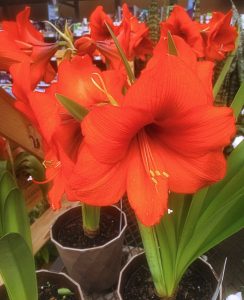
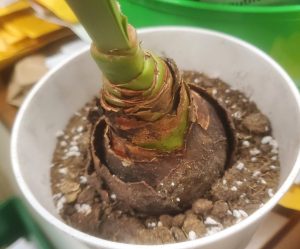
Perhaps the most popular use of Amaryllis at this time of year is as a Holiday container plant. Amaryllis are sometimes available already sprouted and in flower or in ready-to-plant kits. Otherwise, starting from scratch with a bulb is no problem! Select a container which is big enough to allow two inches of space between the bulb and the side of the pot. The pot should have some weight to it as the Amaryllis may get a bit top-heavy as it grows. After covering the drainage holes with pieces of broken pottery, adding a two to three-inch layer of gravel at the bottom of the pot will help add weight to keep light pots from tipping over. Add several inches of potting medium and center the bulb and roots and fill in the soil so that half the bulb is exposed. Water the bulb in well and set the pot in a bright location. Don’t water the bulb again until it begins to sprout. As the bulb begins to sprout, set the pot in a warm location that receives several hours of direct sun. Resume the watering to ensure even moisture without overwatering. As soon as the flowers open, move the plant to a bright, indirect light out of the direct sun. This will allow the flowers to stay at their prime for a longer period of time. Once the flowers have faded and have been removed, move the plant into a light shade area. Water and feed the plant to promote new growth. Containerized plants can be left in the original pots for two or more years, or you could consider adding them to your landscape plant palette.
As a colorful landscape feature, Amaryllis bulbs are planted between September and January in well-drained soil enriched with compost. Site selection is important as light shade conditions are preferred. If they are in too much shade, expect poor flowering, and if in too much sun, the leaves tend to yellow. Clumps of ten plants of the same color look best when planting in the landscape. You can place them in rows or in natural, informal swaths twelve to fifteen inches apart and deep enough so that the neck of the bulb is just showing above the soil. Water the bulbs in well and there after until they are established. Water is important for good development throughout the growing season.
After a number of years, Amaryllis bulbs may become crowded and need separation. Dividing these bulb clusters will refresh the planting bed and encourage additional blooms and bigger, more prolific bulbs. Add organic matter and remove dead bulbs and small offsets to propagate or give away. Mulching will help suppress weeds and retain moisture. Once established, Amaryllis are carefree and drought tolerant making them Florida-Friendly Landscaping™ approved. One word of caution however, amaryllis are known to be toxic to dogs and cats, so practice due diligence in this respect.
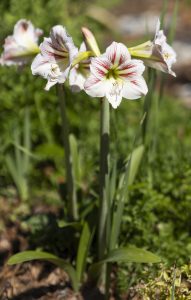
Inside or outside – once the flowers are finished – make sure to remove the stalks to keep the plant from forming seed pods. If you do not complete this simple task, you will likely have fewer flowers the next season – all the energy will go into producing seeds and not flowers. Taking their dead blooms off also make the planting look better and more pleasing to the eye. The foliage must be maintained however so that it can provide sustenance for next season’s flowers. You will find that the strap-like leaves will persist for much of the growing season and then begin to dieback in late summer/fall. The plants over-winter with no leaves, and only the flower buds and stems will be noticed in late winter/early spring as they emerge for another show.
Amaryllis are long-lived perennials that keep giving year after year. The flowers are stunning and are truly worth your investment for a floriferous future! For more information on all types of flowering bulbs, or to ask a question, please visit https://www.facebook.com/CharlotteCountyExtension. You can also call the Master Gardener Volunteer Helpdesk on Mondays, Wednesdays, and Fridays from 1 to 4 pm at 764-4340 for gardening help and insight into their role as an Extension volunteer. Ralph E. Mitchell is the Director/Horticulture Agent for UF/IFAS Extension Charlotte County. He can be reached at 941-764-4344 or ralph.mitchell@charlottecountyfl.gov. Connect with us on social media. Like us on Facebook @CharlotteCountyExtension and follow us on Instagram @ifascharco.
Resources:
Park Brown, S. & Black R. J. (2021) Amaryllis. The University of Florida Extension Service, IFAS.
The Florida-Friendly Landscaping™ Guide to Plant Selection & Landscape Design (2022) The University of Florida Extension Services, IFAS.
American Society for the Prevention of Cruelty to Animals. Toxic and Non-Toxic Plants – Amaryllis – https://www.aspca.org/pet-care/animal-poison-control/toxic-and-non-toxic-plants/amaryllis
 0
0