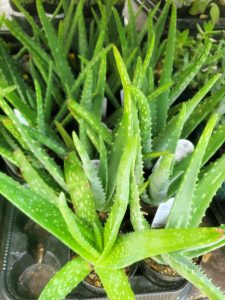
It seems that at one time or another every gardener has had an Aloe plant or two – one of the most commonly kept houseplants. Although there are over four-hundred Aloe species, Aloe vera is perhaps the most popular due to its reputed skin-soothing nature and easy-going growing requirements. You should not have any problems growing this common succulent touted by both experienced and novice gardeners alike.
The Aloe vera is a succulent plant from Africa well adapted to droughty conditions, less-than-wonderful soil, and less-than-talented gardeners. Made up of a rosette of thick fleshy leaves with leaf margins sporting soft serrated teeth, this Aloe can be grown in a pot using well-drained soil suitable for cacti. Place it in full sun area and make sure not to overwater – that also means no excess water sitting in the saucer underneath the pot. Repotting may be required from time to time as the plant grows and expands from sideshoots. Step it up into a pot just a bit bigger than the old one as too big of a container could hold excess moisture and trigger a root rot situation. Although able to grow indoors in a sunny location, the Aloe vera will adapt to less light and then can actually sunburn if suddenly brought outdoors into full sun. As a plant in a pot on the kitchen window, the gelatinous material that comes from the thick leaves has been used to sooth minor burns and sunburns.
As a Florida-Friendly Landscaping™ approved groundcover, and “not a problem species (un-documented)” in regard to invasiveness as per the UF/IFAS Assessment of Non-Native Plants in Florida’s Natural Areas, Aloe vera can be planted outdoors and does well in full sun areas with well-drained soil. Water to establish the plants, but from then on allow them to survive on rainwater alone. Mature plants that can grow upwards to two-feet tall will eventually produce stalks of attractive showy yellow or red flowers in the spring. Original plants will develop side-shoots and gradually fill in an area with additional plants. I started with one small pot installed in a flower bed which spread into a four-foot-wide patch of tightly packed plants – an ornamental and suitable groundcover.
The Aloe vera is a simple plant with multiple uses. They make great gifts, attractive groundcovers and provide potential cooling burn relief when needed. Once you have successfully grown Aloe vera, you may want to make a collection of the commonly available species, cultivars, and hybrids available in the market from petite types to more robust tree-like forms in shades of blue/green with unique variegation. Introduce yourself to gardening with a nice Aloe plant today – your gateway plant to gardening and easy-going growing! For more information on all types of plants for your garden, or to ask a question, you can also call the Master Gardener Volunteer Helpdesk on Mondays, Wednesdays, and Fridays from 1 to 4 pm at 764-4340 for gardening help and insight into their role as an Extension volunteer. Ralph E. Mitchell is the Director/Horticulture Agent for UF/IFAS Extension Charlotte County. He can be reached at 941-764-4344 or ralph.mitchell@charlottecountyfl.gov. Connect with us on social media. Like us on Facebook @CharlotteCountyExtension and follow us on Instagram @ifascharco.
Resources:
Busbee, L., Andrews, F. & Criss, J. (2022) Aloe vera. The University of Florida Extension Services, IFAS – Santa Rosa County.
Gardening Solutions (2025) Aloe vera. The University of Florida Extension Service, IFAS.
The Florida-Friendly Landscaping Guide to Plant Selection & Landscape Design (2022) The University of Florida Extension Services, IFAS.
UF/IFAS Assessment of Non-Native Plants in Florida’s Natural Areas. (2025). Aloe vera. The University of Florida Extension Service, IFAS.
D’Aurora, D. (2024) Aloe, a Hardy Houseplant. The Pennsylvania State University – PennState Extension.
Wikipedia (2025) Aloe vera. https://en.wikipedia.org/wiki/Aloe.
Griffin, R. M., Watson, S. (Medically Reviewed by Begum, J., MD. (2024) Everything About Aloe Vera. WebMd. https://www.webmd.com/diet/supplement-guide-aloe-vera
 1
1