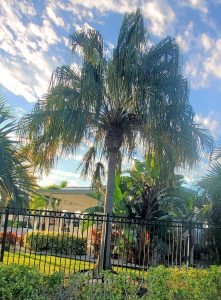
With all the palms to choose from in our area, selecting one to fit your landscape and our climate can be challenging. I would like to recommend an uncommon palm that I think more people should try – the ribbon palm. Stately, exotic, and dependably hardy for our area, the ribbon palm is worth a look.
Originally from Australia, ribbon palms grow really well in our section of Florida. Hardy down to at least twenty degrees F, you do not have to worry about freezes with this palm. Growing upwards to thirty-feet tall, the ribbon palm is very graceful, not only because of its slender build and equally balanced crown, but also due to its unique ribbon-like fronds that give the canopy an almost weeping appearance. The large seven to nine-foot fronds are an attractive dark green with a grayish green underside which split into many segments that look like dangling ribbons. The leaf stem is armed with short teeth, so be careful when handling. The trunk – growing up to ten inches in diameter – is light brown with visible ornamental leaf base scars. The flowering stems are up to nine feet tall and produce many small yellow flowers followed by one-half-inch inedible black fruit.
Plant your ribbon palm in a full sun to part shade area in well-drained soil. Water to get the palm established but consider it drought tolerant thereafter. Small specimens can be kept in containers, but relatively fast growth will have you looking for a permanent site in short order. Use ribbon palms as single specimens, planted in groups of three or along the front of a building. Spotting mature specimens in the landscape can be tricky. Perhaps one of the nicest plantings in our area is in front of the Mid-County Regional Library on Forrest Nelson Boulevard. These have been in for many years and nicely frame one side of the front entrance. There is also another fine planting of ribbon palms just outside a wall in front of a community on Harbor View Road – you cannot miss it.
Exotic palms will benefit from proper nutrition as they grow. We would recommend a granular slow-release fertilizer 8-2-12-4 (or 8-0-12-4) applied in November, February, and May as per label directions. In August use a 0-0-16-6, again as per label directions (or a 0-0-24 “Summer Blend” if you cannot find it). This fertilizer program provides all of the nutrients needed by palms.
Where can you find a ribbon palm in our area? Occasionally they may be found in the local box store garden centers, otherwise, check the local family-run nurseries for a selection of these fine palms. I grew one from seed, but that took several years, and it is now only about four and one-half feet tall.
Ribbon palms simply standout in the crowd and offer a different, but eye-appealing look that few others provide – all tied up in a ribbon! For more information on all types of palms suitable for local area, or to ask a question, you can also call the Master Gardener Volunteer Helpdesk on Mondays, Wednesdays, and Fridays from 1 to 4 pm at 764-4340 for gardening help and insight into their role as an Extension volunteer. Ralph E. Mitchell is the Director/Horticulture Agent for UF/IFAS Extension Charlotte County. He can be reached at 941-764-4344 or ralph.mitchell@charlottecountyfl.gov. Connect with us on social media. Like us on Facebook @CharlotteCountyExtension and follow us on Instagram @ifascharco.
Resources:
McKenzie, M., Andreu, M. G., Friedman, M. H. & Quintana, H. V. (2022) Livistona decipiens, Ribbon Fan Palm. The University of Florida Extension Service, IFAS.
Broschat, T. K. (2021) Fertilization of Field-Grown and Landscape Palms in Florida. The University of Florida Extension Service, IFAS.
 1
1