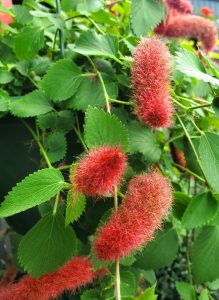
I you have seen a dwarf chenille plant; you can easily understand why the word “chenille” is French for caterpillar. This colorful groundcover plant is covered with up to two-inch-long red to pink fluffy caterpillar-like flowers arrayed above a field of small green serrated foliage. Would dwarf chenille plants be a good groundcover in your landscape? I can safely say “yes”!
Not to be confused with the larger chenille plant, Acalypha hispida, the dwarf chenille plant (Acalypha pendula) is native to Cuba, Haiti, and the Dominican Republic. This plant has been under cultivation for some time as a landscape favorite in Florida and is known to be medium in drought-tolerance, grows best in full sun to part-shade conditions, and slowly grows to less than a foot high and a little more than a foot wide. Install this whimsical plant on eighteen-to-twenty-four-inch centers which will allow room to accommodate future growth. It is interesting to note that only female plants are sold – the male plants do not have attractive flowers. The female inflorescence is in fact made up of clusters of flowers – a spike – formed into what is called a catkin. Technically able to flower year-round, the dwarf chenille plant will bloom best – and with a deeper red color – when given full sun. Too much shade can produce pinkish flowers over time.
While dwarf chenille plants make an outstanding groundcover, they are also preadapted for hanging baskets. The trailing nature of these plants makes them ideal candidates for cascading over hanging basket rims. Dwarf chenille plants have also been used in rock gardens, at the edge of a retaining wall, or simply in a large planter used as a “spiller” trailing over the edge. While the dwarf chenille plant has many other common names such as Strawberry Firetails and Kitten’s Tail, I only found one named cultivar. This one cultivar is called – ‘Summer Love’ – which is a prolific producer of bright red two-inch flowers.
Although considered a groundcover, please do not walk on dwarf chenille like turf. Keep dwarf chenille plants in designated planting beds and not open to public trampling. Also, as this plant is in the spurge family, the sap can cause skin irritation – handle with care.
Dwarf chenille plants are easily propagated by cuttings. Avoid growing these plants from seed – it not only takes longer but will result in some male plants with no showy flowers.
The dwarf chenille is a Florida-Friendly Landscaping™ approved plant suitable for any local landscape. You will see how flowers do indeed look like fuzzy red caterpillars – a look that is endearing and sure to make you a fan for life!. For more information on all types of landscape ornamentals, or to ask a question, you can also call the Master Gardener Volunteer Helpdesk on Mondays, Wednesdays, and Fridays from 1 to 4 pm at 764-4340 for gardening help and insight into their role as an Extension volunteer. Ralph E. Mitchell is the Director/Horticulture Agent for UF/IFAS Extension Charlotte County. He can be reached at 941-764-4344 or ralph.mitchell@charlottecountyfl.gov. Connect with us on social media. Like us on Facebook @CharlotteCountyExtension and follow us on Instagram @ifascharco.
Resources:
Gilman, E. F., Klein, R. W. & Hansen, G. (2017) Acalypha pendula: Dwarf Chenille Plant. The University of Florida Extension Service, IFAS.
The Florida-Friendly Landscaping Guide to Plant Selection & Landscape Design (2022) The University of Florida Extension Services, IFAS.
Landre, C. (2025) Dwarf Chenille – Acalypha pendula. South-Florida-Plant-Guide.com.
Margarete’s Garden (2009) Chenille Plant. https://margaretsgarden.wordpress.com/2009/10/10/chenille-plant/ .
Acalypha pendula (2025) Wikipedia. https://en.wikipedia.org/wiki/Acalypha_pendula .
Acalypha pendula (2025) Almost Eden. https://www.almostedenplants.com/shopping/products/680-trailing-chenille-plant-strawberry-firetails-red-hot-cats-tail-kittens-tail-strawberry-firetails-dwarf-chenille-plant/ .
Mahr, S. (2025) Chenille Plant, Acalypha hispida. Division of Extension – University of Wisconsin.
Wikipedia (2025) Catkin. https://en.wikipedia.org/wiki/Catkin .
Silk, S. (2025) The Secret to Great Garden Containers: Thrillers, Fillers, and Spillers. Fine Gardening – Issue
 1
1