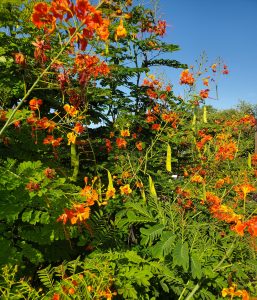
As gardeners well know, some plants have so many common names that it becomes a bit confusing to know what plant we are talking about. Take the Pride of Barbados or Caesalpinia pulcherrima, for example. In addition to the Pride of Barbados, this plant is also called the Peacock flower, Dwarf Poinciana, Mexican Bird of Paradise, Barbados flower-fence, and the Red Bird of Paradise. A member of the legume family, the Pride of Barbados is a small evergreen to deciduous tree that produces outstanding yellow, orange, and red flowers. Not to be confused with the Royal Poinciana, the Pride of Barbados is a much smaller popular landscape choice.
The Pride of Barbados is originally found in the West Indies and other parts of tropical America. Growing up to fifteen feet tall with fern-like leaves and some sharp spines, the Pride of Barbados is best known for its two-to-three-inch flowers. The flowers are a combination of five wavy red and yellow-orange petals and ten red stamens that develop at the end of branches. There is an all-yellow cultivar called ‘Lutea’, and a pink one called ‘Compton’ – just for a change of color. The flowers are followed by flat brown bean pods. The toxic seeds produced can be planted to grow new plants and germinate best if they are soaked in hot water or nicked before planting.
Depending on our weather (frosts) the flowers may appear year-round or just in the late summer and early fall. Even if a freeze kills the plant back to the ground, it will grow back and flower as warm weather returns. The Pride of Barbados does best in a full-sun, well-drained area – poor drainage may encourage mushroom root rot. Once established, this plant is drought tolerant, medium in salt-tolerance, and survives in poor soil in a wide range of pH conditions.
The Pride of Barbados can make a great informal screen or hedge as well as a single specimen plant. In addition, beyond the attractiveness of the blooms, butterflies and hummingbirds also enjoy the flowers. This woody plant can also be pruned into a small tree and should do well as a small space accent planting. Sometimes the branches get out of bounds and grow too long. You can severely prune the plant in winter or very early spring which will result in a more compact plant.
Overall, this flowering woody plant is a recommended Florida-Friendly Landscaping™ recommended plant with great characteristics and sustainability. Although some seeds that drop can sprout and provide volunteer plants to share with friends, the Pride of Barbados is categorized by the UF/IFAS Assessment of Non-Native Plants in Florida’s Natural Areas, as “Not a problem species” as far as invasiveness is concerned.
I have seen several Pride of Barbados plants growing well in surrounding Charlotte County landscapes including our own Demonstration Garden on Harbor View Road. On occasion, this plant is available at local garden centers and nurseries but are often considered a passalong plant shared from friend to friend. If you see one, you will want one! For more information on all types of flowering woody plants, or to ask a question, you can also call the Master Gardener Volunteer Helpdesk on Mondays, Wednesdays, and Fridays from 1 to 4 pm at 764-4340 for gardening help and insight into their role as an Extension volunteer. Ralph E. Mitchell is the Director/Horticulture Agent for UF/IFAS Extension Charlotte County. He can be reached at 941-764-4344 or ralph.mitchell@charlottecountyfl.gov. Connect with us on social media. Like us on Facebook @CharlotteCountyExtension and follow us on Instagram @ifascharco.
Resources:
Gilman, E. F. & Watson, D. G. (1993) Caesalpinia pulcherrima, Dwarf Poinciana. The University of Florida Extension Services, IFAS.
The Florida-Friendly Landscaping™ Guide to Plant Selection & Landscape Design (2022) The University of Florida Extension Services, IFAS.
UF/IFAS Assessment of Non-Native Plants in Florida’s Natural Areas. (2025). The University of Florida Extension Service, IFAS.
Rodriguez, D. (2006) “Pride of Barbados” A Great Heat Loving Plant and Future Texas SuperStar. Texas A & M University System, Texas Cooperative Extension of Bexar County.
Schneider, Y. & Reyes, A. (2024) Don’t Give Up on Pride of Barbados Plants. Texas A & M University System, Texas Cooperative Extension of Travis County.
Tops Tropicals (2025) Caesalpinia pulcherrima ‘Compton’ (Pride of Barbados). https://toptropicals.com/catalog/uid/caesalpinia_pink.htm?srsltid=AfmBOoqRgKYADxWsYiJgP3cvwb8by-za-VznpBWZ5l5H8OdsO34Uqlbf .
Tops Tropicals (2025), Caesalpinia pulcherrima ‘Lutea'(Pride of Barbados). https://toptropicals.com/catalog/uid/caesalpinia_lutea.htm .
Landre, C. (2025) Dwarf Poinciana Tree. South-Florida-Plant-Guide.com.
North Carolina Extension Gardener – Plant Toolbox (2025) Caesalpinia pulcherrima. NC State University.
 1
1