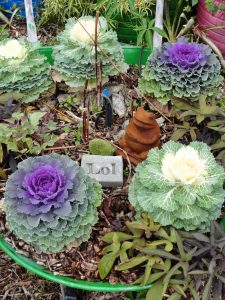
It may seem really early to be thinking about the fall flower garden and bedding plants, but once you are in the middle of that season, it is often too late to act. Planning ahead, please consider growing one really tough and ornamental type of annual suitable to thrive in our “cool season” and bear florescent foliage – flowering kale or cabbage. Very similar to our normal kale and cabbage, these plants produce colorful leaves that give them a flower-like appearance.
First appearing in seed catalogs in 1936, ornamental cabbage and flowering kale have been a welcome addition to brighten up the winter garden. To begin, flowering/ornamental cabbage and kale are all considered kale. To differentiate the two, flowering kale are those plants with curly or feathery foliage. Flowering cabbage on the other hand has flat leaves arranged in an attractive colorful rosette. Keep in mind that these plants don’t produce flashy flowers, just colorful leaves. The true flowers of these Cruciferous plants are non-descript and unattractive. Leaf colors range from red and green, purplish, or white and green. In temperatures below sixty degrees Fahrenheit, the color actually intensifies.
While the ornamental cabbage and flowering kale can be easily started from seed, it is just as easy to purchase started plants available from most garden centers in season. If you try starting these from seed, allow two and one-half to three months from seed to colorful transplant – plan ahead. Select a full sunny area to plant and incorporate three to four inches of organic matter and about two-pounds of a slow-release general purpose granular fertilizer worked into each one-hundred square feet of bed space. Set the transplants about eighteen inches apart for mass plantings. In addition to use as a bedding plant, ornamental cabbage and flowering kale also do well in pots, hanging baskets, and larger planters.
Selecting your favorite cultivars may take some time as you explore the wide variety available. Within the realm of ornamental cabbages, look at the various color series such as ‘Tokyo’, ‘Osaka’, and ‘Pigeon’. Flowering kale is broken down into fringed-leaved cultivars such as ‘Sparrow’, ‘Chidori’, and ‘Kamone’ and the feather-leaved types such as ‘Coral Queen’, ‘Coral Prince’, ‘Red Peacock’ and ‘White Peacock’. There are even long-stemmed types grown to be used as cut flowers such as ‘Sunrise’, ‘Sunset’ and ‘Crane’. Seeds for these cultivars can be found on-line and from seed catalogs.
Although these ornamentals are edible, they are pretty bitter and are best just used as a dish garnish instead. If you have not seen ornamental cabbage or kale, check out local garden centers this coming fall, or grow your own from scratch. They take the cold and bring unique color to your flower beds like no other plants. For more information on colorful seasonal annuals, or to ask a question, you can also call the Master Gardener Volunteer Helpdesk on Mondays, Wednesdays, and Fridays from 1 to 4 pm at 764-4340 for gardening help and insight into their role as an Extension volunteer. Ralph E. Mitchell is the Director/Horticulture Agent for UF/IFAS Extension Charlotte County. He can be reached at 941-764-4344 or ralph.mitchell@charlottecountyfl.gov. Connect with us on social media. Like us on Facebook @CharlotteCountyExtension and follow us on Instagram @ifascharco.
Resources:
Gilman, E. F., Klein, R. W. & G. Hansen (2022) Brassica oleracea Flowering Kale, Ornamental Cabbage. The University of Florida Extension Service, IFAS.
Gilman, E. F. (2011) Brassica oleracea ‘White Peacock’ White Peacock Flowering Kale. The University of Florida Extension Service, IFAS.
Winter, N. (2007) Expanding winter selections by planting cabbage, kale. Central Mississippi Research & Extension Center, MSU.
(2004) Greenhouse Crops and Floriculture – Flowering Cabbage and Kale. The University of Massachusetts Extension Service.
Klingaman, G. (2000) Plant of the Week: Ornamental Kale, Flowering Cabbage. University of Arkansas Cooperative Extension Service.
Copley, Ochota, K., McDaniel, T. & Shaw C. (2025) Brassica Oleracea (Ornamental Cabbage and Kale). N.C. Cooperative Extension.
Mahr, S. (2025) Ornamental Cabbage and Kale, Brassica oleracea. Wisconsin Horticulture Division of Extension.
 1
1