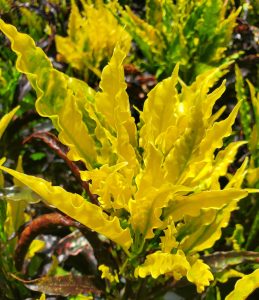
If you heard the name ‘Sloppy Painter’ or ‘Yellow Icing’ would you know what type of plant it was? How about ‘Gold Star’ or ‘Fishbone’? These are all croton cultivars. Cultivars are cultivated plants that have selected for certain attributes that can be preserved moving forward by propagation methods such as cuttings, grafting, tissue culture, etc. Plant cultivar names are so intriguing as they capitalize on a feature or characteristic of the plant that is easy to remember and often colorfully blunt. Two interesting croton cultivars I saw recently were ‘Piecrust’ and ‘Banana’. Not necessarily uncommon, but interesting, colorful, and collectable by croton aficionados.
No other ornamental foliage plant quite meets the definition of “tropical” like a croton does. Crotons bring bright colors, interesting leaf shapes and variations that catch the eye and enhance curb appeal. You see crotons for sale at every garden center as they tend to be a “must have” and sell themselves with stunning colors. Hardy in zones 9b through 11, crotons can grow in our county but may need protection during cold snaps. Useful both inside as houseplants and outside in the landscape, crotons are for everyone.
Originally from India, Malaysia and several South Pacific Islands, crotons were selected for leaf colors ranging from red to orange to yellow to green with all types of variegation and color splashes. And if the color was not enough, the shapes and sizes of the leaves are spectacular from thin and narrow and almost grass blade-like to wide and broad. Various twists and turns add another dimension as croton leaves are often cork-screwed in shape or have other wild contorted attributes. Crotons are used outdoors in mass plantings, in containers, and as foundation plantings. Planted outdoors in the landscape, they can grow up to six feet tall and six-feet wide. Planting crotons three feet apart on center is the suggested distance between plants. If growing in containers, use a four-to-seven-gallon pot to develop a nice plant. Those grown in full sun will have the best color with some exceptions – too much light will actually cause red and orange leaf colors to fade. A site with shifting sun exposure may be ideal. Croton leaves begin green and then color-up as they mature if they get enough light. For indoor use, crotons have less light but can still maintain their color for months.
Another use of crotons is the floral quality of these plants. With such a variety in color and shape, cut croton parts make excellent subjects for vases and can be used in many flower arrangements. Single leaves can be used by simply twisting them off from the stem. Small stems should be removed with pruners. Keep in mind that the sap can stain and please note that crotons possess irritating and poisonous qualities in consideration to children and pets.
If you want to make more crotons from your original, propagation is a fairly easy chore. Tip cuttings of three to six inches each with three to five leaves stuck in a sterile potting medium will root in about four weeks.
To pick a favorite croton variety is a difficult task as all have some type of desirable feature. The cultivars that I mentioned above are unique and – as with many other cultivars – really capture a description of what they look like. The croton cultivar ‘Piecrust’ for instance has new mottled yellow-green leaves which mature in time to become maroon, red, and bronze narrow foliage mixed with green. The noteworthy part of this croton is that the edge of each leaf is wavy and scalloped giving the appearance of a classic piecrust. ‘Banana’ is another cultivar named for its long narrow leaves with rounded ends that grow with a slight twist. The leaves are bright yellow and green with spots and a yellow line along the midvein of each leaf – very banana-like in appearance.
There should be at least one croton in every local landscape. I have one that must be at least twenty-five years old. Tried, true and dependable, crotons are for everyone! For more information on all types of colorful shrubs suitable for our area, or to ask a question, you can also call the Master Gardener Volunteer Helpdesk on Mondays, Wednesdays, and Fridays from 1 to 4 pm at 764-4340 for gardening help and insight into their role as an Extension volunteer. Ralph E. Mitchell is the Director/Horticulture Agent for UF/IFAS Extension Charlotte County. He can be reached at 941-764-4344 or ralph.mitchell@charlottecountyfl.gov. Connect with us on social media. Like us on Facebook @CharlotteCountyExtension and follow us on Instagram @ifascharco.
Resources:
The Croton Society – ONLINE REFERENCE RESOURCE WITH HI-RES PHOTOS (2009) https://www.palmpedia.net/wiki/THE_CROTON_SOCIETY.
Stamps, R. H. & Osborne, L. S. (2009) Croton Production and Use. The University of Florida Extension Service, IFAS.
Gilman, E. F. (1999) Codiaeum variegatum. The University of Florida Extension Service, IFAS.
Yasalonis, A. (2025) Colorful and Carefree: Growing Crotons in Your Central Florida Yard. The University of Florida Extension Service, IFAS – Polk County
Landre, C. (2025) Crotons – Codiaeum variegatum. https://www.south-florida-plant-guide.com/crotons.html
UF/IFAS Gardening Solutions – Crotons. (2024) The University of Florida Extension Service, IFAS.
Mahr, S. Croton, Codiaeum variegatum. University of Wisconsin – Division of Extension.
Cultivar – Wikipedia. (2025) https://en.wikipedia.org/wiki/Cultivar.
 0
0