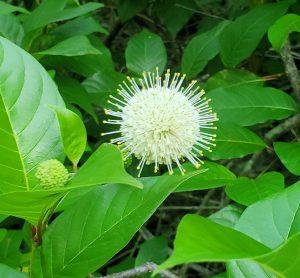
To see a buttonbush flower and get a whiff of its scent is an experience. The flowers – also called pincushion flower – looks like an alien satellite – perfectly round with numerous spikey projections surrounding it with a corona of yellow anthers. The fragrant flower scent reminds me of honey and is sweet and attractive to many pollinators. Not a plant for just anywhere in your landscape, its niche is on the fringe.
The buttonbush is a really interesting native plant that is in flower right now where it grows best – on the fringe. By that I mean that it grows best on the fringe of ponds and wetlands that may be part of your landscape. I also like to consider this plant on the fringe as it is best kept away from your home as it is very flammable. Despite this, the button bush is a common and desirable plant that you may already naturally have in undeveloped parts of your property.
Now, while the buttonbush is an approved Florida-Friendly Landscaping™ plant, it is a perfect example of “Right Plant, Right Place”. Being a wetland plant, the buttonbush is not drought tolerant. Also – as it is very flammable – it should be kept at least thirty feet away from buildings in our wildfire prone region as a commonsense safety measure. Lastly, this shrub is toxic to people and domesticated animals. On the flipside, the buttonbush is an important plant for wildlife in consideration of food and cover. Butterflies, bees, and hummingbirds go crazy over the rich flowers where they supply pollination in return for nectar and pollen.
Consider the buttonbush for bog-like conditions best found within freshwater wetlands, adjacent to stormwater ponds, and drainage areas. This woody shrub wants wet soil and full sun or partial shade in an almost understory location. They have low to no salt-tolerance – and in a typical landscape situation – will require supplemental irrigation for best growth. Growing upwards to ten foot tall and eight-feet wide, pruning can help keep this large shrub/small tree in-bounds. The buttonbush will flower throughout the summer months with substantial – up to one and one-half inch – round flowers. Expect the buttonbush to be around for a good long time as specimens can survive for decades. Unless naturally growing in your landscape, sources for buttonbush are generally going to be limited to local or regional native nurseries.
The buttonbush is a unique native plant suitable for some sites in our region. Keep in mind its freshwater needs and capacity to do well on the fringe – perhaps a candidate for a difficult moist place in your landscape not suitable to any other woody plant. Once you have located a buttonbush, take a deep whiff of the aroma, and admire the floral display – you will be an instant fan! For more information on all types of native plants suitable for planting in our area, or to ask a question, you can also call the Master Gardener Volunteer Helpdesk on Mondays, Wednesdays, and Fridays from 1 to 4 pm at 764-4340 for gardening help and insight into their role as an Extension volunteer Ralph E. Mitchell is the Director/Horticulture Agent for UF/IFAS Extension Charlotte County. He can be reached at 941-764-4344 or ralph.mitchell@charlottecountyfl.gov. Connect with us on social media. Like us on Facebook @CharlotteCountyExtension and follow us on Instagram @ifascharco.
Resources:
Brown, S. H. & Cooprider, K. (2011) Cephalanthus occidentalis. The University of Florida Extension Services, IFAS – Lee County
The Florida-Friendly Landscaping Guide to Plant Selection & Landscape Design (2022) The University of Florida Extension Services, IFAS.
Gilman, E. F. Klein R. W. & Hansen G. (2023) Cephalanthus occidentalis – Buttonbush. The University of Florida Extension Services, IFAS.
UF/IFAS Gardening Solutions (2024) Buttonbush. The University of Florida Extension Services, IFAS.
 0
0