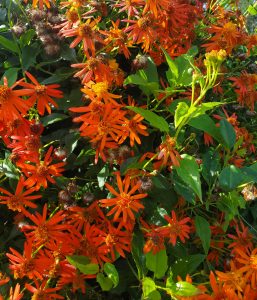
Flowering vines are always stunning as they climb up a fence or cover a pergola with a display that demands attention and compliments. There are many to choose from, but one standout is the Mexican flame vine. With daisy-like, orange-red flowers highlighted with a golden eye, this vine is a quick grower and does not disappoint both the new and experienced gardener.
Right upfront please keep in mind that the Mexican flame vine is aggressive. Fortunately, it has not reached the level of being categorized as invasive by either the Florida Invasive Species Council, or by the UF/IFAS Assessment of Non-Native Plants in Florida’s Natural Areas, where they state it is “Not considered a problem species at this time”. So, moving forward, be on notice that this flowering vine is a quick grower. It has been used to rapidly grow up a course palm trunk, to quickly cover a fence or to add features to a trellis or lattice – even a fence post. On a different level, it has been used as a sprawling shrub/groundcover or even grown along a wall where it will cascade over the edge – hanging baskets can be used as well for an attractive display. The Mexican flame vine is a “twining” vine. Twining vines climb host structures by spiraling around vertical uprights.
Originally from Mexico, the Mexican flame vine is a perennial plant also found on down through Central America and into northern South America. Growing up to twelve feet tall and six-feet wide, this evergreen vine is hardy in our area and does best in a full sun to part-shade light exposure. With moderate drought tolerance and no salt tolerance, the Mexican flame vine is otherwise not fussy about soil conditions and grows so quickly that it is used as an annual in areas where a freeze takes it out at the end of the season.
The one-inch-wide orange to orange-red flowers will occur throughout the year with most showing up from spring through fall. The Mexican flame vine does have the habit of producing most of its flowers on the top part of the plant. This can be managed a bit by heading the top growth back to force new growth and flowers to develop lower on the vine. While the Mexican flame vine flower is generally orange red in color, one named cultivar called ‘Sao Paulo’ has deep orange, brick red blooms. This vine is easily propagated by cuttings and seeds. Another good feature of the Mexican flame vine is that butterflies, hummingbirds, and bees are very attracted to its daisy-like flowers.
Take advantage of this quick-growing flowering vine to fill in a bare upright spot that needs some color and character. The Mexican flame vine is sure to satisfy and light an inspirational flowery blaze in your landscape – to the envy of your neighborhood! For more information on all types of flowering vines suitable for our area, or to ask a question, you can also call the Master Gardener Volunteer Helpdesk on Mondays, Wednesdays, and Fridays from 1 to 4 pm at 764-4340 for gardening help and insight into their role as an Extension volunteer. Ralph E. Mitchell is the Director/Horticulture Agent for UF/IFAS Extension Charlotte County. He can be reached at 941-764-4344 or ralph.mitchell@charlottecountyfl.gov. Connect with us on social media. Like us on Facebook @CharlotteCountyExtension and follow us on Instagram @ifascharco.
Resources:
Gilman, E. F. Klein, R. W. & Hansen, G. (2023) Senecio confusus – Mexican Flame Vine. The University of Florida Extension Service.
UF/IFAS Assessment of Non-Native Plants in Florida’s Natural Areas. (2025). The University of Florida Extension Service, IFAS.
Pseudogynoxys chenopodioides (2025) https://en.wikipedia.org/wiki/Pseudogynoxys_chenopodioides .
Brown, S. P. & Knox, G. W. (2016) Flowering Vines for Florida. The University of Florida Extension Service.
Missouri Botanical Garden (2025) Pseudogynoxys chenopodioides. https://www.missouribotanicalgarden.org/PlantFinder/PlantFinderDetails.aspx?taxonid=277491&isprofile=0&.
Florida Invasive Species Council (2023) Plant List. University Of Georgia – Center for Invasive Species And Ecosystem Health.
North Carolina Extension Gardener Plant Toolbox (2025) Pseudogynoxys chenopodioides. NC State Extension.
Walsh, R.S. (2025) In the Garden: Mexican flame vine identified by its leaves (2025) flowers SANIBEL-CAPTIVA – Island Reporter, Islander and Current.
 0
0