I remember growing sunflowers as a child and was amazed at how big they got in such a short period of time – it was a fun-flower to me – both novel and colossal. Sunflowers are in the same family as marigolds and lettuce, and have been used in one form or another by humans since 3000 B. C. The Genus of sunflowers is Helianthus. The meaning of this word comes from the Greek for ‘sun’ which is ‘helios’ and ‘flower’ which is ‘anthus’ – a perfect name in any language! Sunflowers are native North American flowers, and whether you know this plant as an ornamental, bird seed, or even a tasty snack food, the common sunflower has been a real benefit to gardeners and the world in terms of eye appeal and food.
The sunflower is a true native North American flower with many uses. Sunflowers were used as a food source by Native American populations. The seed was ground into flour to make protein-rich breads and mixed with other food. Spanish explorers brought the sunflower back to the Old World in the early 1500’s where it was a popular ornamental . History notes that in the late 1900’s and early 20th century, Russia took to growing sunflowers commercially for both oil and food production. The birdseed industry credits sunflowers with an abundant harvest of a songbird’s favorite kernels. Sunflower seeds are also a popular human snack food – check any convenience store. Recently, the sunflower has also gained popularity as a cut flower with florists. The gardener has enjoyed this large flower as a staple annual ornamental in the flower bed or incorporated into many vegetable gardens.
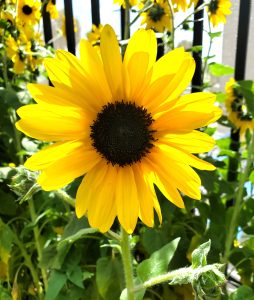
Botanically speaking, the sunflower has a blossom made up of a cluster of flowers (disk flowers) that form the head. The outer petals of the head make up the ray flower portion of the flower. The sunflower is part of the Compositae family which, as mentioned above, includes not only lettuce and
marigolds, but also dandelions, asters, chrysanthemums, and thistles. While many of the old common types are well over five feet tall with yellow blooms, sunflower breeders have produced an abundance of sizes and new colors ranging from orange, gold, lemon yellow, bronze, amber, red, and white. Some types have multiple smaller heads suitable for floral arrangements, while others are now available with double flowers. I have grown many different types in the past and liked them all. UF/IFAS did conduct sunflower trials in 2003 which provided information on characteristics and qualities on many cultivars – please see here – https://hort.ifas.ufl.edu/floriculture/cut_flower/cultivars_alphabetical.shtml – 2003 Sunflower Trial Cultivars.
Sunflowers are drought tolerant, do best in full sun, and are not fussy about soil conditions. They are commonly used in the landscape for borders, as temporary screening, or in containers. They grow best when direct seeded, so plan before you plant – seed in late winter to early spring for flowers in mid-spring in our area. By late spring to early-summer, the heat can cause a quick decline in sunflowers, so take a break until fall for a repeat flower display. Follow the seed packet directions for spacing and ultimate distance between plants.
If seeds are saved for birds or your own consumption, cut the mature seedhead off with a portion of the stem remaining and let it dry under cover hanging in a paper bag for a several weeks. Growing a sunflower patch with children is a great introduction to gardening with quick results and generational sharing of this healthy hobby. Sunflowers can make quite an impact, even temporarily, in a landscape by providing color and a fun gardening activity for both adults and youth – they are the best fun-flower I know! For more information on all types of annual flowers suitable for our area, and when to plant them, or to ask a question, you can also call the Master Gardener Volunteer Helpdesk on Mondays, Wednesdays, and Fridays from 1 to 4 pm at 764-4340 for gardening help and insight into their role as an Extension volunteer. Ralph E. Mitchell is the Director/Horticulture Agent for UF/IFAS Extension Charlotte County. He can be reached at 941-764-4344 or ralph.mitchell@charlottecountyfl.gov. Connect with us on social media. Like us on Facebook @CharlotteCountyExtension and follow us on Instagram @ifascharco.
Resources:
Gilman, E. F. Klein, R. W. & Hansen, G. (2023) Helianthus annuus ‘Sonja’ Sonja Sunflower. The University of Florida Extension Service, IFAS
Schoellhorn, R., Emino, E., E. Alvarez, & Frank, M. (2015) Warm Climate Production Guidelines for Specialty Cut Flowers: Sunflower. The University of Florida Extension Service, IFAS
2003 Sunflower Trials Cultivars – https://hort.ifas.ufl.edu/floriculture/cut_flower/cultivars_alphabetical.shtml
Sunflowers – Gardening Solutions http://gardeningsolutions.ifas.ufl.edu/plants/ornamentals/sunflowers.html
Helianthus – https://en.wikipedia.org/wiki/Helianthus
Barnes, M. (2024) Around the Countryside Sunflowers – A Native Plant with an Amazing History. Clemson University
Myers, R. L. & Minor, H. C. (1993) Sunflower: An American Native. University of Missouri Extension Service.
 2
2