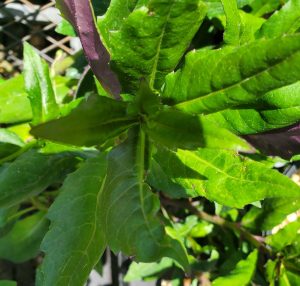
While I do enjoy eating spinach, I have also grown to love certain spinach substitutes that can take the place of spinach in our subtropical climate which includes vegetable amaranth and Malabar spinach. There is another spinach substitute called Okinawa spinach. While Okinawa spinach may have been an outlier for some time, it is becoming mainstream. I saw some plants for sale at a box store garden center just the other day and was pleasantly surprised by its appearance. Both ornamental and nourishing, Okinawa spinach is an edible ornamental.
Okinawa spinach can be found in Japan as well as parts of India to Nepal, Myanmar, and southern China. A member of the chrysanthemum family, there are two species of Okinawa spinach – one with all green leaves, and the other – Gynura bicolor – which has green and purple foliage. Growing upwards to two to three feet tall, Okinawa spinach grows more like a low to medium-height perennial groundcover. This plant does produce flowers, but no seeds develop, so it is best just to prune the flowers off to redirect the energy into the leaves. Quick to grow, but not overly overpowering, plant individual Okinawa spinach transplants eighteen to twenty-four inches apart for best results. Pick the leaves and the top four to six inches of stem when harvesting. True confession – while I have eaten vegetable amaranth and Malabar spinach, I have not tried Okinawa spinach. It is my understanding that while the younger leaves can be eaten raw, the leaves and shoots are a bit mucilaginous and reminiscent of okra. Include Okinawa spinach cooked in stir frying, soups, and quiches – a nutritious addition to these popular foods.
To grow more Okinawa spinach simply use stem cuttings to propagate additional plants. They root so easily that you can stick the cuttings directly into the garden bed soil – share a few with friends and neighbors as well.
As an ornamental edible, you can include the green and purple foliage in landscape beds where the color appeal and edibility are on display. Okinawa spinach also makes a great container plant – by itself or in combination with flowering annuals or perennials – this will be beautiful and a conversation starter.
Okinawa spinach takes its place as a warm-season vegetable that is available when no other true spinach can be grown. From the fringe to the front stage, keep Okinawa spinach in mind for a meal and eye appeal! For more information on all types of edible ornamentals, or to ask a question, you can also call the Master Gardener Volunteer Helpdesk on Mondays, Wednesdays, and Fridays from 1 to 4 pm at 764-4340 for gardening help and insight into their role as an Extension volunteer. Ralph E. Mitchell is the Director/Horticulture Agent for UF/IFAS Extension Charlotte County. He can be reached at 941-764-4344 or ralph.mitchell@charlottecountyfl.gov. Connect with us on social media. Like us on Facebook @CharlotteCountyExtension and follow us on Instagram @ifascharco.
Resources:
UF/IFAS Gardening Solutions (2024) Tropical Spinaches. The University of Florida Extension Service/IFAS.
Wikipedia (2025 ) Gynura bicolor – https://en.wikipedia.org/wiki/Gynura_bicolor.
COMMON TROPICAL FOOD FOREST PLANTS OF SOUTH FLORIDA- OKINAWA SPINACH (2025) FIU Institute of Environment. https://environment.fiu.edu/what-we-study/projects/food-forest-initiative/_assets/food-forest-guide.pdf
 0
0