Introduction
Florida growers are facing a new challenge with the emergence of the two-spot cotton leafhopper (Amrasca biguttula), also known as the cotton jassid. This invasive pest, first detected in Florida in late 2024, has spread rapidly across the cotton-growing region of the southeastern United States. Within Florida, it has been found on multiple host plants, including cotton, okra, eggplant, tomato, and hibiscus, from Miami-Dade County to Santa Rosa County.
Identification
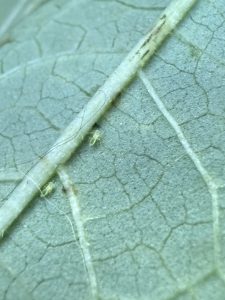
The two-spot cotton leafhoppers are small, pale green with yellowish-green wings (figure 1). It can be distinguished from most native species in North America by the pair of black spots on the head and black spots at the tip of each wing.
Distribution
Native to the Indian subcontinent, the two-spot cotton leafhopper is a highly polyphagous pest that feeds on cotton, okra, eggplant, tomato and ornamentals such as hibiscus. In its home range, it is a significant economic pest of cotton and okra, responsible for up to 50% yield loss in cotton and up 70% in Okra. In July 2025, the pest was confirmed on cotton in Gilchrist County, Florida, and has since been detected in more than 90 counties across Florida, Georgia, Alabama and South Carolina. Its rapid spread highlights its ability to thrive in warm climates and adapt to new cropping systems.
Pest Damage
Both adults and nymphs feed on the undersides of leaves, piercing plant tissue and sucking sap, which leads to a characteristic injury called hopperburn. Symptoms of hopperburn include yellowing, reddening, browning, curling, and eventual defoliation. In cotton, heavy infestations can result in the shedding of squares, flowers, and young bolls. On okra (figure 2) and eggplant, it can stunt growth and drastically reduce yield and market quality. With populations capable of building quickly, the potential for economic loss in Florida’s cotton and vegetable industries is significant.

Management
Researchers and extension specialists are actively studying management strategies for this new pest. For now, growers are advised to:
- Scout regularly: In cotton, inspect the undersides of leaves from the top 5 nodes of the plant from a minimum of 5 plants or 25 leaves in multiple locations across the field.
- Use thresholds: The current treatment threshold in cotton is 1–2 nymphs per leaf are present, particularly when hopperburn symptoms are visible.
- Apply effective insecticides:
- Cotton: Field trials across the Southeast suggest that Bidrin (dicrotophos, 6 oz/A IRAC group 1B), Centric (thiamethoxam, IRAC group 4A), and Transform (sulfoxaflor, IRAC group 4C) provide consistent control, while bifenthrin (IRAC group 3A) has not been effective.
- Okra: systemic insecticides such as thiamethoxam, imidacloprid, and acetamiprid (all three belonging to IRAC group 4A) have shown good results in other regions, though localized trials are ongoing.
- Pyrethroids: Mainly Bifenthrin and likely others do not provide acceptable control in any crop tested.
Conclusion
The arrival of the two-spotted cotton leafhopper underscores the importance of vigilance and rapid response to invasive species. UF/IFAS and FDACS are continuing to monitor its spread and conduct trials to refine management recommendations for Florida growers. While most of the impacts of the two-spot cotton leaf hopper have been on commercial cotton, researchers anticipate this pest to become a bigger issue in vegetable crops (both commercial and backyard) this winter and fall in the Suwannee Valley. In the meantime, early detection and timely intervention are key to minimizing crop damage. Growers are encouraged to stay in close contact with their local extension agents for the latest updates on pest management strategies.
Authors
Derrick R. Conover, UF/IFAS Extension, Columbia County
Dr. Isaac Esquivel, UF Assistant Professor, Entomology
Raymond Balaguer, UF/IFAS Extension, Suwannee Valley
Dr. Kevin Korus, UF/IFAS Extension, Alachua County
More Information
Please see the following link from the Florida Department of Agriculture and Consumer Services…
https://ccmedia.fdacs.gov/content/download/117692/file/two-spot-cotton-leaf-hopper-pest-alert.pdf
 3
3