 Welcome back to Nutrition Stories, our popular series exploring hot topics in nutrition and dietetics. Today’s guest is Genevieve Hamlin, a graduate of the UF Didactic Program in Dietetics (DPD) in the Food Science and Human Nutrition (FSHN) Department at the University of Florida. In this article, Genevieve discusses why busy college students can struggle with mindless or distracted eating and how mindfulness-based interventions (MBIs) can encourage mindful eating. In addition, she shares tips on how to incorporate MBIs into your daily life.
Genevieve:
As a college student, life can feel like a never-ending juggling act. Between classes, assignments, part-time jobs, and social commitments, finding time to eat—let alone to eat slowly and intentionally—can seem impossible. How often do you find yourself scarfing down a meal while scrolling through your phone, watching Netflix, or cramming for an exam? If this sounds familiar, you’re not alone. Many people struggle with mindless or distracted eating, a habit that can lead to overeating, poor digestion, and a disconnect from the joy of food.1
Research suggests that time constraints, financial stress, and limited access to nutritious food can make healthful eating especially difficult for students.2 These systemic barriers don’t just affect food choices—they also create conditions in which eating quickly and unconsciously becomes the norm. What if I told you that there was a completely free, manageable approach that can not only help you feel more satiated and connected to the food that you eat, but also improve your ability to cope with stress? This is where mindfulness-based interventions come in.
Mindless Eating in College Life
 Mindless eating is exactly what it sounds like—eating without paying attention. It describes the moments when you find yourself eating a meal while dealing with distractors like screens, work, or stress. You might grab a quick bite between classes, eat dinner while catching up on your favorite show, or snack on chips while studying.
The problem? When you’re not paying attention to your food, you’re more likely to overeat, miss out on the pleasure of eating, and even experience digestive discomfort. Studies have shown that distractions during meals, like watching TV or scrolling on your phone, can alter your perception of satiety, making it harder to recognize when you’re full.
This phenomenon can be explained by Load Theory, which suggests that when your brain is overloaded with stimuli (like multitasking), your attention capacity is exhausted, and higher-level processes like memory and awareness are diminished.1 In the context of eating, this means you’re less likely to notice how much you’ve eaten, how the food tastes, or even whether you’re enjoying it.
 What You Can Do to Combat Mindless Eating

Mindfulness-based interventions (MBIs) describe a variety of techniques like meditation that help to bring one’s attention to their present experience—perceptions, emotions, sensations—with a sense of non-judgmental observation.3 In evaluating the present moment, you become more aware of your immediate physical environment.
Mindfulness encourages you to slow down and focus on the experience of eating. This practice means paying attention to the taste, texture, and aroma of your food, as well as your body’s hunger and fullness cues. By doing so, you can develop a healthier relationship with food, improve digestion, and even enhance your overall wellbeing.
Why MBIs Work to Encourage Mindful Eating
Recent research demonstrates that MBIs can improve eating behaviors and nutritional habits. A 2023 randomized controlled trial found that mindful eating practices were more effective than traditional nutrition education or calorie-restricted diets in addressing poor dietary behaviors.4 Participants who received mindful eating training showed marked improvements in eating discipline, awareness of hunger/fullness cues, and reduced emotional appetite—key factors in sustaining healthier nutrition patterns.
In the chaos of student life, mindful eating offers a simple way to reclaim mealtime as a chance to reset, recharge, and enjoy the food that fuels your busy days.
These findings align with broader evidence that MBIs, such as Mindfulness-Based Eating Awareness Training (MB-EAT), help individuals cultivate a more intentional relationship with food by reducing distracted eating and enhancing responsiveness to internal cues.5 Further exploration of lasting behavioral change with MBIs in an empirical review found that many patients who participate in MBIs continue to practice mindfulness skills after the program ends.6 Unlike restrictive diets, mindful eating emphasizes how and why we eat, fostering long-term habits that prioritize nourishment over external triggers and can enhance our abilities to control, understand, and cope with pain and stress.7
Try MBIs For Yourself
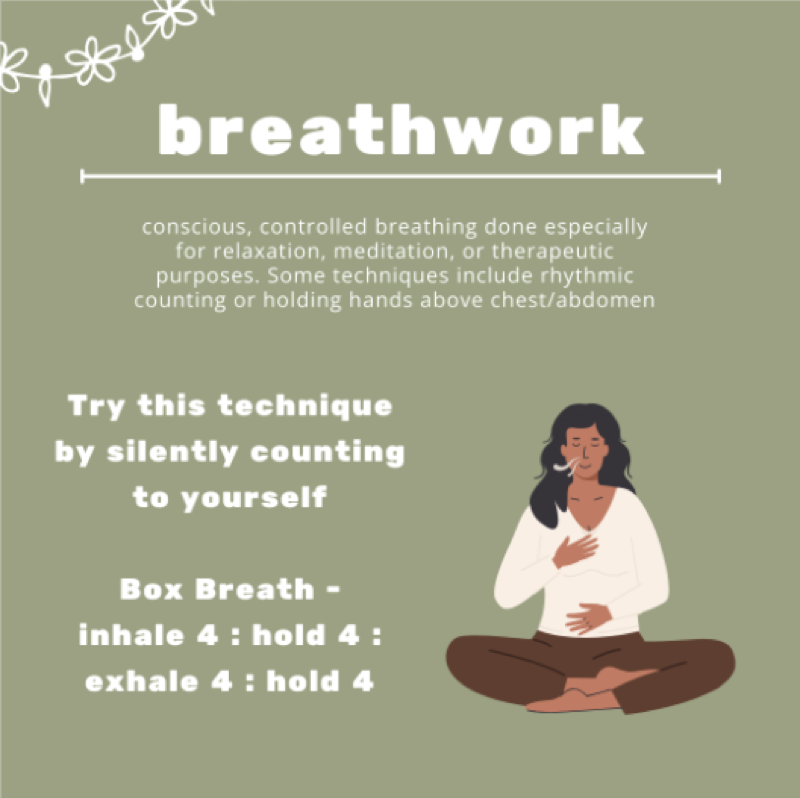 MBIs are completely free and accessible methods of bringing awareness to eating behavior. We live in a world full of distractions and it can be easy to lose touch with the experience of eating. By taking just a few moments to breathe deeply and become aware of your present experience, you can create an intentional relationship with the food you eat. Here are some helpful practices to get you started:
Start with your breath: Before you start eating, take a moment to pause and take a few deep breaths. Try three or four rounds of a breathing technique like the Box Breath.
Eliminate distractions: Turn off the TV, put your phone away, and create a calm eating environment. A calm environment allows you to fully engage with your meal and your body’s natural hunger and satiety signals.
Engage your senses: As you eat, pay attention to the colors, smells, textures, and flavors of your food. Take small bites and chew slowly to lean into the experience of eating.
Check in with your body: Take pauses to ask yourself: Am I still hungry? Am I eating because I’m truly hungry, or am I actually bored or stressed?
Practice gratitude: Take a moment to appreciate the food in front of you. Whether it was a meal you or someone else prepared, reflect on where each ingredient came from. Reflection can help you find a deeper connection to the food that you enjoy.
Making MBIs Work for You
 Time management: Unfortunately, busy schedules don’t have a magical fix. Most of our commitments are unavoidable. However, you can take a step back and look at your regular schedule. What are some ways that you could prioritize, delegate, or break up tasks? By providing structure and clarity to your day, you can feel more organized and in control.
Make it bite-sized: Rather than overwhelming yourself with a massive change, start with one bite-sized change at a time. Try enjoying one or two meals without distraction this week. Perhaps begin by putting your phone on “do not disturb” or make sure the TV is turned off during your next meal.
Stress and emotional eating: If you find yourself turning to food for comfort, mindfulness can help you become more aware of your emotions and how they influence your eating habits. Try writing in a journal or practicing meditation to better understand your triggers.
Move your body: Whether your favorite form of exercise is playing kickball with your friends or going to your favorite yoga class, moving your body is a great way to manage stress. Exercise doesn’t have to cost money; moving your body could be as simple as taking your dog for a run or swapping your regular coffee date for a walk around town. Here are a few free video resources to try:
One Bite at a Time
Incorporating mindfulness into your toolkit doesn’t have to look like a complete overhaul of your current habits or routines. Think of these techniques as short practices to sprinkle in whenever you feel yourself growing distracted or overwhelmed. MBIs are completely free and accessible methods to bring more awareness to eating behavior. We live in a world full of distractions and it can be easy to lose touch with the experience of eating. In the chaos of student life, mindful eating offers a simple way to reclaim mealtime as a chance to reset, recharge, and enjoy the food that fuels your busy days. By taking just a few moments to breathe deeply and become aware of your present experience lies the opportunity to create an intentional relationship with food.
References
- Morris J, Vi CT, Obrist M, Forster S, Yeomans MR. Ingested but not perceived: Response to satiety cues disrupted by perceptual load. Appetite. 2020;155:104813. doi:https://doi.org/10.1016/j.appet.2020.104813
- Jurado-Gonzalez P, Xavier Medina F, Bach-Faig A. Barriers to home food preparation and healthy eating among university students in Catalonia. Appetite. 2024;194:107159. doi:10.1016/j.appet.2023.107159
- Yu J, Song P, Zhang Y, Wei Z. Effects of Mindfulness-Based Intervention on the Treatment of Problematic Eating Behaviors: A Systematic Review. Journal of Alternative & Complementary Medicine. 2020;26(8):666-679. doi:https://doi.org/10.1089/acm.2019.0163
- İrem İNÖZÜ, Gizem KÖSE. Mindful Eating is More Effective to Beat Emotional Eating than Nutrition Education and Diet: A Randomized Controlled Study. Acıbadem üniversitesi sağlık bilimleri dergisi. 2023;14(4).doi:https://doi.org/10.31067/acusaglik.1340369
- Kristeller J, Wolever RQ, Sheets V. Mindfulness-Based Eating Awareness Training (MB-EAT) for Binge Eating: A Randomized Clinical Trial. Mindfulness. 2013;5(3):282-297. doi:https://doi.org/10.1007/s12671-012-0179-1
- Godfrey K, Gallo L, Afari N. Mindfulness-based interventions for binge eating: a systematic review and meta-analysis. JOURNAL OF BEHAVIORAL MEDICINE. 2015-0401015;38:348-362.
- Baer R. Mindfulness training as a clinical intervention: A conceptual and empirical review. CLINICAL PSYCHOLOGY-SCIENCE AND PRACTICE. 2003-06-01 2003;10:125-143.
Looking for more posts sharing stories about nutrition hot topics? Check out the rest of the UF/FSHN Nutrition Stories Series!
 2
2