This blog was co-authored with Rick Lusher, FAWN Project Manager.
The Florida Automated Weather Network (FAWN) maintains a network of weather stations across the state of Florida. They make the data available to assist growers in managing their operations. FAWN data is especially useful for cold weather protection and irrigation management. You can find a map of the station locations on the FAWN home page. Stations nearest to Martin County include Ft. Pierce and Jupiter, and inland stations in St. Lucie West, Okeechobee, Wellington, and Belle Glade. In this blog, we’ll walk through a couple of the FAWN cold protection tools recommended by Rick Lusher, FAWN Project Manager.
Forecast Data
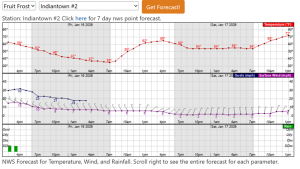
First, you may want to view the NWS Graphical Forecast. The FAWN site provides forecasts from the following: FAWN, My Florida Farm Weather, or Fruit Frost. Fruit Frost stations are former NWS thermometer locations. There is a Fruit Frost Station located in Indiantown. Scroll down below the map and select the Source as “Fruit Frost” and the Station as “Indiantown #2.” Next, click “Get Forecast”. The graphic will show the forecasted temperatures, wind gusts, and rainfall.
Monitoring Data
In addition to weather forecasts, FAWN also allows growers to monitor temperatures at one or more of their network’s weather stations during a cold spell.
- On the FAWN home page, you will see the map of FAWN weather stations, with the current temperature reading at each location. You can see the dew points, wind speeds, minimum temperatures, or rainfall amounts by choosing options from the Station Data list to the left of the map.
- Click on a FAWN weather station you’d like to monitor over time. A data summary will appear to the right of the map, showing the station name and current air temp, wind speed, rainfall, humidity. Click the “More” link at the bottom of the list. Next, you’ll see the station page, with access to all available data.
- From the blue menu on the left of the screen, choose “Cold Protection.” You’ll now have the option of setting your crop-specific critical temperature. You can tell FAWN the critical temperature for your crop or use crop-specific critical temperatures provided.
- Below the NWS Graphical Forecast, you’ll see the Minimum Overnight Temperature, which is estimated around 6 pm nightly. Temperatures are estimated using the Brunt Equation.
- Next, the Forecast Tracker is shown. The Tracker shows a 24-hour period of data, updated hourly. It can help by showing how the weather station data compares to the NWS forecast data and the critical temperature you selected. Below the graph is a table, showing hourly differences between actual weather station readings and NWS forecasted temperatures. In this example, the weather station readings in St. Lucie West were trending about 1 degree above and below the NWS forecast temperatures within the past 4 hours. After reviewing the tracker data, you’ll know whether temperatures near you are generally trending lower or higher than the NWS forecast. The more localized data can
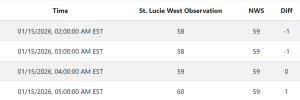
A screenshot of the forecast tracker table, available through the FAWN website. help with applying NWS forecasts and making decisions around cold protection and recovery.
- Below the Forecast Tracker, you will see the Irrigation Risk (evaporative cooling potential) data. Irrigation Risk uses the wet-bulb temperature to categorize the potential for further cooling if plant surfaces are wet from a running irrigation system. If the air is dry and windy, water can evaporate from wet plant surfaces, further cooling those surfaces, potentially to the wet bulb temperature. If the wet bulb temperature is lower than the crop critical temperature, then damage can occur. The risk tables in FAWN indicate whether there is any current or forecasted irrigation risk in the next several hours.
- Lastly, the Irrigation Cutoff Temperature table is shown. This table uses the wet bulb temperature to provide a safe temperature at which irrigation can be discontinued without risk of further plant damage.
Your FAWN Cold Protection Toolkit
The FAWN website offers the tools described here as part of their Cold Protection Toolkit, which also includes FAWN freeze alerts and other tools for cold protection. If you need additional resources, contact FAWN or your local UF/IFAS or FAMU Extension office.
 0
0