At the Sarasota County UF/IFAS Extension Office, we’ve been cultivating a Food Forest to showcase the most productive, unique, and often underutilized fruits and crops suited to our distinctive southwest Florida climate. Through this project, we aim to inspire and educate our community by offering a firsthand look at these remarkable trees, shrubs, and vines, allowing visitors to sample flavors before purchasing, and providing opportunities to gather seeds and cuttings.
To deepen community engagement, we’re launching a monthly blog series that will highlight the best edible plants to harvest each month. While some trees are still maturing and may take a few years to reach full production, we invite you to visit anytime and enjoy the fruits that are ready now. Come experience the abundance and potential of local, sustainable gardening that can be added into your landscape. Nothing will be fresher or more fulfilling than something you grow and pick yourself!
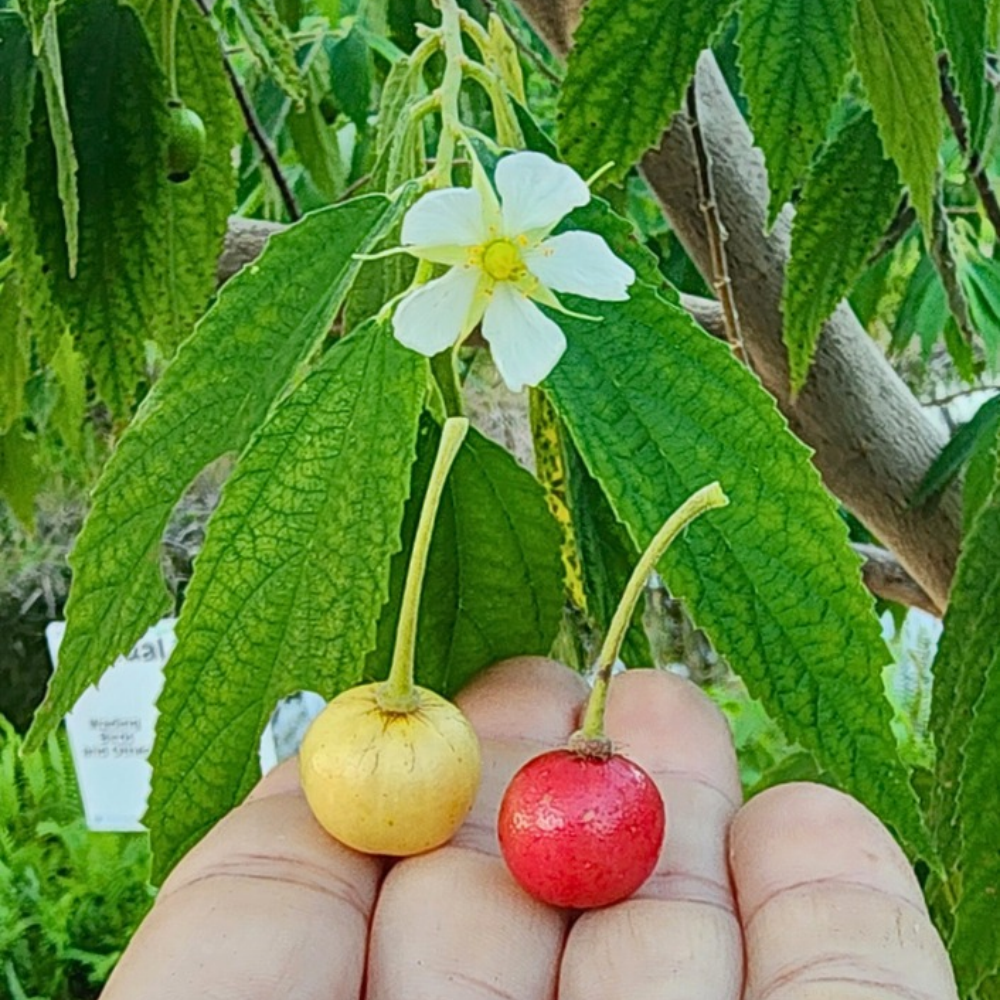
Of all the fruit trees I’ve covered in this series, Muntingia calabura may be the most generous. It grows fast, fruits almost year-round, and is rarely without a few ripe berries hanging from its branches.
It also has more common names than it needs. “Strawberry Tree” refers to the flowers, which look like strawberry blossoms; the name has nothing to do with the taste. “Jamaican Cherry” is misleading, since the tree isn’t native to Jamaica. “Panama Berry” is closer, but its native range stretches from Mexico south to Argentina, far beyond Panama.
I prefer Cotton Candy Cherry. Most people describe the flavor as cotton candy, and the small round fruits dangle from long stems like cherries. You can also never go wrong with alliteration.
The Fruit
The fruits are small and round, about half an inch across, with thin, tender skin and soft, juicy pulp. They carry more nutrition than their size suggests. Per 100 grams (about 3.5 ounces), analyses from El Salvador and the Philippines report 80 to 150 milligrams of vitamin C, more than the same weight of orange, plus 104 to 125 milligrams of calcium, 4.6 grams of fiber, and roughly 100 calories.
The flavor is where the name comes from. Most people describe it as cotton candy, and others compare it to kettle corn. Miami botanist Julia Morton called it very sweet, musky, and somewhat fig-like, and noted that children eat them by the handful.
Two types are grown in Florida. Red-fruited trees bear smaller fruit with more flavor, while yellow-fruited trees bear larger fruit that is sweeter but milder. Both are filled with an abundance of tiny seeds you eat without noticing, much like a cherry tomato. No pit in this cherry!
Fast to Grow, Quick to Fruit

Few fruit trees grow this fast. In my experience it even outpaces papaya, going from seedling to a 10-foot tree in under a year. Left unpruned, it can reach 25 to 40 feet, with spreading, nearly horizontal branches that droop at the tips. I trim ours quarterly, removing any vertical leaders and promoting horizontal branching. It has been easy to manage and having the fruit within reach is worth it.
Production is the real draw. The tree flowers and fruits continuously, slowing only slightly during the coolest months, so it is almost always carrying ripe fruit. Expect abundant fruit ripening on a daily basis.
That combination makes it one of the first trees I recommend to schools and community gardens. It fruits quickly, keeps producing, and gives students something to pick on nearly every visit.
A Favorite with Wildlife
People aren’t the only ones who love this fruit. The young tree at our office was picked clean by squirrels, mockingbirds, catbirds, cardinals, and blue jays, and those are just the visitors I watched.
The good news is that production outpaces the wildlife as the tree matures. A young tree may lose most of its crop, but a mature tree produces more and more, until you can pick a bowlful every day and still leave plenty for the birds.
Invasive Potential?
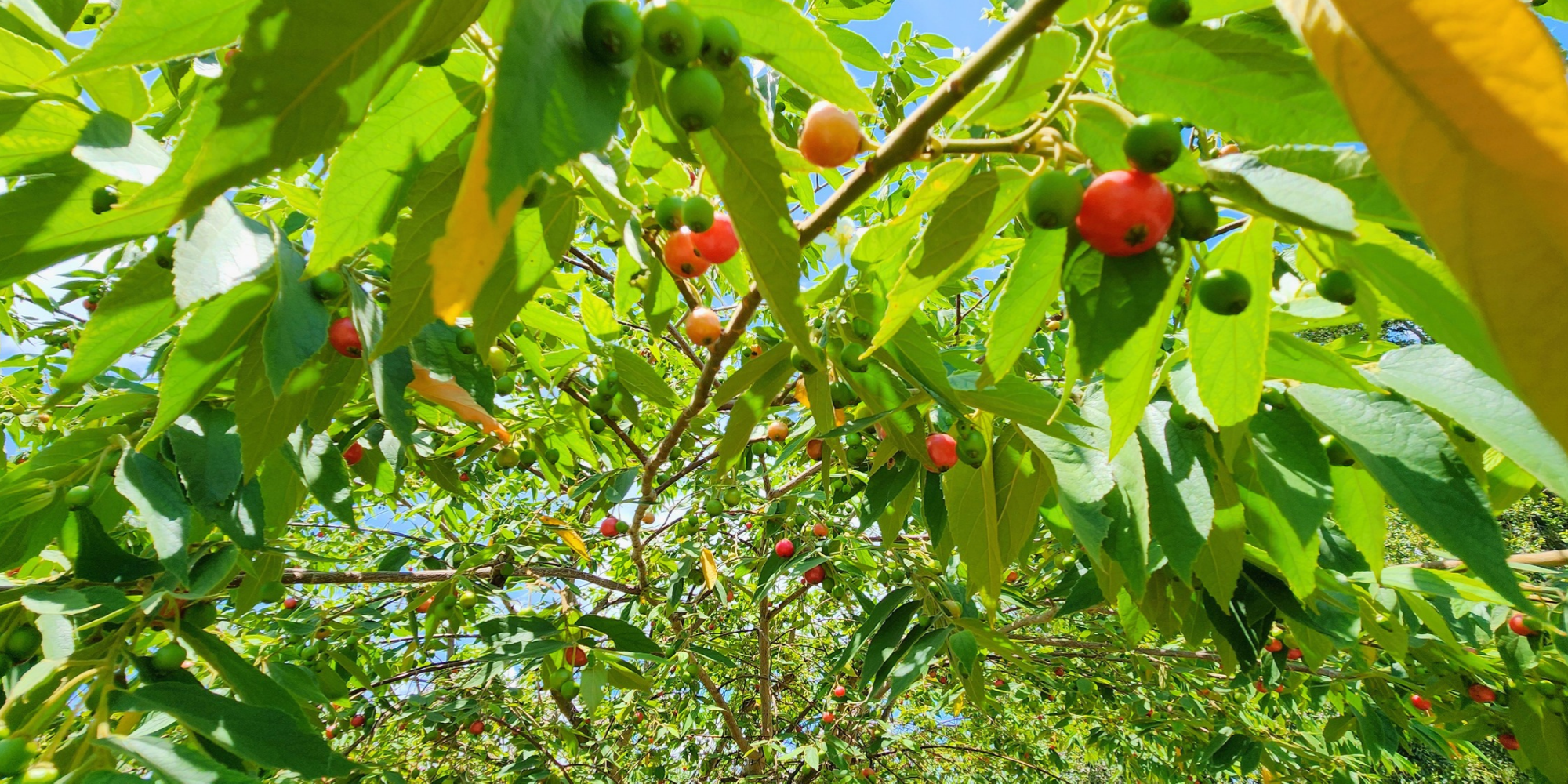
Cotton Candy Cherry has naturalized widely in Southeast Asia, and in the Philippines, it runs wild on hillsides and cliffs. Where seedlings thrive and are able to take root, the never-ending fruit favored by birds and its rapid growth lets the species spread quickly. Leading to it out competing native species in those areas. It is always important to note that plants can be invasive in our area but totally benign in another. As climate, soil, pests, and many other environmental conditions impact the ability of a plant to spread out of control.
Florida is a different story thankfully. It has been planted here for decades, with the earliest Florida specimen vouchered in 1961, and the Florida Natural Areas Inventory shows only five individual feral observations statewide. It is not a listed noxious weed, the Florida Invasive Species Council has not ranked it, and UF/IFAS has not yet assessed it. For how popular they have become in recent years and how prolific the fruit production is, this is good to see.
My personal theory is our sand may be part of the reason. The tree seems to prefer rocky ground from pictures I have seen abroad, and our quick-draining sand dries out young seedlings, which is a death sentence. After years with one in our demonstration garden and in my own yard, I’ve seen no seedlings, only root suckers where a shovel damaged a root.
Growing It on the Suncoast
- Climate: Suited to USDA zones 9b through 11 and grown as far north as Orlando. Frost is a problem especially for young trees. So coastal areas are safer the farther north you go.
- Soil: Tolerates poor, acidic, or alkaline soils and is drought-resistant once established. It is not salt-tolerant, so keep it away from salt spray.
- Water: Water young plants regularly until roots are established, since our sand dries out quickly.
- Pruning: Branches are weak and break easily. Prune long limbs regularly and prevent vertical growth, which also keeps fruit within reach.
- Propagation: Grows from seed, cuttings, or air layers. Seedlings is by far the best method as the root system is very important for trees that don’t handle wind well.
Sources
- Morton, J. 1987. Jamaica Cherry. Fruits of Warm Climates. Miami, FL.
- Saracino, T. 2024. Panama Berry Tree: Muntingia calabura. UF/IFAS Extension Hillsborough County.
- Florida Natural Areas Inventory. Muntingia calabura.
- DOST Food and Nutrition Research Institute. Jamaica cherry (Muntingia calabura). Philippine Food Composition Table.

 6