At the Sarasota County UF/IFAS Extension Office, we’ve been cultivating a Food Forest to showcase the most productive, unique, and often underutilized fruits and crops suited to our distinctive southwest Florida climate. Through this project, we aim to inspire and educate our community by offering a firsthand look at these remarkable trees, shrubs, and vines, allowing visitors to sample flavors before purchasing, and providing opportunities to gather seeds and cuttings.
To deepen community engagement, we’re launching a monthly blog series that will highlight the best edible plants to harvest each month. While some trees are still maturing and may take a few years to reach full production, we invite you to visit anytime and enjoy the fruits that are ready now. Come experience the abundance and potential of local, sustainable gardening that can be added into your landscape. Nothing will be fresher or more fulfilling than something you grow and pick yourself!
Mouse Melon: A Native Snack Hiding in Plain Sight
Every summer like clockwork, a delicate vine threads its way through the beds at the Demonstration Gardens at Twin Lakes Park. Nobody plants it, we honestly don’t want it. Left unpulled by late summer and early fall it is draped over small shrubs and fences, covered with dangling fruits barely larger than a jelly bean that look exactly like miniature watermelons.
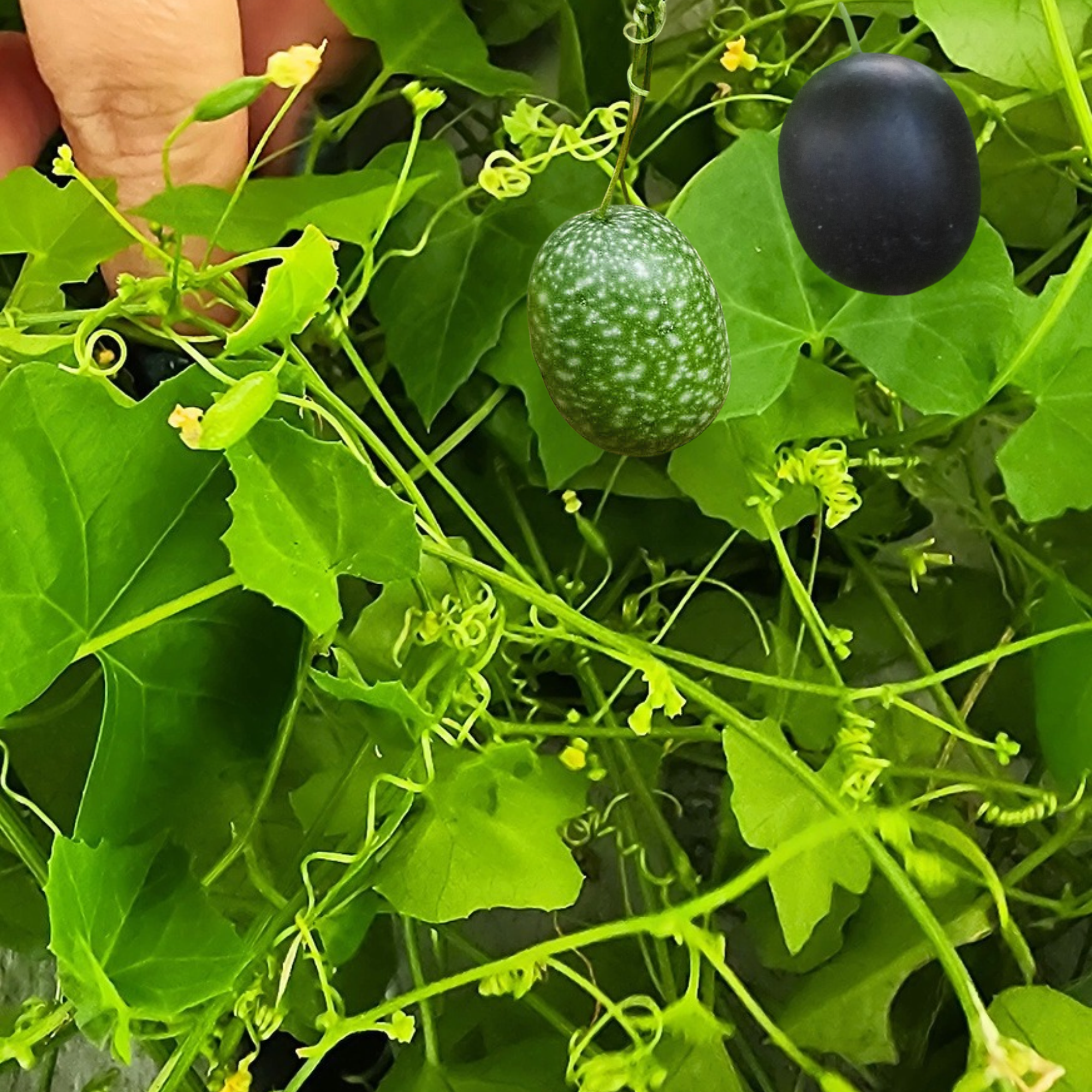
This is Mouse Melon (Melothria pendula), also commonly called creeping cucumber. It is a native member of the gourd family (Cucurbitaceae) found throughout Florida, and it is edible at the right stage. Once our staff learned that, a walk through the garden became a snack break and weeding became a lot more rewarding.
How to Recognize it
Mouse Melon is a slender vine that creeps across the ground in loose mats or climbs into shrubs and fences with curly tendrils. Look for these features together:
- Leaves: alternate, three- to five-lobed, and rough to the touch, resembling a more delicate and small English ivy. A crushed leaf smells like cucumber.
- Flowers: bright yellow, five-petaled, and a quarter inch across or smaller, held on long stalks.
- Fruit: roughly half an inch to three-quarters of an inch long, light green with pale mottling, like a barbie doll-sized watermelon. Fruits darken as they ripen and eventually turn black.
- Where it grows: moist, sandy soils in part sun to full shade, especially along fences, woodland edges, and garden beds.
If you have any doubt about your identification and it is something you didn’t plant, you should never consume it.
The species name pendula describes how the fruits dangle from their stalks like a pendulum. Melothria traces to an ancient Greek word for apple, the same root that gives us “melon.”
References differ on its life cycle. The Florida Wildflower Foundation lists it as a perennial, while UF/IFAS weed identification resources describe it as a summer annual. In our gardens it behaves like an annual, sprouting fresh from seed each year. Likely spread by Mockingbirds and Catbirds.
Pick Them Light Green
The right stage is a firm, light green fruit with pale mottling. At that point it is crisp, with a clean cucumber flavor and sometimes a slight tartness. Our staff eat them whole, straight off the vine, and they work just as well tossed into a salad. Kayla says “it tastes more like a tasty cucumber than a store bought cucumber”.
As the fruit darkens, quality does drop fast. Dark green fruits turn soft and lose their flavor, and black fruits are unpleasant and can act as a laxative. An account from 1863 described the seeds as strongly purgative, which likely explains the plant’s mixed reputation for being
The rule is simple: light green, yes; dark or black, leave it on the vine. Those ripe fruits will reseed next year’s crop.
Forage Where It’s Clean

Mouse Melon favors roadsides, fence lines, ditch banks, and parking lot shrubs, which are often the worst places to harvest. Skip any site that may have been sprayed with herbicides or pesticides, and avoid busy roads and other areas with heavy pollution. We pick ours from garden beds we maintain ourselves, where we know the site’s history.
As with any wild food, be certain of your identification before eating. If you are unsure, bring a sample to your local UF/IFAS Extension office. Just make sure to try to bring in leaves, flowers, and fruit. The more material the easier the identification.
Growing Mouse Melon
You won’t find Mouse Melon at the garden center. Plants are not commercially available, though seed can be found through a few specialty sources. Most gardeners meet it as a volunteer.
Where it pops up, it is worth considering before you pull it. It makes a fine-textured groundcover in shady spots, and its small yellow flowers attract a variety of pollinators. If it wanders where you don’t want it, remove the vines before the fruits ripen to limit next year’s seedlings.
If you’d rather grow tiny cucumbers on purpose, try the Cucamelon (Melothria scabra), a close relative native to Mexico and Central America. Seed catalogs sell it as cucamelon, Mexican sour gherkin, and sometimes mouse melon. It is a better choice for a vegetable garden, but our native Mouse Melon remains a tasty foraged treat.
Next Year: Pickles
This season, most of our harvest never made it past the garden path. Next year we plan to pickle a batch. Their size and watermelon markings make them a natural fit for small jars, and the unripe fruit are pickled in the West Indies and Central America.
We’ll share how they turn out. In the meantime, watch for the vine on your next visit to the Demonstration Gardens at Twin Lakes Park or maybe even in your yard!
Sources
- Bell, E. Creeping cucumber. Florida Wildflower Foundation.
- Deane, G. Creeping Cucumber: Melothria Pendula. Eat the Weeds.
- UF/IFAS Everglades Research and Education Center. Creeping Cucumber (Melothria pendula).
- Mahr, S. Mouse Melon or Mexican Sour Cucumber, Melothria scabra. University of Wisconsin–Madison Extension.
During the preparation of this work, the author used AI to help build and refine the blog post. After using this tool/service, the author reviewed and edited the content, and takes full responsibility for the content of the publication.

 4