We all love taking new plants home, but they often come in plastic nursery pots that aren’t ideal for long-term plant health (plus, they aren’t always the best to look at!). With increasing plastic pollution, keeping this debris out of our environments and landfills is becoming even more important! Read on for some creative ideas on how to reuse those plastic plant pots!!!
Reuse ideas!
Water Reservoir
Cut up the bottoms off of the container pots and bury them around or next to your plants. Water into the void created by the pot to help retain water and prevent soil erosion. The pot will allow the water to slowly drain into the soil, helping to water your thirsty plants. Try this with plants like peppers and tomatoes!

Bug Hotel!
Use the pots to make a bug hotel! Bees, beetles, ants, and other insects can have many benefits in your garden. A bug hotel will provide a safe area for bugs and pollinators to live and reproduce. While these are often made with wood, you can also use a plastic plant pot as the containing structure for your bug hotel, filling the inside with bamboo and sticks! See how to make a pollinator hotel here (just use your pot instead of the wood for the main structure!)
Pot Space Filler
If you plan to use a large garden pot for decoration, it’s not always necessary to fill the entire thing with soil. If your plant has shallow roots, you can use the empty plastic pots to fill the bottom of the container and take up space. Place the plastic pots upside down at the bottom of your pot and fill the soil around them to reduce the amount of dirt you need!

Plant Collars and Edging
Cut up the plastic pots and use the material to create barriers to protect your plants. Creating collars around the plants will help to protect seedlings from wind and pests, and can event help with frost protection! You can also cut the pots up into strips and place them around plants and in garden beds to create your own edging materials and divide your beds into sections!

Green houses or frost protection
Seedlings are delicate and easily susceptible to rapid changes in weather or drying out. Flip over smaller plant pots and use them to cover the seedlings as they begin to grow.
Here’s a few ways this can help:
- Create a mini greenhouse to keep the plant humid and moist!
- Help protect from frost on frigid nights
- Keep out those pesky bugs
Reuse for small plants or as seed starters!
Although larger plants that come in plastic nursery pots will often outgrow their containers, these pots are great for starting the growth of new seeds or smaller plants!
Before you reuse these pots, make sure to clean them properly to prevent the spread of any disease or pests!
- Remove any loose soil or remaining roots
- Clean with hot, soapy water
- Disinfect the pots using a bleach solution (10% is recommended)
- Rinse and dry, then reuse!
Fill with new potting soil and watch those seedlings grow!!!

To make the pots more fun try painting them to add decoration to your garden!
Live near the coast? Help grow mangroves!
Mangroves are an important coastal plant species that protect our shorelines from erosion, provide habitat for numerous marine animals, and help clean our waters. Mangroves spread through a type of seed called a propagule. These propagules often wash up onto beaches and can be easily grown!
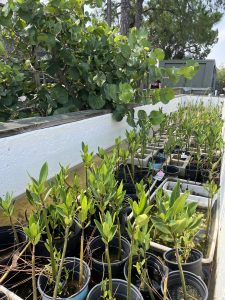

Note: Mangroves are protected plant species. Only unrooted propagules can be collected from the ground, water, or shoreline, to be replanted. Propagules can not be removed from the soil if they have begun rooting and they can never be collected directly from the trees. Learn more here: Mangrove propagation
These mangroves can be used for restoration purposes or planted along your shoreline! Reach out to your local Florida Sea Grant Agent to learn more!
Pasco Sea Grant Agent: Dr. Megan Moore me.moore@ufl.edu
Use as Gardening Tools
Plastic plant pots can be reused in many different ways, acting as tools to help in the garden.
- Use the small ones as shovels to help scoop soil and dirt when replanting!
- Organize small items like string, gloves, seed packs, and zip ties in the pots as storage containers!
- Use large pots as collection bins, carrying them around with you to collect weeds or harvest veggies as you explore in your garden!

Credits
This post corresponds with a project that was supported by the Tampa Bay Estuary Program Bay Mini Grant, awarded to UF/IFAS Extension Florida Sea Grant Pasco County in collaboration with Pasco County Public works. The Tampa Bay Estuary Program has a specialty license plate (Tarpon Tag) that supports bay restoration efforts through the Bay Mini Grant. TBEP is a wonderful organization, and its ability to offer these grants is supported by the sale of the Tarpon license plate. Whether you are an avid fisherman in search of feisty snook, tarpon, or redfish, a kayaker who enjoys paddling through a maze of mangroves, or simply a landlubber who appreciates the fiery reflection of a sunset over the water, you can help support bay restoration efforts by purchasing a Tampa Bay Estuary specialty license plate (Tarpon Tag).’ https://tbep.org/get-involved/tarpon-tag/


Learn more about the Bay Mini Grant Pond Restoration project here: News Article
Have a question? Ask the Authors!


Environmental Program Coordinator for the Department of Public Works Pasco County, Milla R. Turner at mturner@mypasco.net.
For more detailed information, contact your local University of Florida Extension Office.
Follow us!
Support our program
Donate here to support the educational programming offered by UF/IFAS Extension Florida Sea Grant. *Be sure to indicate that the funding is for the Sea Grant program.
An Equal Opportunity Institution.
 4