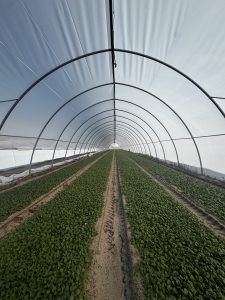
In 2017, the farming company Cultiva was established in Jennings, Florida. Originally deriving from Italy, the company brought over to the U.S. their idea of growing salad crops year-round using a technique called high tunnel farming. The tunnels help protect the crops and regulate temperatures and growing conditions in the highly variable weather in North Florida, allowing for an extended growing period. Cultiva grows a lettuce “Spring Mix”, both conventional and organic, as well as arugula, spinach, and cilantro.

Today, Federico Boscolo, Owner/Farm & Operations Manager, and the Cultiva team farm approximately 150 acres with a total of 870 tunnels, including 143 organic tunnels. Each tunnel is about 260 feet long and 26 feet wide. Cultiva takes pride in their harvest and shipping processes. The ability to harvest, process, cool, and load their crops on a delivery truck all in the same day is what makes their company stand out. Customers are willing to pay more for the guaranteed freshness and the high-quality products they receive.
Best Management Practices (BMPs) at Cultiva
When Cultiva started growing in Florida, they knew they needed to learn how to properly manage irrigation and fertilizers in these new Florida conditions. They knew that the shallow-rooted systems and sandy soil did not work in their favor when it came to these issues. The combination of sandy soil, which drains quickly, and shallow-rooted crops made precise water and nutrient management highly important. Since then, the company has been implementing BMPs into their day-to-day operations to cut input costs, save time, and help their crops flourish while conserving resources.
Soil Moisture Sensors & Time Domain Reflectometry (TDR) Probes
They adopted soil moisture sensors to help them monitor the moisture in the soil. They soon came to realize that for their unique case they would need shorter 4-inch probes to better match their crop’s rootzone, as the standard probes are 8 inches long, which are more suited to crops with much deeper roots and longer growth cycles. With guidance and assistance from the University of Florida/Institute of Food and Agricultural Sciences (UF/IFAS) North Florida Research and Education Center – Suwannee Valley (NFREC – SV) and Hamilton County Extension Agent, Keith Wynn, Cultiva adopted 4-inch TDR soil moisture probes. UF/IFAS NFREC – SV and Keith Wynn supported Cultiva with the implementation and use of the technology for irrigation decision-making. The TDR probes send electromagnetic pulses through the ground to calculate the volume of water the soil holds. Data is collected daily to make irrigation decisions for the following day. In Cultiva’s case, this BMP provides information that can be used to make daily irrigation decisions.
Previously, Cultiva would irrigate their crops for up to 20 minutes. A significant amount of water was shown to be hitting the sand and dissipating elsewhere. The overhead sprinkler irrigation system they use released large water droplets, which did not distribute evenly to the outer beds. This uneven application would contribute to water and fertilizer being pushed away from the plants. This, along with the amount of irrigation, also contributes to an increase in disease pressure. Altogether, this creates a situation where the farm is simultaneously over-irrigated in some areas while under-fertilizing others. Federico and the team at Cultiva found that irrigating for shorter periods, approximately 5 minutes at a time, more frequently throughout the day provided the plant with the specific nutrients it needed while reducing water and fertilizer loss.
Federico noted that the TDR soil moisture system has had the most substantial impact when it comes to irrigation for Cultiva. The data collected from the probes help determine irrigation timing and application amounts, reducing the risk of both under-irrigation and over-irrigation while conserving water and minimizing fertilizer leaching. By using TDR readings along with evapotranspiration (ET) values available through UF/IFAS websites, the team can make more informed irrigation decisions and adjust irrigation times based on current soil moisture needs. With shallow-rooted crops growing in sandy soils, Cultiva has been working to find the balance between adequate irrigation and nutrient retention.

Controlled Release Fertilizer (CRF)
The NFREC – SV and Suwannee River Water Management District (SRWMD), along with the Florida Department of Agriculture and Consumer Services (FDACS) and Office of Agricultural Water Policy (OAWP), have helped fund and support a Nutrient Efficiency Project. This project works closely with farmers/producers in the Suwannee Valley region to find ways to improve nitrogen use efficiency by implementing BMPs, including controlled-release fertilizers. Cultiva was selected and able to participate in this project and, as a result, has been able to reduce nitrogen rates on their farm with the use of CRFs.
In the past, Cultiva used a dry nitrogen fertilizer that was applied by a spreader applicator. Throughout the growing cycle, a portion of the nitrogen is taken up by the crop while some may be lost through leaching associated with irrigation events. With this, the nitrogen fertilizer has been applied multiple times throughout the growth cycle, which can become costly. CRF is a granular fertilizer that is coated and regulates the release of nutrients into the soil based on soil temperature. The coating is formulated to release the fertilizer to the plant at a rate designed to meet the crop’s changing needs.
For Cultiva, the use of this CRF has been a step in the right direction toward nutrient management efficiency. Through soil and tissue sampling conducted with support from UF/IFAS NFREC – SV, they have been able to closely monitor and meet the plant’s nutrient requirements. Today, they use only 60% of the amount typically recommended. Reducing fertilizer use also means lower input costs, saving Cultiva money while simultaneously allowing the crops to flourish. Another significant aspect of this BMP is that the coating on the fertilizer helps prevent nutrients from leaching into the surrounding soil and environment, promoting responsible nutrient management and water conservation practices. Overall, this BMP benefits both producers and the local environment.
Overcoming Mother Nature
In 2023, Hurricane Idalia hit North Florida and had a tremendous impact on Cultiva. Idalia took out 100% of the plastic covering on the tunnels and bent approximately 29,000 tunnel arcs that form the shape of the tunnel structures. This resulted in extensive structural and crop damage, totaling about $2.5 million.
The following year, Hurricane Helene came through the region and further impacted the farm. Including crop damage, Cultiva had a grand total of around $3 million in losses and damages from the two storms. For Federico and the team, recovery became another important factor in the farm’s success.
Emergency Planning /Natural Disaster Preparation
Through the recovery process, Federico and his team came up with a plan to overcome any future storm threats. This plan consisted of removing the plastic covering from the tunnels before the storm arrives, which would significantly reduce the overall damage to the plastic. Although this process was highly labor-intensive, it would allow the wind to blow through the structure of the tunnel without damaging its shape, making it worth the time and effort in the long run.
With support from Florida’s Commissioner of Agriculture and FDACS disaster loan programs, Cultiva was able to begin recovering from the damage. As of September 28th, 2026, Cultiva Farms reports approximately 76% recovered from storm-related damages and expects to reach full recovery by March of 2027.
Looking Ahead
Their experience demonstrates that effective farm management extends beyond production practices. It requires adaptability, resource management, and preparation for challenges that are outside a grower’s control. Moving forward, Cultiva plans to adopt CFR practices throughout the entire farm, strengthening their commitment to sustainable farm management practices. Ultimately, these efforts will help Cultiva become a stronger steward of the land while creating opportunities for the leafy green industry to prosper in North Florida.
Authors: Kelsey Thomas, Sydney Williams, Kelsey Crain, and Robert Hochmuth
 6