Written by Miriam Rios, 2026 Undergraduate Summer Intern
What is an Aquatic Preserve?
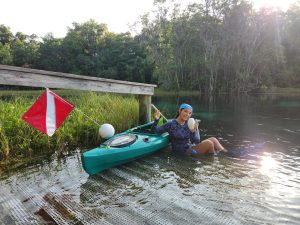
Before this internship, I didn’t fully understand what the Department of Environmental Protection (DEP) does or what an Aquatic Preserve actually is. Now, through my internship at DEP’sRainbow Springs and Ocklawaha Aquatic Preserve, as a Natural Coastal Biological Station (NCBS) intern, I’ve seen firsthand how much work goes into protecting Florida’s waterways. I learned how field data becomes management plans, how agencies collaborate, and how staff balances public engagement with conservation. Being part of that process, even for one summer, gave me a new appreciation for environmental management and the people who make it happen.
During my internship with the Rainbow Springs and Ocklawaha Aquatic Preserve, I had the privilege of working alongside Joe Tallant, environmental specialist, and Trisha Green, manager of the Aquatic Preserve, who introduced me to the wide range of ecosystems and field conditions they navigate every day. Watching how they adapted to each site, from clear spring runs to winding river channels, showed me how flexible and resourceful they must be when working across multiple regions. Their mentorship helped me build confidence in fish identification, plant identification, habitat assessment, and many other skills that I know will stay with me.

A “Typical” Day
It’s hard to describe a “typical” day because every day was different. Some days were spent calibrating dataloggers, deploying sondes, or collecting water quality samples. Other days consisted of learning how to trailer boats, practicing safe launching and retrieval, and taking care of the needs of the state parks. And of course, many days were dedicated to the invasive species program.
The Invasive Species Removal Program targeted Nile tilapia and armored sailfin catfish (plecos). These species were released and have had significant ecological impacts on many of Florida’s bodies of water, especially in Rainbow Springs and the Ocklawaha River. Plecos burrow into riverbanks, causing erosion, increasing turbidity, and, in severe cases, collapsing sections of shoreline. Tilapia clear out vegetation to create breeding nests, compete with native fish, and disrupt natural food webs. The Aquatic Preserve of Rainbow Springs (RSAP) and the Ocklawaha River (ORAP) staff have been spearfishing these species in order to lower the population to a manageable level. So far this year, the staff have gotten about # of tilapia and # of Pelco off the rivers.

As fun as removing invasives can be, the Aquatic Preserve staff does much more than spearfishing. One of their most important monthly responsibilities is water quality monitoring. The team uses YSI EXO multiparameter sondes to measure dissolved oxygen, temperature, pH, turbidity, and conductivity along both rivers. During my internship, I learned how to calibrate the YSI EXO to ensure each measurement was accurate and how to properly deploy it throughout the preserves to track long‑term water quality trends.
The public plays an important role in the Aquatic Preserve, which is why outreach is such a key part of the job for AP staff. This summer, I was able to contribute to outreach projects, including creating new educational signs for local boat ramps and developing surveys to gather public feedback on them. Through this work, I learned about the different events the Aquatic Preserve participates in and hosts throughout the year, all aimed at helping people better understand and appreciate the Aquatic Preserve as a whole.

prepare to take water quality samples. Photo Credit: Joe Tallant.
Acknowledgements
Whether we were on the boat all day or catching up on office tasks and outreach projects, one thing was always true: every single day I learned something new and useful. From invasive removal and water quality to everything in between, I learned so much throughout this internship. I am incredibly grateful to Joe Tallant and Trisha Green, manager of the Aquatic Preserve, for their mentorship, patience, and encouragement.
 0