Written by Frankie Just, 2026 Undergraduate Summer Intern

This summer is one I will never forget. As an NCBS intern, I had the opportunity to engage in marine science through fieldwork and laboratory research. Every week brought new experiences that strengthened my understanding of the scientific process and helped me develop skills I’ll use throughout my career.
Project Overview

My main role was working as a scientific diver on the underwater assessment of fisheries on the move project under Dr. Robert Lamb. This long-term study, a collaboration among UF/IFAS, NOAA, and FWC, examines how changing ocean conditions affect fish populations, invertebrate communities, and economically important fisheries species across a latitudinal gradient along the Gulf Coast (Apalachicola, Cedar Key, Tampa, and Naples), on reefs down to about 20 meters. Surveys will continue every summer and winter, plus after major storms, for the next decade, providing valuable information to resource managers and stakeholders throughout Florida.

Intern Responsibilities
Fieldwork meant diving all across Florida. Each day began with coordinated sources from local fishermen, scientists, or past experience. Once we would get to a set of coordinates, we would drop down to the site to first ensure the reef we were monitoring was in this set of coordinates. This would often take trial and error since sometimes the coordinates were not exactly on top of the reef. Once confirmed, I would assist in creating a 20-meter-long transect, where we would then document the different species of fish we saw along the transect, how many of each species, and the estimated length of the species we saw.
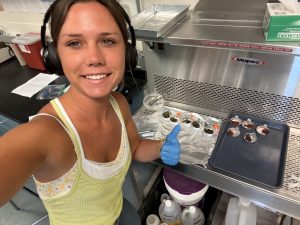
In addition to scientific diving, I gained valuable experiences on several other projects. In the Aquatic Pathology Laboratory, I prepared samples of biomass collected from the Galápagos Islands for stable isotope analysis. I also assisted in assembling Fish-Specific Autonomous Reef Monitoring Structures (FARMS), which will be placed in each study site of the project. Throughout the summer, I also contributed to fieldwork for several other ongoing projects, allowing me to experience a wide variety of research techniques and scientific disciplines.

Independent Study
One of the most rewarding aspects of my internship was being encouraged to think beyond simply assisting with research. With Dr. Lamb’s guidance, I designed and will lead my own independent research project, continuing through the fall and spring semesters. Nested within the underwater assessment of fisheries on the move monitoring effort, this project will examine how water quality parameters (temperature, salinity, nutrient concentrations, and dissolved oxygen) vary across the four study regions, alongside plankton community composition across sites, seasons, and storm events. By integrating these measurements with the long-term reef monitoring data, I hope to provide the environmental context needed to interpret biological community metrics.
Final Words
I am incredibly grateful to NCBS for providing this unforgettable internship opportunity. I sincerely thank Dr. Robert Lamb for his mentorship, encouragement, and unwavering support throughout the summer. I also thank Melanie Gomez, Cayman Christ, Doug Marcineck, Shea Husband, Carter Oleckna, Katherine Cummings, and everyone who welcomed me onto their projects and generously shared their expertise. Finally, I thank NOAA, the FWC, and everyone in the UF/IFAS Fisheries department whose support made this research possible. This was an incredible learning experience that I will carry with me throughout my career.
 1