Written by Ashley McDonald, Biological Scientist at UF/IFAS Nature Coast Biological Station
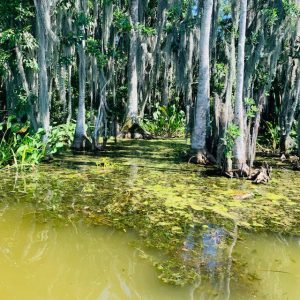
Aquatic plant restoration has been an imperative goal for the rehabilitation of a number of Florida’s lakes and springs, which have experienced ecological declines caused by invasive species, nutrient enrichment, and urban expansion. One of the research priorities of the Nature Coast Biological Station, together with UF|IFAS departments of Soil and Water Sciences and Environmental Horticulture is to enhance the likelihood of restoration success for aquatic vegetation projects. Decades of monitoring the successes, and just as importantly- the failures of past restorations have shown us that the key to restoration success begins with having adaptable restoration plans. The understanding that planning a restoration for a specific location, with specific goals tailored to that location, is not a “one size fits all” scenario is nothing new to natural resource managers. However, as restoration science progresses, we’re learning how to encompass the whole ecosystem into our plans, and the one thing certain about ecosystems is that they are often in a state of flux, therefore we must anticipate and adapt our plans accordingly.
Outlining the Project
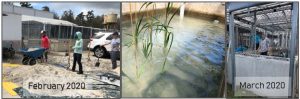
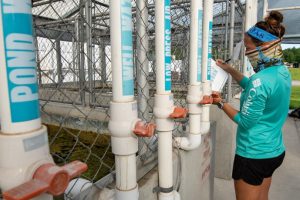
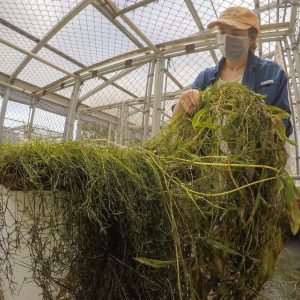
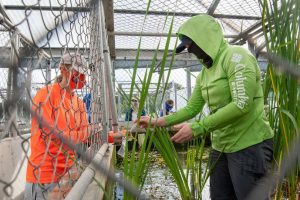
To examine the extent of adaptability in planting aquatic vegetation for restoration purposes, our team spent months planning and prepping a novel large-scale experiment in collaboration with Dr. Wesley Daniel of the United States Geological Service (USGS) using mesocosms* at the Wetland and Aquatic Research Center (USGS WARC) in Gainesville, FL. This undertaking included 14 tons of sand moved and placed with shovels, 180 plastic bins drilled and glued to make optimal submerged planting containers, over 1,000 seedlings planted, and a decent amount of bribery on my part to convince student volunteers to come back and help with even more sand-shoveling.
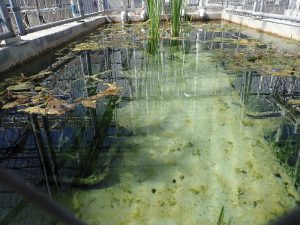
Immediately following the launch of our experiment, the theme of “adaptability” became all-encompassing when Covid outbreaks in the US, led to university and federal government shutdowns and restrictions on research activities. To ensure the health of coworkers, friends, and family, our team incorporated strict social distancing protocols based on guidelines provided by the UF Research council and USGS WARC as recommended by the CDC. However, we were also determined to keep this experiment up and running, so our team rapidly adapted by coming up with one-person monitoring and maintenance routines for this massive experimental undertaking that we had just invested months of effort to build from scratch.
Adapt! Evolve!
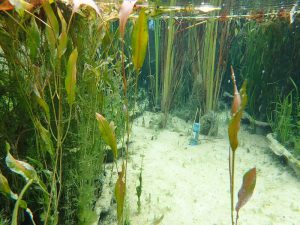
While developing and incorporating these changes was a significant and unforeseen challenge to ensure our physical and intellectual efforts weren’t wasted, carrying out this experiment during a pandemic represents only a small fraction of the stress and anxiety we’ve all experienced as a collective society this year. I have been fortunate enough to have had the guidance and adaptable strength of my collaborators and teammates to assist through these research-specific challenges. Because of this, our group successfully completed the entire experimental run and monumental experiment breakdown during the pandemic without compromising our research integrity or personal health. I may have thought such a task to be near-impossible only six months ago, but our success shouldn’t really be all that surprising.
Carry On
This is because humans are highly adaptable- in fact, researchers theorize most major human developments occurred in waves during periods of peak environmental volatility (known as variability selection theory, developed by Dr. Rick Potts). This knowledge combined with modern scenes of social gathering via video chats, parents working from home while children get their education over the internet, and mass community cooperation to wear face coverings during a viral pandemic are all primary examples of our own rapid adaptability to carry forward with life in these unstable times. Since the end of our experiment, I have kept this idea of adaptability and extended it into all life aspects- not only for research and field sampling efforts but also for my personal life plans. And in knowing adaptability is within our human nature, I have less anxiety, and more certainty, about the future.
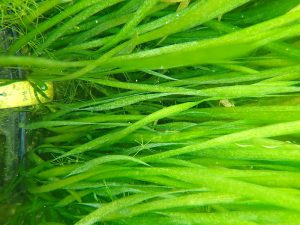
*Mesocosm- A bounded and partially enclosed outdoor experiment to bridge the gap between the laboratory and the real world in environmental science (Odum, 1984)
Acknowledgments:
Emergent/Submerged Vegetation Experiment Research Team- Ashley M. McDonald (Research Scientist- NCBS), Christine Rohal (Postdoctoral Researcher- Soil and Water Sciences, Environmental Horticulture) , Laura K. Reynolds (Assistant Professor- Soil and Water Sciences), Charlie W. Martin (Research Assistant Professor- NCBS), Carrie Reinhardt Adams (Associate Professor- Environmental Horticulture)
Experimental efforts supported with funds provided by St. Johns River Water Management District, contract 31945 to LKR, CRA, CWM.
In collaboration with- Wesley Daniel, Program Manager for the Nonindigenous Aquatic Species Database at USGS Wetland and Aquatic Research Center
And special help from a great support team- Whitney Scheffel, Audrey Looby, Jamila Roth, Alex Bijak, Sarah Tevlin, Natalie Stephens, Scott Alford, Natalia Medina Irizarry, Elysia Lewis, Leah West
Killer photography by AJ Maher
 0
0