Welcome to Nutrition Stories, our series exploring hot topics in nutrition and dietetics! Today’s guest is Karli Walker, a graduate of the UF Didactic Program in Dietetics (DPD) and a current MS-DI graduate student in the Food Science and Human Nutrition (FSHN) Department at the University of Florida. In this article, Karli discusses how the foods we eat affect our sleep and offers advice on how to use nutrition to help treat insomnia.
Karli:
Sleep is essential when it comes to mental, physical, and emotional health, but for many college students, adequate sleep is hard to come by. Busy class schedules and homework, volunteering and jobs, and the stress of managing it all can make it increasingly difficult for college students to achieve optimal sleep. This article will delve into the factors, such as environmental and social, that negatively impact sleep, as well as the importance of getting enough sleep and how the support of good nutrition can help.
What is insomnia and what causes it?

Insomnia is characterized as a chronic sleep disorder in which it is difficult to fall asleep or stay asleep, leading to daytime fatigue and reduced energy levels.1 Conversely, occasional sleeplessness is short-term and usually attributed to behavioral habits. Up to 75% of all college students in the U.S. have reported some degree of sleep disturbances, but more importantly, of this percentage, nearly one-third (26.4%) of them truly suffer from insomnia.2
Studies show that the demands of employment and academia are strongly linked to insomnia in college students, and this interaction between sleep and stress is cyclical.2,3 This means that high-stress contributes to insomnia and insomnia contributes to more stress, creating a cycle that is hard to escape.3 Additional causes of insomnia include stress from relationships with family members and peers, late-night use of technology, and finances.

The effects of insomnia
The effects of compromised sleep can be detrimental to academic performance, physical health, and mental/emotional well-being. Over 78% of students with insomnia experience depression, and if students already present with depression, then their risk for insomnia is 9.5 times greater than for students without depression.2 The American Academy of Sleep Medicine reports that grades are poorer and GPA is lower in students who experience sleep disturbances.4
Melatonin supplements or over-the-counter sleep aids are often used to treat insomnia, but these aids pose dependency risks as well as safety risks since many of these supplements lack regulation.5 Therefore, it is critical to find a solution to this problem outside of medications and supplements so that quality of life and overall health does not diminish.
Adequate sleep is associated with improved ability to focus during classes, manage workloads, and perform well on class evaluations.6 Beyond academic indicators, sufficient sleep is also related to improved fitness performance, improved cognition, and better insulin sensitivity.7
How can nutrition help reduce insomnia?
With all the causes and poor outcomes of insomnia, how do you escape this cycle and get your sleep back on track? Nutrition plays a significant role in regulating sleep, especially in conjunction with other lifestyle strategies, such as setting a consistent sleep schedule and exercising regularly. Studies have found associations between diet quality—the concept of how well one’s eating habits align with their nutritional and health-related needs—and sleep that are worth exploring.8,9 Before suggesting some foods that could improve sleep outcomes, let’s look at some dietary patterns that likely inhibit sleep.

Sleep-interfering variables
One of the biggest factors that disrupts the sleep cycle is the timing of meals. Consuming most of the day’s calories in the evening or eating less than two hours before bedtime contributes to poor digestion and changes in the composition of the gut microbiome.10 These two habits cause a shift of the gut microbiota to a pro-inflammatory state, ultimately contributing to a misalignment in circadian rhythm.10 Pro-inflammatory factors bind to receptors and repress the transcription of genes that control the body’s clock.11
Other dietary habits are also linked to sleep disturbances, such as high fat and sugar consumption, low fiber consumption, and even underconsumption of energy.12 Lastly, chronic consumption of caffeine blocks adenosine, the chemical responsible for your drive to sleep, while chronic consumption of alcohol interferes with REM sleep.10,13 Hence, habitual consumption of caffeine and alcohol can increase the risk of insomnia.
Sleep-promoting foods
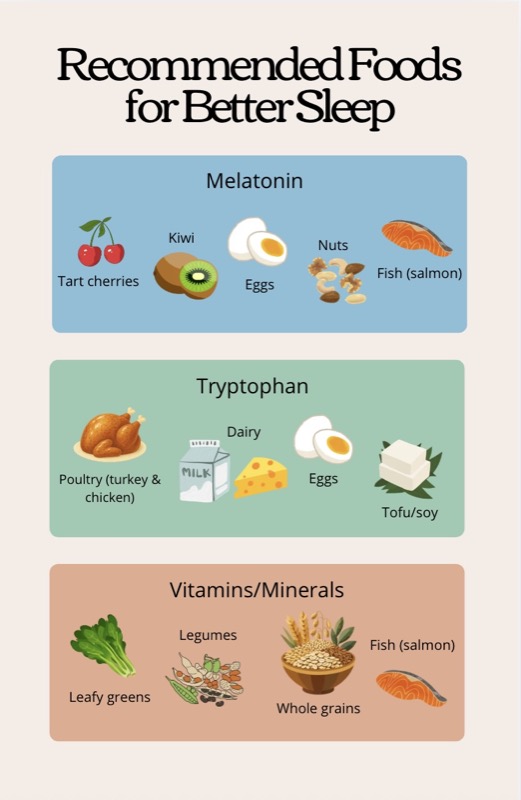 So, what should you be incorporating into your diet that is beneficial for sleep? Melatonin-rich foods, such as tart cherries, fatty fish, and nuts, decrease sleep onset latency (time to get from wakefulness to light sleep) in insomnia and increase the likelihood of waking up feeling well-rested.10
Tryptophan is one of many essential amino acids, meaning it must be obtained from the diet, and it is necessary for the synthesis of serotonin.10 Serotonin is a regulator of the sleep-wake cycle and promotes better sleep.10 Food sources of tryptophan include kiwis, animal proteins, dairy, and nuts and seeds.
Foods that are rich in vitamin D (e.g., egg yolks), omega-3 fatty acids (e.g., salmon), fiber (e.g., legumes), and magnesium (e.g., green leafy vegetables) are also linked to improved sleep outcomes. As a bonus, these foods contain at least two of these beneficial nutrients, so you can maximize your nutrient intake. Try to consume these foods during the day and avoid eating too close to bedtime.
Whole foods versus food constituents
Commonly, food is not the initial solution to insomnia; rather, medications or supplements are prescribed. Approximately 66% of college students take supplements to meet daily requirements that may not be attained via food and to promote general health.15 However, medication and supplement usage can have negative effects, some of which include daytime drowsiness, nausea and vomiting, dependence, and drug-nutrient interactions. Additionally, microwavable, highly processed meals and fast foods are also convenient for college students but don’t always meet dietary requirements.
While there are benefits of taking medications and supplements, as well as convenience in consuming fast foods, the idea of nutrient synergy should also be considered. Nutrient synergy is the notion that the combined effects of at least two nutrients in whole foods yield greater physiological outcomes than an isolated nutrient in the form of a supplement.14 Under healthcare guidance, inclusion of whole foods that contain vitamins, minerals, and other nutrients can promote stability of the circadian rhythm. The ultimate goal is that improved sleep will improve academic performance and health outcomes in college students who suffer from insomnia.

Play with your food: see what changes work for you
Making any kind of lifestyle change can be challenging. Take it one step at a time and slowly work up to incorporating sleep-promoting foods into your daily diet. Consider adding 1-2 new foods into the rotation and slowly reduce the consumption of alcohol or caffeine (if applicable) and ultra-processed foods. Consult your healthcare provider before making any dietary changes.
If insomnia persists, then reach out to your healthcare providers to rule out medical causes of insomnia and manage potential anxiety or challenges with sleep hygiene. Proper nutrition can be an important factor that promotes better sleep in college students struggling with insomnia, and with better sleep, students can stay focused throughout the day, improve academic performance, and better manage their stress.
References
- Mayo Clinic. Insomnia- Symptoms and Causes. Mayo Clinic. Published 2024. https://www.mayoclinic.org/diseases-conditions/insomnia/symptoms-causes/syc-20355167.
- Mbous YPV, Nili M, Mohamed R, Dwibedi N. Psychosocial Correlates of Insomnia Among College Students. Prev Chronic Dis. 2022;19(19). doi:https://dx.doi.org/10.5888/pcd19.220060.
- Gardani M, Bradford DRR, Russell K, et al. A systematic review and meta-analysis of poor sleep, insomnia symptoms and stress in undergraduate students. Sleep Medicine Reviews. 2022;61(101565):101565. doi: https://doi.org/10.1016/j.smrv.2021.101565.
- American Academy of Sleep Medicine. College students: Getting enough sleep is vital to academic success. American Academy of Sleep Medicine- Association for Sleep Clinicians and Researchers. Published November 6, 2017. https://aasm.org/college-students-getting-enough-sleep-is-vital-to-academic-success/
- Bilodeau K. Supplementing your sleep- Harvard Health. Harvard Health. April 2022. https://www.health.harvard.edu/healthy-aging-and-longevity/supplementing-your-sleep
- Hassan S, Alqahtani NM, Alshahrani SM, Alhefzy AA, Alharthi O, Alharbi M. Association between sleep quality and academic performance among undergraduate medical health sciences students: A cross-sectional study. Cureus. 2025;17(9):e91548. doi: 10.7759/cureus.91548.
- Feingold CL, Smiley A. Healthy sleep every day keeps the doctor away. Int J Environ Res Public Health. 2022;19(17):10740. doi: 10.3390/ijerph191710740.
- Hiza HAB, Koegel KL, Pannucci TE. Diet quality: The key to healthy eating. Journal of the Academy of Nutrition of Dietetics. 2018;118(9):1583-1585. doi:https://doi.org/10.1016/j.jand.2018.07.002.
- St-Onge MP, Mikic A, Pietrolungo CE. Effects of diet on sleep quality. Adv Nutr. 2016;7(5):938-949. doi: 10.3945/an.116.012336.
- Pattnaik H, Mir M, Boike S, Kashyap R, Khan SA, Surani S. Nutritional elements in sleep. Cureus. 2022;14(12):e32803. doi: 10.7759/cureus.32803.
- Ferrell JM. Circadian rhythms and inflammatory diseases of the liver and gut. Liver Res. 2023;7(3):196-206. doi: 10.1016/j.livres.2023.08.004.
- St-Onge MP, Roberts A, Shechter A, Choudhury AR. Fiber and saturated fat are associated with sleep arousals and slow wave sleep. J Clin Sleep Med. 2016;12(1):19-24. doi: 10.5664/jcsm.5384.
- Song F, Walker MP. Sleep, alcohol, and caffeine in financial traders. PLos One. 2023;18(11):e0291675. doi:10.1371/journal.pone.0291675.
- Townsend JR, Kirby TO, Sapp PA, Gonzalez AM, Marshall TM, Esposito R. Nutrient synergy: Definition, evidence, and future directions. Front Nutr. 2023;10:1279925. doi:10.3389/fnut.2023.1279925.
- Lieberman HR, Marriott BP, Williams C, et al. Patterns of dietary supplement use among college students. Clinical Nutrition (Edinburgh Scotland). 2015;35(5):976-985. doi: https://doi.org/10.1016/j.clnu.2014.10.010.
Looking for more posts sharing stories about nutrition hot topics? Check out the rest of the UF/FSHN Nutrition Stories Series!
 1