A hurricane seems like an obvious and ideal football mascot. A storm like that implies power, strength, and intensity running roughshod over anything in its way. I have discussed hurricanes in this blog before—and Florida is the most hurricane-prone state in the union. But within Florida, Miami is a frequent target, with over 100 tropical storms and hurricanes hitting the city since the 1850’s. Its low elevation and geographical position at the tip of the peninsula make it particularly vulnerable to storms coming in from both the Gulf and Atlantic.
But like many schools, the University of Miami has an additional wildlife mascot, albeit a more unassuming one. Ironically, the Cornell bird lab refers to it as having a “football-shaped” body.


The white ibis (Eudocimus albus) is a docile shorebird, seen in marshes and swamps foraging through the muck. Miami chose the ibis as their mascot based on an old bit of Florida folklore, which holds that among all the animals living along the coast, the ibis is the last to settle in before a storm hits. In the days before satellite imagery and round-the-clock weather coverage, people paid closer attention to the behavior of wildlife around them. Animals living more attuned to the environment around them seem to have a sixth sense around impending weather—most likely a response to changes in barometric pressure and a sensitivity to low-frequency sound waves. I have noticed this too, the way birds and insects are silent before a major storm because they’ve flown to safety or hunkered down. Early Florida settlers observed this behavior and realized if even the busy ibis has disappeared, a tropical storm was impending and they should take cover, as well. Many folks have observed ibises as the first to return after a storm, feeling like a sign of hope after destruction.
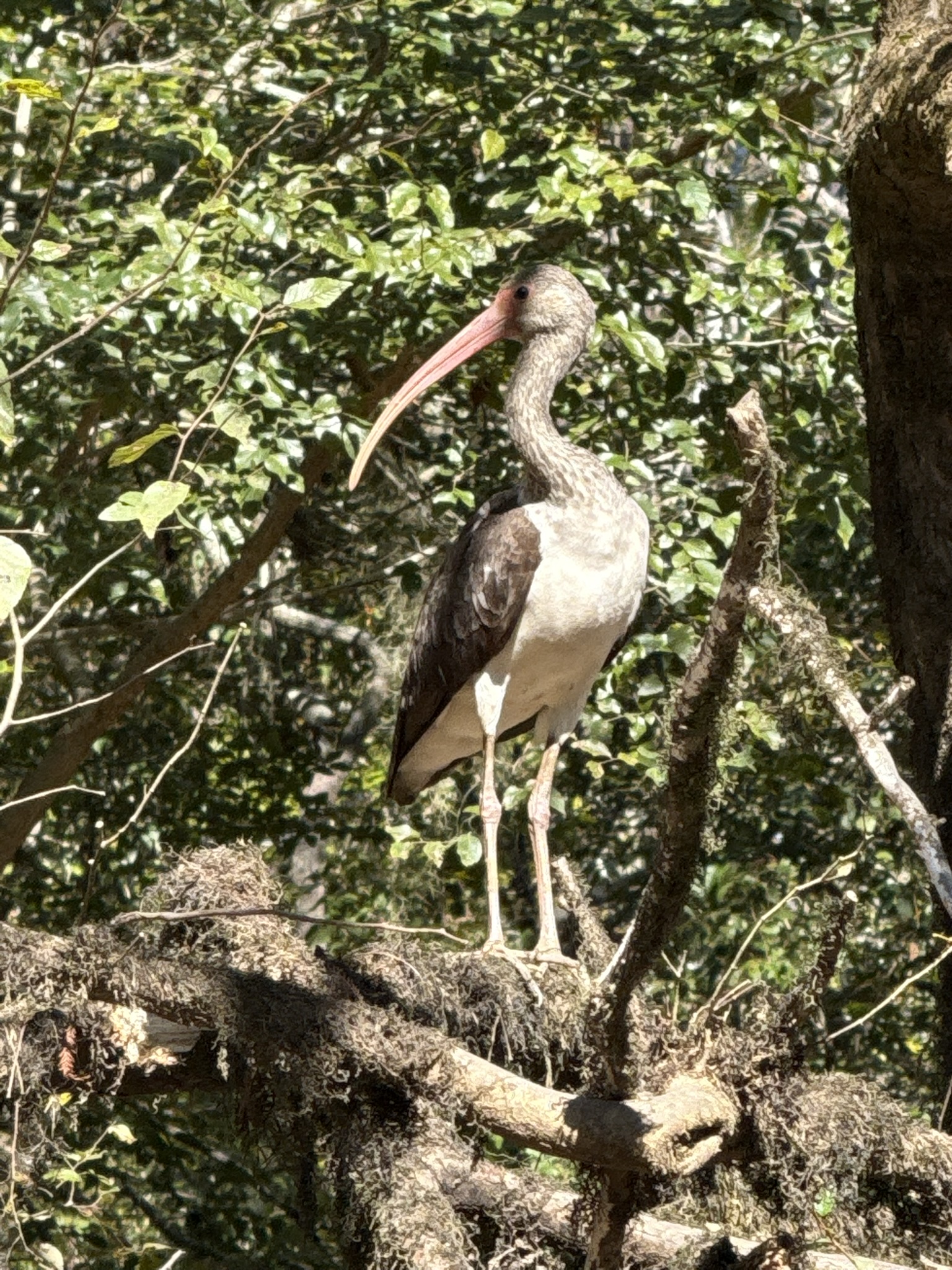
The feathers of adult white ibises are fully white, with black wingtips. They are only about a foot tall, relatively short for a wading bird. As juveniles, they are well-camouflaged with brown and gray-mottled feathers. They have a long, down-curved pinkish-orange beak and orange legs. They use their beaks to forage in the mud and shallow water for fiddler crabs, fish, snakes, frogs, and even insects like mosquitoes and ants.
Like many other wetland bird species, there were once millions of white ibises in the Everglades, and were hunted for food by Native Americans and settlers. Populations have moved north due to habitat displacement from development in south Florida, but the entire state of Florida is within its native range.
The University of Miami’s Sebastian the Ibis was named for a campus dorm, San Sebastian Hall. The ibis had been an unofficial mascot—and the name of the yearbook—for several decades, but after a student performed at football games in a homemade ibis costume in 1958, a tradition was born. Sebastian the Ibis has been firing up Miami fans at sporting events ever since.

The Miami Hurricanes football team of the 1980’s had quite the reputation—they were extremely good, but their flashy braggadocio got under the skin of many opponents. Many referred to them as the “bad boys” of college football. Longtime rivals with Florida State, the intensity ramped up during the 1989 season (which Miami dominated as national champions that year) and even Sebastian the Ibis got caught up in the zeitgeist. As anyone following FSU football knows, before games their mascot Chief Osceola rides out on horseback with a flaming spear. During the FSU-Miami game that fall in Tallahassee, the ibis mascot (embodied by student John Routh) conspired with friends to have Sebastian wear a fireman’s jacket and helmet, and run out on the field before the game with a fire extinguisher. The idea was to snuff out that flaming spear, or at least upset the FSU fans by acting like he would. Amid the chaos of teams running out on the field, a police officer told Routh to put down the extinguisher but he accidentally engaged it, soaking the officer in the chest with water. It only got worse from there, with a tussle ensuing and the Ibis nearly being arrested. A legendary photo taken by Miami Herald photographer Joe Rimkus of the episode now resides in the University of Miami Sports Hall of Fame.
 10