Like a surprising number of schools, the University of West Florida (UWF) has two mascots: the Argonaut and the Nautilus. Or technically, a mascot and “emblem.” Both representatives are tied intrinsically to the university’s location in historic, coastal Pensacola, a fitting tribute to the school’s excellent reputation in both marine science and underwater archaeology. It’s particularly appropriate for a university whose faculty and students discovered the sunken (and land-based) remains of the oldest European settlement in the country to be represented by an ancient sailing explorer and a deep-sea creature. The blue and green school colors are meant to represent the sky and the sea.

Inspired by the Oliver Wendell Holmes poem, “The Chambered Nautilus,” UWF’s first president chose the nautilus as its “official emblem” at the school’s founding in 1965. The poem exhorts the reader not to stay in one’s “outgrown shell” but to grow and expand into “each new temple, nobler than the last.”

The nautilus (“sailor” in Greek) is a “living fossil,” a cephalopod (like octopus and squid) related to the ancient ammonite, which has been found in fossil records dating back to 500 million years ago. It is a strange and fascinating sea creature, with prominent eyes, a calcified jaw, a large, chambered shell, and more than 90 tentacles. The nautilus is limited in its growth to the shell it resides in. Instead of molting like a blue crab or relocating like a hermit crab, the growing nautilus extrudes a new and larger chamber, which it moves into while sealing off the last. By the time it reaches full maturity, an adult nautilus may have as many as 30 chambers. They are typically 5-10” across when full sized. Their ability to achieve neutral buoyancy by moving water around their chambers, along with jet propulsion for movement allowed them to become the “first of the large free-swimming carnivores in the sea.” They dominated ancient oceans until bony fishes evolved, and are still alive and (mostly) well in the oceans throughout the Indo-Pacific.

The current UWF “traditions” web page explains the shell as an icon that “represents the history and soul of our rich and storied past and a future brimming with possibility and potential.” The nautilus emblem can be seen in the University seal, on architectural features throughout campus, and lives on subtly in the athletic arena, with cheers like, “Shell Yeah,” and “Give ‘em Shell” used when promoting school spirit.

When I graduated from UWF almost 20 years ago with my Master’s degree, they did not have a football team. They had a full suite of highly competitive Division II athletic teams for other sports, but brought in football very recently–in 2016. Just three years after, the newly created football team won a national championship. This year, they are competing at a DI level, and as of today earned an impressive 2-0 record in their new division.

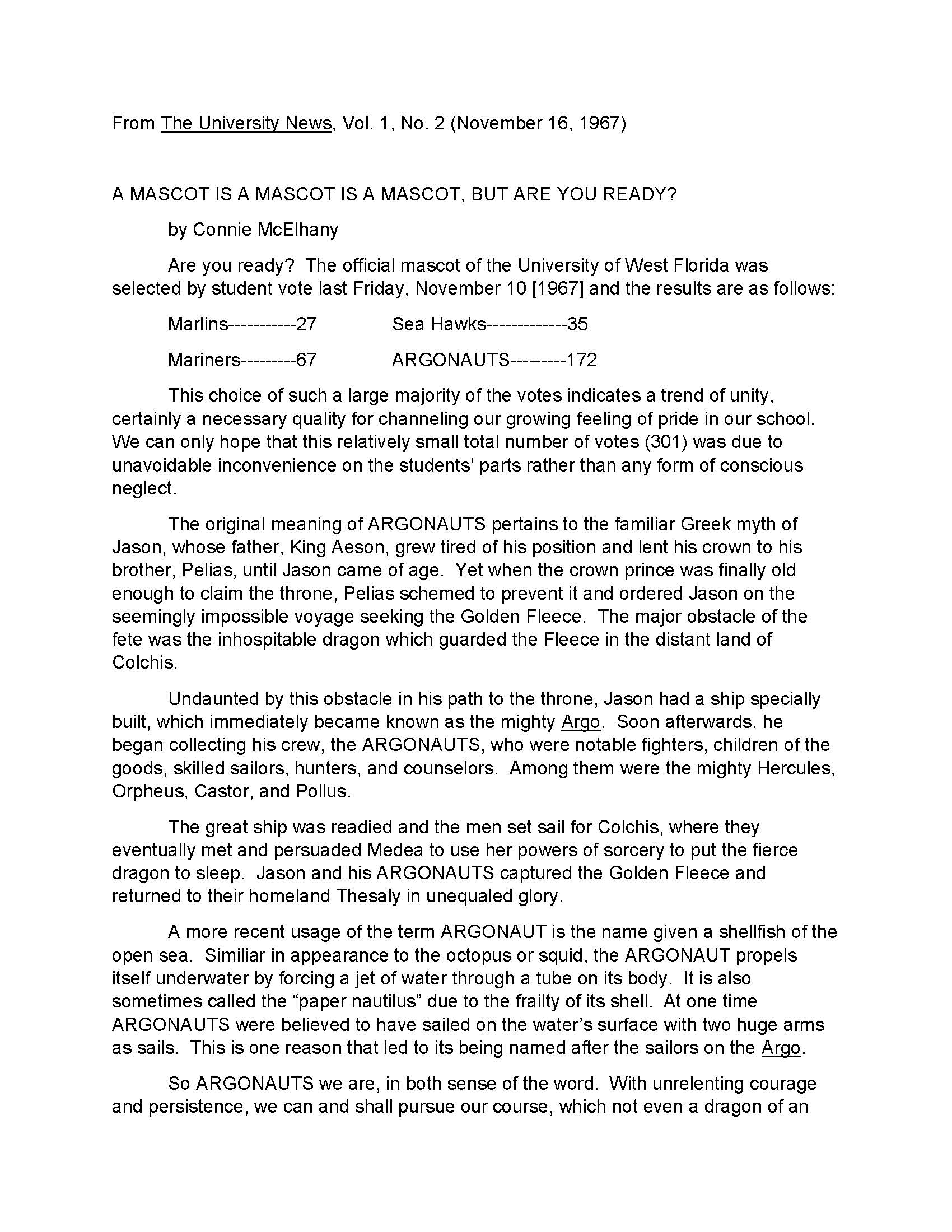
In the athletic realm, the nautilus has been de-emphasized in a recent marketing update to highlight the fiercer Argonaut logo. The Argonaut was chosen by a student vote in 1967 to serve as the athletic mascot, and is appropriately coastal, as well. “Argonautica” is an epic tale of ancient Greek origin, written around 300 BC and predating the Odyssey by four centuries. It is a complicated story involving a king’s son, Jason, and his quest to earn his place on the throne by retrieving a golden ram’s fleece imbued with magical powers. Like the Odyssey or any Harry Potter book, the journey from central Greece to the golden fleece’s location along the Black Sea near Russia entails endless twists, turns, obstacles, and tragedies. All of these were, of course, overcome successfully. The Argo (meaning “swift”) was Jason’s ship, built by a man named Argos and manned by a crew called the Argonauts. The UWF mascot, Argie, is represented by a Greek warrior in traditional dress, including a helmet, sword, shield, and sandals.
There is some discussion among older UWF alumni that the student body’s choice of the argonaut also referred to the organism Argonauta argo, a cephalopod called the “paper nautilus” that looks like a normal octopus folded into a thin nautilus shell—therefore combining the nautilus and Argonaut in one organism. In the university’s archives, a student article in “The University News” mentions both the Greek myth and the paper nautilus, tying the two mascots together intrinsically from the very beginning. As author Connie McElhaney states in her article on November 16, 1967, “so ARGONAUTS we are, in both sense of the word. With unrelenting courage and persistence, we can and shall pursue our course, which not even a dragon of an obstacle can discourage. And, though, our shells are still, perhaps paper-thin, we will be found living self-motivated now and after we have endowed our spirit to future ARGONAUTS at dear ole UWF.”
 8