Introduction
The bay scallop (Argopecten irradians) was once common in the lower portions of the Pensacola Bay system. However, by 1970 they were all but gone. Closely associated with seagrass, especially turtle grass (Thalassia testudinum), some suggested the decline was connected to the decline of seagrass beds in this part of the bay. Decline in water quality and overharvesting by humans may have also been a contributor. It was most likely a combination of these factors.
Scalloping is a popular activity in our state. It can be done with a simple mask and snorkel, in relatively shallow water, and is very family friendly. The decline witnessed in the lower Pensacola Bay system was witnessed in other estuaries along Florida’s Gulf coast. Today commercial harvest is banned, and recreational harvest is restricted to specific months and to the Big Bend region of the state. With the improvements in water quality and natural seagrass restoration, it is hoped that the bay scallop may return to lower Pensacola Bay.
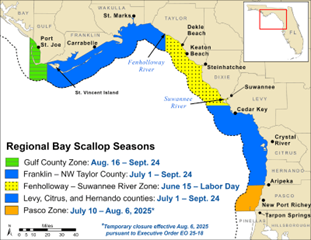
Image: FWC
Since 2015 Florida Sea Grant has held the annual Pensacola Bay Scallop Search. Trained volunteers survey pre-determined grids within Big Lagoon and Santa Rosa Sound. Below is the report for both the 2026 survey and the overall results since 2015.
Methods
Scallop searchers are volunteers trained by Florida Sea Grant. Teams are made up of at least three members. Two snorkel while one is the data recorder. More than three can be on a team. Some pre-determined grids require a boat to access, others can be reached by paddle craft or on foot.
Once on site the volunteers extend a 50-meter transect line that is weighted on each end. Also attached is a white buoy to mark the end of the line. The two snorkelers survey the length of the transect, one on each side, using a 1-meter PVC pipe to determine where the area of the transect ends. This transect thus covers 100m2. The surveyors record the number of live scallops they find within this area, measure the height of the first five found in millimeters using a small caliper, which species of seagrass are within the transect, the percent coverage of the seagrass, whether macroalgae are present or not, and any other notes of interest – such as the presence of scallop shells or scallop predators (such as conchs and blue crabs). Three more transects are conducted within the grid before returning.
The Pensacola Scallop Search occurs during the month of July.
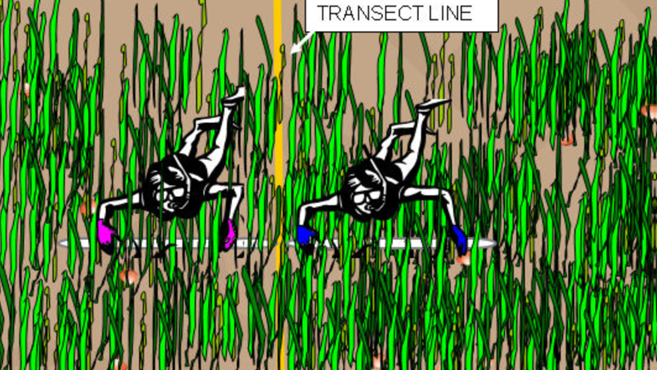
Image: University of Florida
2026 Results
81 volunteers on 17 teams surveyed 14 of the 66 1-nautical mile grids (21%) between Big Lagoon State Park and Navarre Beach. 64 transects (6,400m2) were surveyed logging 2 live scallops and 65 dead ones. Both live scallops were reported from Big Lagoon this year. It is believed the cause of scallop mortality may have been the significant decrease in salinity due to the heavy rains in June. Salinities dropped from 20-25ppt to below 10ppt in much of the bay area. Another possible cause was warm water. We did not monitor temperatures, so we were not sure how high they were, but many volunteers reported that snorkeling felt like bath water. It could have been a combination of the two.
2026 Big Lagoon Results
6 teams surveyed 4 of the 11 grids (36%) within Big Lagoon. 24 transects were conducted covering 2,400m2. 2 live scallops and 17 dead ones were found.
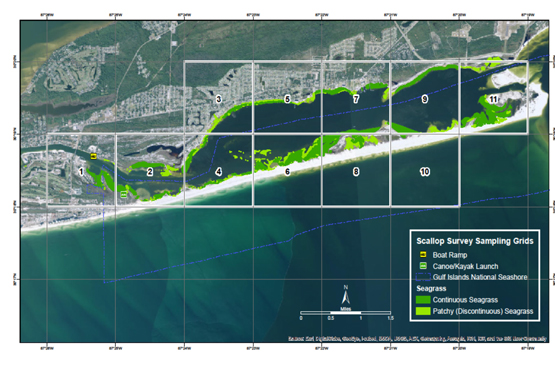
2 scallops were logged in 2026 and there were 17 dead ones reported. No sea urchins were found but blue crabs (scallop predators) were. This equates to 0.02 scallops/200m2. Big Lagoon remains a collapsed population. All three species of seagrass were found (Thalassia, Halodule, and Syringodium). Seagrass densities ranged from 74-100% per grid and averaged 91% coverage. Macroalgae was present in all 4 grids surveyed this year and was reported as abundant in 2 of those.
2026 Santa Rosa Sound Results
11 teams surveyed 10 of the 55 grids (18%) in Santa Rosa Sound. 40 transects were conducted, covering 4,000m2.
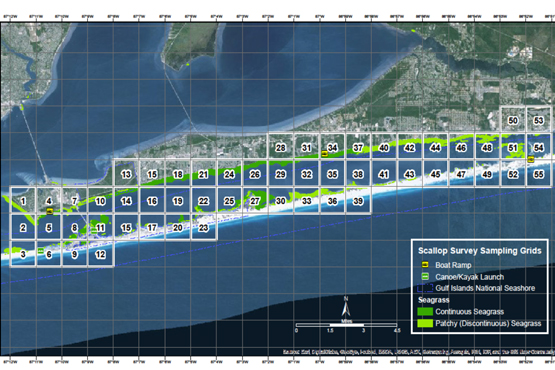
0 live scallops were logged but there were 48 dead ones. This equates to 0.00 scallops/200m2. Scallop searchers reported blue crabs, whelks, and rays but no sea urchins. All three species of seagrass were found. Seagrass densities ranged from 50-100% per transect with an average percent coverage of 76%. Macroalgae was present in 8 of the 10 grids (80%) and was abundant in 2 of those.
2015 – 2026 Big Lagoon Results
| Year | No. of Transects | No. of Scallops | Scallops/200m2 |
| 2015 | 33 | 0 | 0.00 |
| 2016 | 47 | 0 | 0.00 |
| 2017 | 16 | 0 | 0.00 |
| 2018 | 28 | 0 | 0.00 |
| 2019 | 17 | 0 | 0.00 |
| 2020 | 16 | 1 | 0.12 |
| 2021 | 18 | 0 | 0.00 |
| 2022 | 38 | 0 | 0.00 |
| 2023 | 43 | 2 | 0.09 |
| 2024 | 67 | 101 | 3.02 |
| 2025 | 76 | 0 | 0.00 |
| 2026 | 24 | 2 | 0.02 |
| Big Lagoon Overall | 423 | 106 | 0.50 |
2015 – 2026 Santa Rosa Sound Results
| Year | No. of Transects | No. of Scallops | Scallops/200m2 |
| 2015 | 01 | 0 | 0.00 |
| 2016 | 01 | 0 | 0.00 |
| 2017 | 01 | 0 | 0.00 |
| 2018 | 01 | 0 | 0.00 |
| 2019 | 01 | 0 | 0.00 |
| 2020 | 01 | 0 | 0.00 |
| 2021 | 20 | 0 | 0.00 |
| 2022 | 40 | 2 | 0.11 |
| 2023 | 28 | 2 | 0.14 |
| 2024 | 85 | 32 | 0.76 |
| 2025 | 86 | 8 | 0.19 |
| 2026 | 40 | 0 | 0.00 |
| Santa Rosa Sound Overall | 2991 | 44 | 0.29 |
1 Transects were conducted during these years but data for Santa Rosa Sound was logged by an intern with the Santa Rosa County Extension Office and is currently unavailable.
Discussion
Based on a Florida Fish and Wildlife Research Institute publication in 2018, the final criteria are used to classify scallop populations in Florida.
| Scallop Population / 200m2 | Classification |
| 0-2 | Collapsed |
| 2-20 | Vulnerable |
| 20-200 | Stable |
Based on this, over the last 12 years we have surveyed, the populations in lower Pensacola Bay are still collapsed. Big Lagoon reached the vulnerable level in 2024, but no scallops were found there in 2025 and only 2 live ones in 2026. This returns Big Lagoon to a collapsed state.
This said there were 65 dead scallops reported. During the drought of the spring of 2026 salinities increased above normal in lower Pensacola Bay and many anecdotal reports of scallops appeared. However, the heavy rains of June lowered the salinity significantly – to near freshwater in some parts of the bay – and may have killed what scallops we had this year.
The Pensacola Bay area continues to have a collapsed system. The larger populations found in 2024 suggest that there are scallops in the area but may not be enough to increase their population status from collapsed to vulnerable. We will continue to monitor each July.
It is important for locals NOT to harvest scallops from either body of water. First, it is illegal. Second, any chance of recovering this lost population will be lost if the adult population densities are not high enough for reproductive success.
Acknowledgements
We would like to thank ALL 81 volunteers who surveyed this year. We obviously could not have done this without you.
Below are the “team captains”.
Ashley Rogers Anna Raney Pensacola-Perdido Estuary Program
Amanda Clayton Kellie Krueger Matt Rayburn & Scouts from Troop 3
Helen Turner Shane Daigle Susan Pinard
Christian Wagley Mark Wolfe 2 teams from the Satori Foundation
Sarah Everhart Kimberly Pennington
Dr. Samantha Brady and students from University of Southern Mississippi

Photo: Matt Rayburn Boy Scout Troop 3
 0